What are mood disorders?
We all have sad days and happy ones, and this ebb and flow is a normal part of life. Mood disorders are conditions in which mood moves outside its normal range in intensity or duration, taking over thinking, energy, sleep and behavior for weeks or months.
This family branches in two directions: depressive disorders, in which low mood alone is the problem, and bipolar disorders, in which mood swings between two poles: a low pole, which is depression, and a high pole, which is mania or hypomania. The American diagnostic manual DSM-5-TR places each in a separate chapter, but we have grouped them here because confusing the two is one of the most common and most serious mistakes.
The World Health Organization stresses that depression differs from usual mood fluctuations and from brief emotional responses to life’s challenges; it is a condition that touches every part of life, including relationships with family, friends and the community.
What happens in the brain with mood disorders?
It used to be said that depression was simply a “lack of serotonin,” but science today sees a picture wider than a single neurotransmitter. Mood disorders are linked to changes in the brain circuits that regulate emotion, reward and motivation, in stress hormones, and in the body clock that regulates sleep and wakefulness.
Serotonin, norepinephrine, dopamine and glutamate take part in regulating mood, energy and pleasure.
Chronic stress raises cortisol and affects the memory and emotion areas.
Sleep disruption can be both a symptom and a trigger, especially for manic episodes.
A genetic predisposition is clear, especially in bipolar disorder, but it is not enough on its own.
This is why medication and psychotherapy work together at different levels: medication helps restore biological balance, and psychotherapy changes the patterns of thinking and behavior that feed the episodes. The details of the causes of each disorder are on the causes of depression page and the causes of bipolar disorder page.
Types of mood disorders
Each disorder in this family has a full guide and its own pages. Here is a brief card for each:
Depression
DepressionAlso known as: clinical depression
Persistent sadness and loss of pleasure and energy lasting two weeks or more, affecting sleep, appetite, concentration and work.
- Category
- Mood disorders
- How common
- About 5% of adults worldwide
- Typical onset
- At any age, often in adolescence and early adulthood
- Link to addiction
Strong
When to seek help: if sadness and loss of pleasure last two weeks or more, and immediately if there are any thoughts about death.
Bipolar disorder
Bipolar disorderAlso known as: manic depression
Alternating episodes of mania or hypomania and depression, often linked to substance misuse.
- Category
- Mood disorders
- How common
- About 36 million people worldwide
- Typical onset
- Usually late adolescence or early adulthood
- Link to addiction
Very strong
When to seek help: during an episode of excessive activity and unusually little sleep, or depression that was preceded by clear periods of “high” mood.
Postpartum depression
Postpartum DepressionAlso known as: postnatal depression
A true depression that begins during pregnancy or in the first year after birth. It differs from the “baby blues” of the first days, and it can be treated safely.
- Category
- Mood disorders
- How common
- More than 10% of new mothers
- Typical onset
- Pregnancy or the first year after birth
- Link to addiction
Weak
When to seek help: if sadness or exhaustion lasts more than two weeks, and immediately if there are hallucinations or thoughts of harming yourself or the baby.
What are the subtypes within mood disorders?
Under each of the two main disorders there are subtypes that the doctor determines according to the severity, duration and pattern of symptoms. Here is a quick look at them:
| Type | Belongs to | What distinguishes it, in brief |
|---|---|---|
| Major depressive disorder | Depression | One or more clear episodes of depression lasting at least two weeks |
| Persistent depressive disorder | Depression | A milder but chronic low mood lasting two years or more in adults |
| Perinatal depression | Depression | Appears during pregnancy or after birth, and differs from the passing “baby blues” |
| Depression with a seasonal pattern | Depression | Episodes that recur in a particular season of the year, usually winter |
| Bipolar I disorder | Bipolar disorder | At least one full manic episode, and usually episodes of depression |
| Bipolar II disorder | Bipolar disorder | Episodes of depression with hypomanic episodes less severe than full mania |
| Cyclothymic disorder | Bipolar disorder | Recurrent mood swings too mild to count as full episodes, lasting a long time |
You will find the full explanation on the pages for types of depression and types of bipolar disorder.
What is the difference between depression and bipolar disorder?
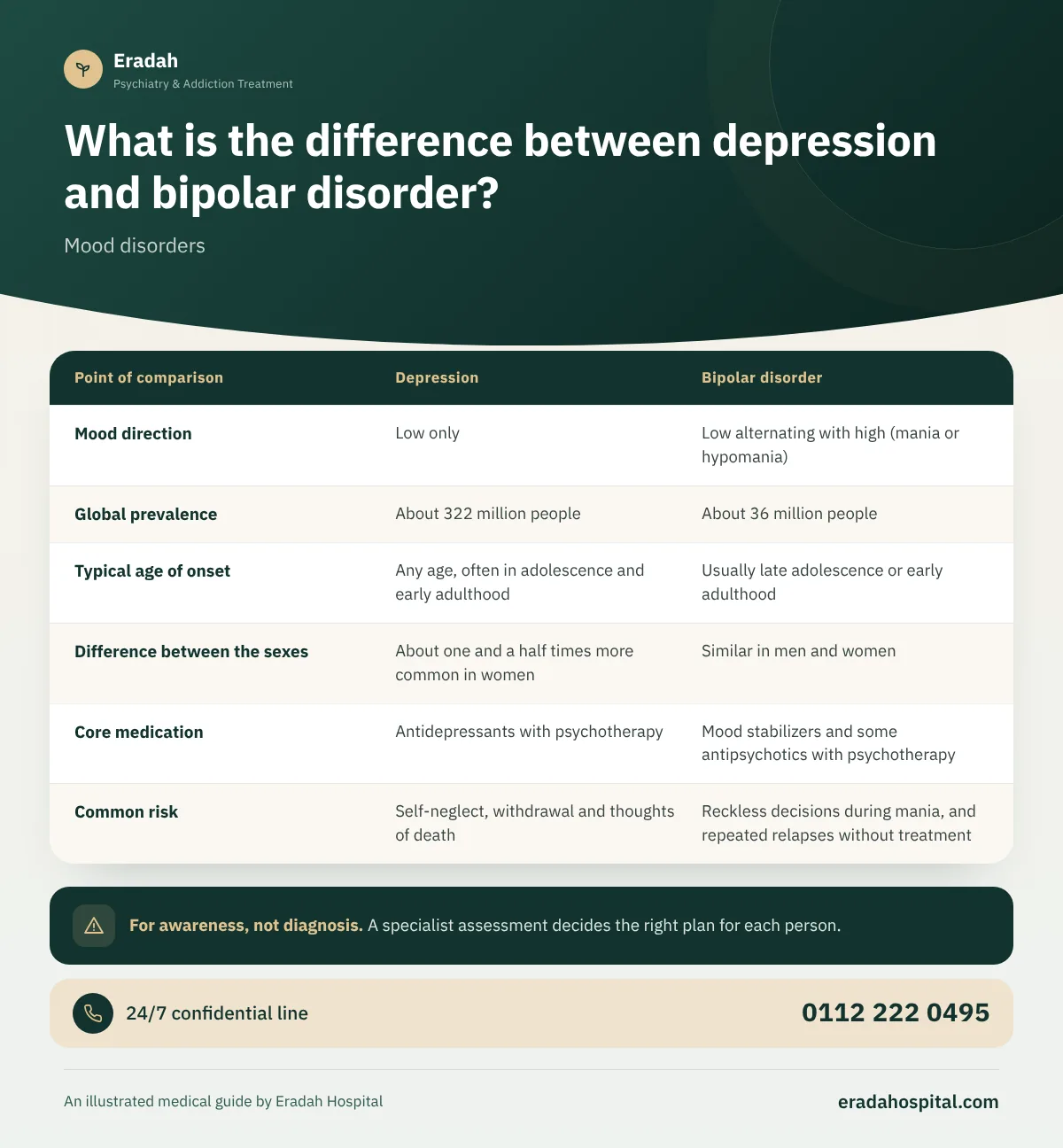
Two patients can look exactly alike during a depressive episode, since sadness, loss of pleasure, exhaustion and sleep disturbance appear in both. The key difference is the presence of episodes of elevated mood in the history of a person with bipolar disorder, even if they were long ago or mild:
| Point of comparison | Depression | Bipolar disorder |
|---|---|---|
| Mood direction | Low only | Low alternating with high (mania or hypomania) |
| Global prevalence | About 322 million people | About 36 million people |
| Typical age of onset | Any age, often in adolescence and early adulthood | Usually late adolescence or early adulthood |
| Difference between the sexes | About one and a half times more common in women | Similar in men and women |
| Core medication | Antidepressants with psychotherapy | Mood stabilizers and some antipsychotics with psychotherapy |
| Common risk | Self-neglect, withdrawal and thoughts of death | Reckless decisions during mania, and repeated relapses without treatment |
Why is bipolar disorder wrongly diagnosed as depression?
Many people with bipolar disorder seek help for the first time during a depressive episode, because depression is painful and obvious, while hypomania may look to the patient and family like just “a period of energy and enthusiasm.” If the doctor does not ask about the history of such periods, it may be diagnosed as ordinary depression.
The guide to diagnosing bipolar disorder explains how the doctor tells them apart and the scales used.
Mood disorders in numbers
Mood disorders are among the most common health conditions and have a major effect on productivity and quality of life worldwide. These are the key figures from the World Health Organization:
The organization also notes that more than 10% of pregnant women or women who have just given birth experience depression, and that only about a third of people with depression receive treatment, even in high-income countries. Source: World Health Organization fact sheets on depression and mental disorders.
Common myths about mood disorders
| The myth | The truth |
|---|---|
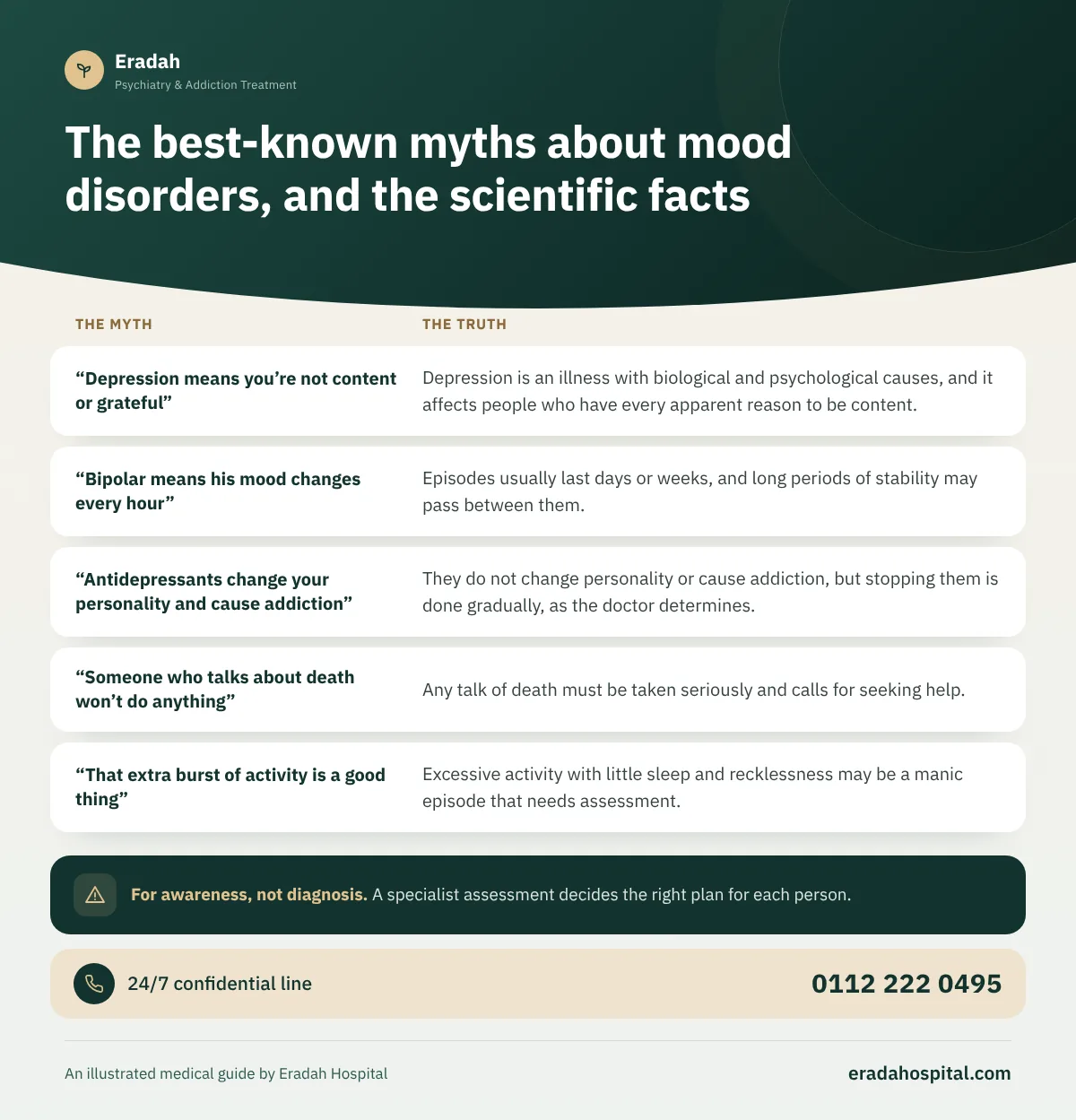
| “Depression means you’re not content or grateful” | Depression is an illness with biological and psychological causes, and it affects people who have every apparent reason to be content. |
| “Bipolar means his mood changes every hour” | Episodes usually last days or weeks, and long periods of stability may pass between them. |
| “Antidepressants change your personality and cause addiction” | They do not change personality or cause addiction, but stopping them is done gradually, as the doctor determines. |
| “Someone who talks about death won’t do anything” | Any talk of death must be taken seriously and calls for seeking help. |
| “That extra burst of activity is a good thing” | Excessive activity with little sleep and recklessness may be a manic episode that needs assessment. |
What are the shared risks of mood disorders without treatment?
- Decline in study and work, and loss of a job or income.
- Strained marital and family relationships, and effects on children.
- A higher risk of misusing alcohol, drugs and sleeping pills.
- Physical health problems linked to sleep, eating and inactivity.
- Reckless financial or social decisions during manic episodes.
- A higher risk of self-harm and suicidal thoughts, which makes early treatment essential.
The details are on the pages for the harms and complications of depression and the harms of bipolar disorder. Early, regular treatment greatly reduces these risks.
When do you need a psychiatrist?
Ask for a psychological assessment if you notice any of the following in yourself or someone close to you. This list is for awareness and is not a diagnosis.
- Sadness, emptiness or loss of pleasure lasting two weeks or more.
- A clear change in sleep, appetite, energy or concentration.
- A period of sleeping little without exhaustion, with talking a lot, racing thoughts and unusual recklessness.
- Recurrent mood swings that affect work and relationships.
- Growing reliance on alcohol, drugs or sleeping pills to lift mood.
- Any thoughts of death or self-harm, in which case help must be sought immediately.
How are mood disorders treated?
Treatment depends on the type and severity of the disorder, but it often combines medication, psychotherapy and lifestyle regulation. In depression, antidepressants are used in moderate and severe cases along with psychotherapy such as cognitive behavioral therapy. In bipolar disorder, the foundation is mood stabilizers such as lithium, which needs regular blood tests, and some antipsychotics, along with psychoeducation and sleep regulation.
None of these medications should be started, adjusted or stopped except on the psychiatrist’s decision. Young people also need close follow-up by the doctor and family at the start of antidepressant treatment. Details are in depression treatment and bipolar disorder treatment.
Mood disorders and addiction
Some people with depression turn to alcohol, hashish or sedatives for temporary relief, while a person with bipolar disorder may rush during mania to try stimulants such as crystal meth (shabu) or drink excessively. The result is often more severe episodes and more relapses, because these substances ruin sleep, weaken the effect of treatment and increase impulsiveness.
Stopping some substances, such as stimulants, can also be followed by a sharp drop in mood that resembles depression. So the patient needs an assessment that distinguishes underlying depression from substance-induced depression, followed by integrated treatment of both together. Read about depression and addiction and bipolar disorder and addiction, or the dual diagnosis page.
How can the family support a person with a mood disorder?
- Learn about the illness, and understand that withdrawal or irritability is part of the episode and not a rejection of you.
- Don’t say “snap out of it”; say “I’m with you, let’s go to the doctor together.”
- Watch for early signs of an episode, such as little sleep or withdrawal, and agree in advance on a plan for what to do.
- Support sticking to medication and appointments, especially during periods of improvement, when patients tend to stop.
- During mania, protect finances quietly without confrontation.
- Take any talk of death seriously, and do not hesitate to seek urgent help.
Suicidal thoughts or a severe manic episode? Get help now
- Talk of wanting to die or of life having no meaning
- Severe hopelessness and a feeling of being a burden on the family
- Suddenly saying goodbye to family or giving away important belongings
- Unexplained sudden calm after a period of severe depression
- Not sleeping for days with excessive activity and dangerous recklessness with money, driving or relationships
- Strange beliefs about superhuman abilities, or hearing voices
Stay with the person and do not leave them alone, listen without arguing or blaming, and keep dangerous objects out of their reach. Call an ambulance (123) or go to the nearest emergency room, and you can call the mental health support line 16328, available around the clock.
Ambulance 123 Mental health support line 16328