What are the stages of crystal meth addiction treatment?
There is no single plan that suits everyone, but successful treatment usually moves through successive, overlapping stages:
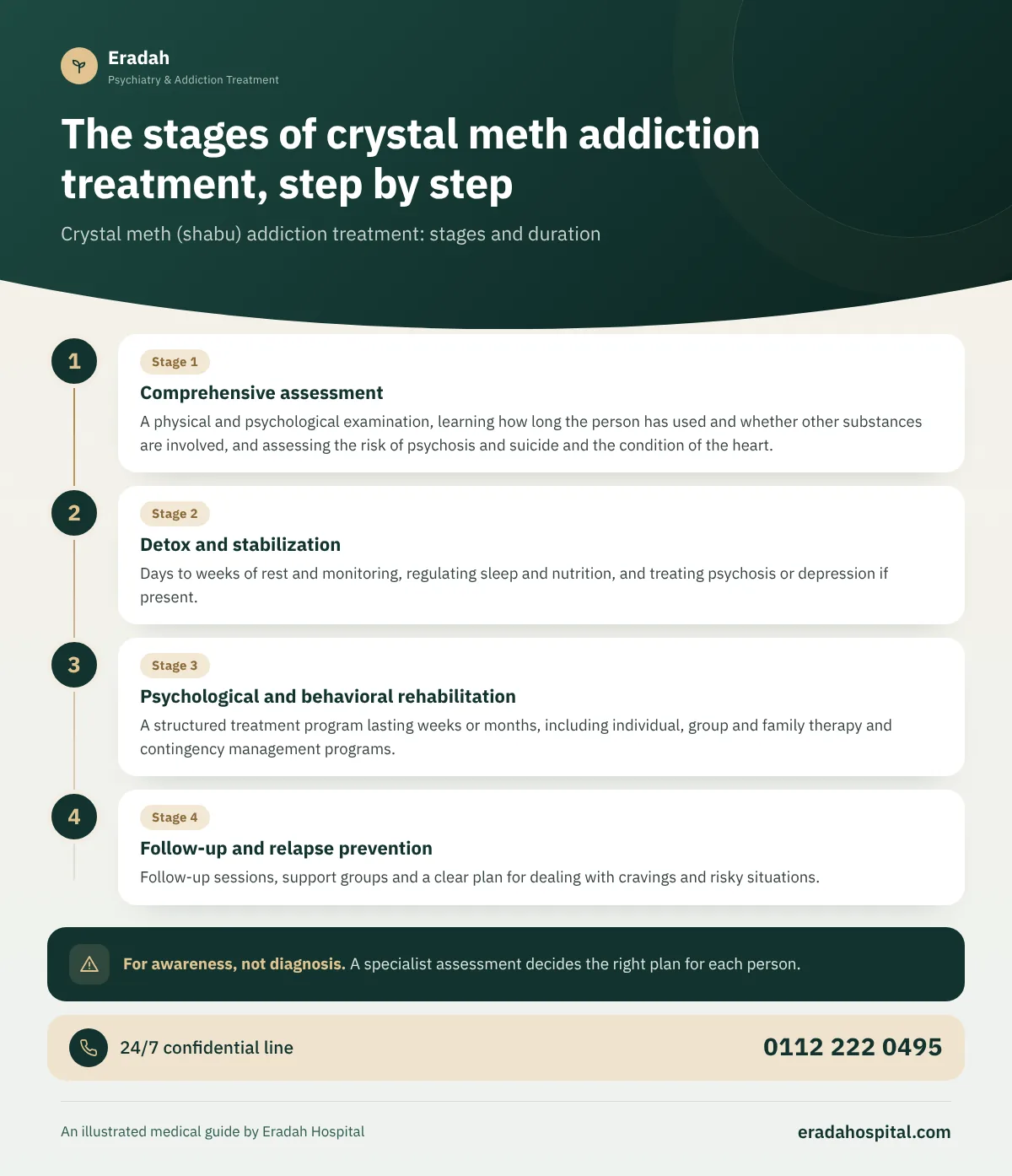
- Stage 1Comprehensive assessment
A physical and psychological examination, learning how long the person has used and whether other substances are involved, and assessing the risk of psychosis and suicide and the condition of the heart.
- Stage 2Detox and stabilization
Days to weeks of rest and monitoring, regulating sleep and nutrition, and treating psychosis or depression if present.
- Stage 3Psychological and behavioral rehabilitation
A structured treatment program lasting weeks or months, including individual, group and family therapy and contingency management programs.
- Stage 4Follow-up and relapse prevention
Follow-up sessions, support groups and a clear plan for dealing with cravings and risky situations.
How is detox from crystal meth done?
Detox from crystal meth differs from detox from opioids or alcohol: it usually does not need medicines that replace the substance, but supportive care instead: sleep, nutrition, fluids and calm, with daily monitoring of the person’s mental state. The timeline of symptoms is covered in the page on crystal meth withdrawal symptoms.
The aim of this stage is not only to get through withdrawal, but for the patient to reach a stable state that allows him to take part in psychological treatment. That is why leaving right after detox without rehabilitation makes relapse far more likely.
Is there a medication to treat shabu addiction?
So far there is no approved medication that treats methamphetamine addiction itself or prevents relapse to it, as confirmed by the US health institutes and the European Union Drugs Agency. But medicines remain important for treating what accompanies addiction, and the doctor decides them case by case:
| Category | Their role |
|---|---|
| Antipsychotics | Treating hallucinations, suspicion and agitation if they appear or persist after stopping. |
| Antidepressants | Treating accompanying depression if it continues after the acute withdrawal phase. |
| Sleep and anxiety medicines | For short, defined periods under medical supervision, to avoid dependence on them. |
| Medicines under research | Such as the combination of bupropion and naltrexone, which has shown benefit in studies but is not yet an approved treatment. |
Medicines for crystal meth addiction under research: what do recent trials say?
Although no medication is approved yet, research on medicines for crystal meth addiction is advancing, and it helps for families to know exactly where it stands, so they are not taken in by promises of a “miracle cure.”
| Medicine | What the studies showed | Limitations |
|---|---|---|
| Naltrexone with bupropion | In a trial published in the New England Journal of Medicine in 2021 with 403 participants, the response rate was 13.6% compared with 2.5% on placebo. | The response occurred in a minority, the naltrexone used was an injection, and this treatment has not yet been formally approved. |
| Mirtazapine | In a trial of 120 participants who also received counseling sessions, positive methamphetamine tests decreased, and depression and insomnia improved. | It was carried out in a specific group in one city and needs confirmation. |
| Other medications | Many medicines have been studied, with mixed results and weak evidence. | They are not relied on outside research. |
What these studies have in common is that the medicine was always added to psychological treatment and counseling, not used in place of them. So the foundation remains behavioral therapy and contingency management, while the doctor decides in each case whether adding a medicine would help, especially when there is persistent depression or insomnia after stopping.
If hallucinations, suspicion or aggression appear, the priority is treating drug-induced psychosis before any other step. Antipsychotic medicines here do not treat the addiction itself, but they protect the patient and his family and allow him to take part in psychological treatment, and the doctor decides how long to continue them according to whether symptoms persist after stopping.
What psychological treatments are effective for crystal meth addiction?
Behavioral therapy is the main treatment for crystal meth addiction, backed by strong research:
They give tangible rewards for sticking with treatment and for negative test results, and have the strongest evidence of any psychological treatment for stimulant addiction.
Teaches the patient to recognize the thoughts and situations that push him to use, and gives him alternative skills for dealing with them.
A structured program lasting about 16 weeks, combining behavioral therapy, family education, individual counseling, support groups and periodic testing.
Helps an ambivalent patient discover his own reasons for change instead of being pressured.
Improves communication within the family and teaches it how to support recovery without blame or indulgence.
Regular exercise improves mood and sleep and helps the brain recover, and is used to complement treatment.
How is psychosis that accompanies crystal meth addiction treated?
Psychosis is one of the most characteristic features of crystal meth addiction, and it needs treatment alongside the addiction treatment. The psychiatrist assesses whether the symptoms come from crystal meth alone and clear with stopping, or whether they reveal an underlying psychiatric disorder that needs long-term treatment. This includes antipsychotic medicines when needed, a calm and safe environment, monitoring of sleep, and educating the family about the signs of psychosis returning.
This is known as dual diagnosis: treating the addiction and the psychiatric disorder together in one plan and with one team, because treating one without the other raises the risk of relapse in both.
How long does crystal meth addiction treatment take?
The length varies with the severity of the addiction and the presence of co-occurring disorders, but research indicates that staying in treatment for at least three months is linked to better outcomes, and that follow-up for months afterward protects against relapse:
| Stage | Approximate duration |
|---|---|
| Assessment | One day to several days |
| Detox and stabilization | One week to several weeks, depending on the psychological state |
| Psychological and behavioral rehabilitation | Usually at least three months |
| Follow-up and relapse prevention | Six months to a year or more |
Inpatient or outpatient: which is more suitable?
| Inpatient treatment (residential) | Outpatient treatment | |
|---|---|---|
| Suits | Psychosis, suicidal thoughts or violence, failed previous attempts, or an unsafe environment | Milder cases with strong family support and a clear motivation to change |
| Advantages | A safe, substance-free environment with round-the-clock monitoring | Work or study can continue, and the cost is lower |
| Challenge | Temporary time away from daily life | Facing triggers every day, which requires a high level of commitment |
How can relapse be prevented after crystal meth treatment?
- Recognizing personal triggers: places, people, feelings and times linked to use.
- A written plan for dealing with cravings when they appear.
- A regular sleep routine, good nutrition and daily physical activity.
- Continuing follow-up sessions and support groups even after feeling better.
- Treating accompanying depression, anxiety or hyperactivity rather than neglecting it.
- Involving the family in the plan and knowing the early warning signs.
If relapse does happen, it is a sign that the plan needs adjusting, not proof that treatment has failed. Returning to treatment quickly after a slip greatly reduces the harm.
What is the family’s role in crystal meth addiction treatment?
The family is a key partner in treatment, and its role goes beyond watching from a distance. Clinical experience indicates that family involvement improves adherence and reduces relapse, provided the involvement is informed:
- Attending education and family therapy sessions to understand the nature of addiction and psychosis.
- Agreeing with the treatment team on clear rules at home after discharge.
- Supporting and rewarding small achievements instead of focusing only on mistakes.
- Not giving money without controls in the first months of recovery.
- Looking after the mental health of family members too, because addiction exhausts everyone.
Myths about crystal meth addiction treatment
| The myth | The truth |
|---|---|
| Stopping for a week is enough to clear the drug from the body | The drug leaving the body is the start of treatment, not the end: changes in the brain and behavior take months. |
| There is no point in treatment because there is no medicine | Behavioral therapy and contingency management programs are effective and proven, and many people recover with them. |
| A person with addiction has to hit rock bottom before getting treatment | Early intervention reduces harm and improves outcomes, and there is no need to wait for a disaster. |
| Relapse means treatment has failed | Relapse is expected in chronic illnesses; what matters is returning quickly to the plan and adjusting it. |
How do you choose a crystal meth addiction treatment center?
- It should be licensed and have psychiatrists who specialize in addiction.
- It should treat dual diagnosis, especially psychosis and depression.
- It should rely on scientifically proven treatments such as cognitive behavioral therapy and contingency management programs.
- It should involve the family in treatment and offer follow-up after discharge.
- It should maintain complete confidentiality and respect the patient’s dignity.
Choosing a hospital for crystal meth addiction treatment
Crystal meth often confronts a family with a scene unlike any other addiction: suspicion of everyone, days without sleep, then a collapse in sleep and mood that may carry suicidal thoughts. So the right hospital must be first and foremost a psychiatric one, able to contain psychosis and agitation calmly, not a shelter that only keeps the patient away from the substance. Questions that reveal whether a place is ready:
- Does a psychiatrist assess the hallucinations from day one and decide whether they need medication?
- How is an episode of agitation managed inside the facility, without humiliation or harshness?
- What is done about the long sleep, intense hunger and sadness that follow stopping?
- Does the family learn the signs of psychosis returning before the patient is discharged?
- Is the environment designed to reduce risks for a patient who is disturbed or impulsive?
Eradah is a licensed psychiatric hospital (license no. 1427) led by a consultant psychiatrist, with a doctor and nursing staff around the clock. It combines treatment of psychosis and addiction in a single dual diagnosis plan, and then the patient moves on to residential rehabilitation in a quiet setting in the midst of a garden. Residential stay is available for men, and the family can start with a call or WhatsApp message to 01122220495 at any hour; the first consultation is free and confidential, and what we need to arrange admission is on the admission arrangements page.
Crystal meth addiction treatment at Eradah
At Eradah we begin with a comprehensive psychological and physical assessment, then a safe stabilization stage under round-the-clock medical supervision that focuses on sleep, nutrition and monitoring of depression and psychosis. This is followed by a rehabilitation program combining cognitive behavioral therapy, contingency management programs, and group and family therapy, and then follow-up after discharge. We treat any co-occurring psychiatric disorder within the same plan, with complete confidentiality from the first call.