One or two late nights do not mean a problem, but when sleep becomes a repeated struggle, insomnia may have settled in. Answer the eight questions to see where your sleep falls on a clear scale.
Start the insomnia test
How is the insomnia test result calculated?
Each question has four answers scored from 0 to 3; the first answer means things are normal, and the last means the problem is severe. The scores of the eight items are added to give a number from 0 to 24. The first five questions concern the night itself, and the last three measure the effect of poor sleep on your daytime.
The screening cutoff adopted by the scale's developers is 6 points: a person who scores 6 or more is likely to have insomnia that deserves assessment. Dividing the higher scores into mild, moderate, and severe is an approximate grouping to make reading easier, and it is not an official part of the scale.
| Level | Reading | Suggested step |
|---|---|---|
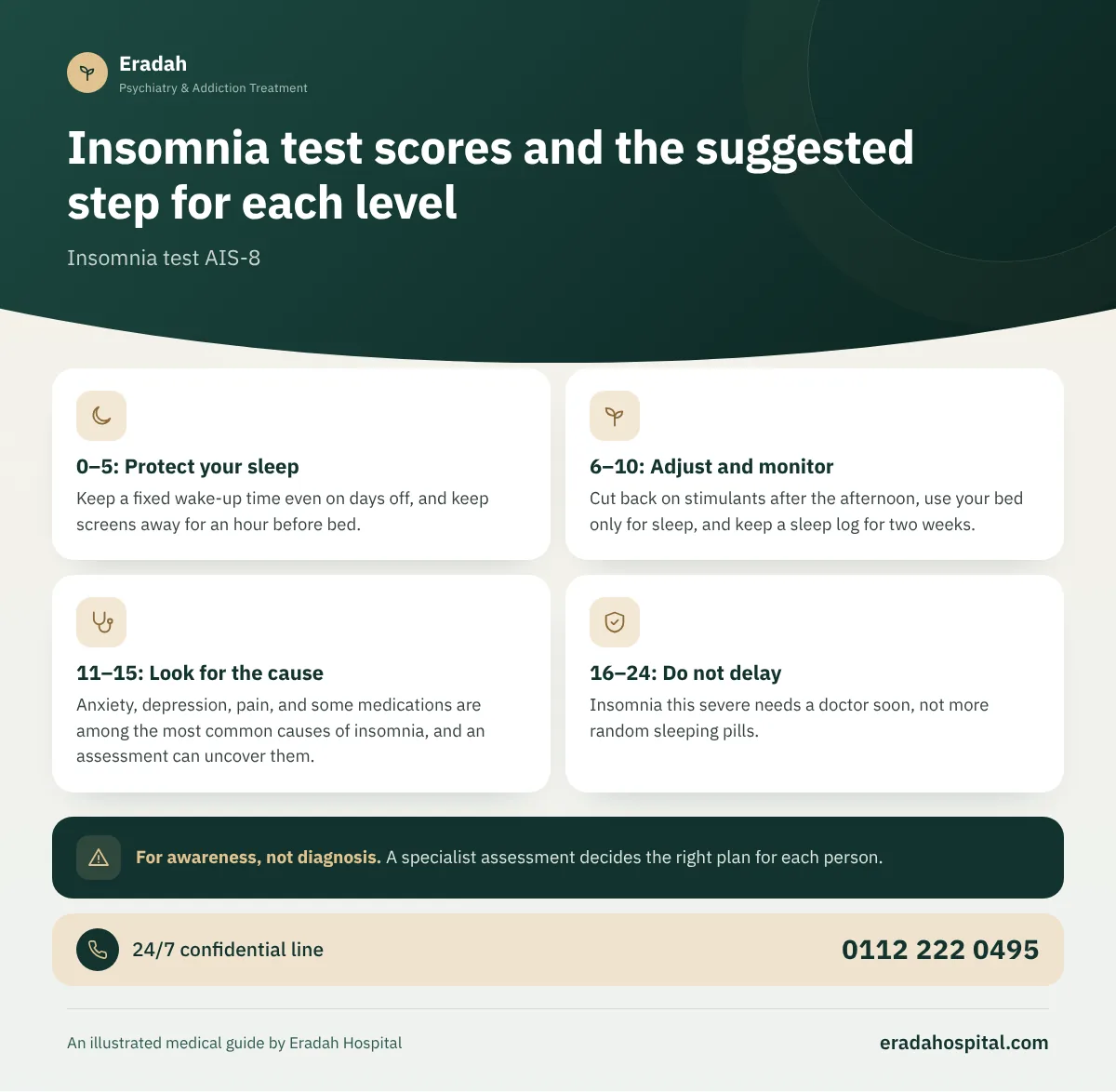
| 0 – 5 | Below the screening cutoff | Healthy sleep habits, and retake the test if things change |
| 6 – 10 | Mild insomnia | Adjust your habits and monitor for two weeks, then get assessed if it continues |
| 11 – 15 | Moderate insomnia | Assessment by a specialist to find the cause |
| 16 – 24 | Severe insomnia | See a doctor soon and start an insomnia treatment plan |
What to do after your result
Keep a fixed wake-up time even on days off, and keep screens away for an hour before bed.
Cut back on stimulants after the afternoon, use your bed only for sleep, and keep a sleep log for two weeks.
Anxiety, depression, pain, and some medications are among the most common causes of insomnia, and an assessment can uncover them.
Insomnia this severe needs a doctor soon, not more random sleeping pills.
What is the Athens Insomnia Scale?
The Athens Insomnia Scale was developed by a team from the psychiatry department at the University of Athens, and its validation study was published in 2000, with its items built on the insomnia criteria of the International Classification of Diseases. In a later study in 2003, a score of 6 or higher distinguished people with insomnia from those without it with high accuracy, picking up most true cases with a small share of false alarms. Because it is short and easy, it is used in clinics and research to track improvement in sleep during treatment.
What sets the scale apart is that it does not rely on the number of hours of sleep alone; some people sleep six hours and wake up energetic, while others sleep eight broken hours and spend their day exhausted. So it combines what happens at night with its effect on your mood, energy, and concentration the next day, which is what a doctor actually cares about during an assessment.
When does insomnia deserve a visit to the doctor?
- If difficulty sleeping continues three nights a week for more than three months.
- If you have started to dread bedtime or spend the night watching the clock.
- If insomnia affects your work, your driving, or your relationships.
- If it comes with persistent sadness, constant anxiety, or night-time panic attacks.
- If the person who sleeps next to you notices loud snoring or pauses in your breathing.
- If you can no longer sleep without a sleeping pill, a sedative, or any other substance.
Limits of the insomnia test
- It does not diagnose insomnia or determine its cause; that requires an interview with a doctor.
- It does not detect sleep apnea or restless legs syndrome.
- Shift work and travel raise the score without there being a disorder.
- Caffeine, stimulants, and withdrawal from sedatives can cause temporary insomnia.
- A low score does not rule out a problem if you feel your sleep is draining you.
Because insomnia is often a symptom of another disorder, the anxiety test or the depression test may also help you complete the picture before you see the doctor.
Insomnia and addiction
The relationship between insomnia and addiction runs in both directions. Many people start with a sleeping pill, a glass of alcohol, or a hashish cigarette to fall asleep, then discover that the dose is no longer enough and that sleep without it has become impossible. Conversely, insomnia is one of the most prominent withdrawal symptoms and one of the strongest triggers of relapse in the first weeks of recovery.
Substances that seem to help sleep actually disrupt it: alcohol, for example, speeds up falling asleep but fragments the second half of the night, sedatives weaken deep sleep over time, and stimulants drive sleep away for days and then leave you drained.
If your score is high and you depend on a substance to sleep, treating insomnia alone is not enough; you need a plan that treats both problems together. Learn about this on the insomnia and addiction page.
Free confidential consultation
Your result is the beginning of understanding, not the end. If you want to know the cause of your insomnia and which treatment suits you, contact the Eradah team on 01122220495 for a free and completely confidential consultation.