Stress is part of life, but there is a big difference between a busy day and a constant feeling that things are slipping out of your hands. This scale does not count your problems; it measures how you experience them, and it is the first step to understanding the tension and stress you have.
Start the stress test
How is the stress test result calculated?
The answers are scored from 0 (“Never”) to 4 (“Very often”). But questions 4, 5, 7, and 8 describe a positive feeling of control, so their scores are reversed: “Never” on them equals 4, and “Very often” equals 0. The ten scores are then added to give a number from 0 to 40; the higher it is, the greater your sense of stress.
The scale's developers did not set official diagnostic cutoffs, because it measures a feeling that varies between people and not a specific illness. But the following grouping is commonly used to read the result:
| Level | Perceived stress level | Suggested step |
|---|---|---|
| 0 – 13 | Low | Keep up your supportive habits |
| 14 – 26 | Moderate | Review the sources of stress and organize your rest |
| 27 – 40 | High | Psychological assessment and a stress treatment plan |
Remember that the score reflects the past month alone. If you went through exams, an illness in the family, or a change at work, it is natural for it to be higher. What matters most is to watch whether it drops once the cause has passed or stays high month after month; stress that does not settle is the kind that truly deserves attention.
What to do after your result
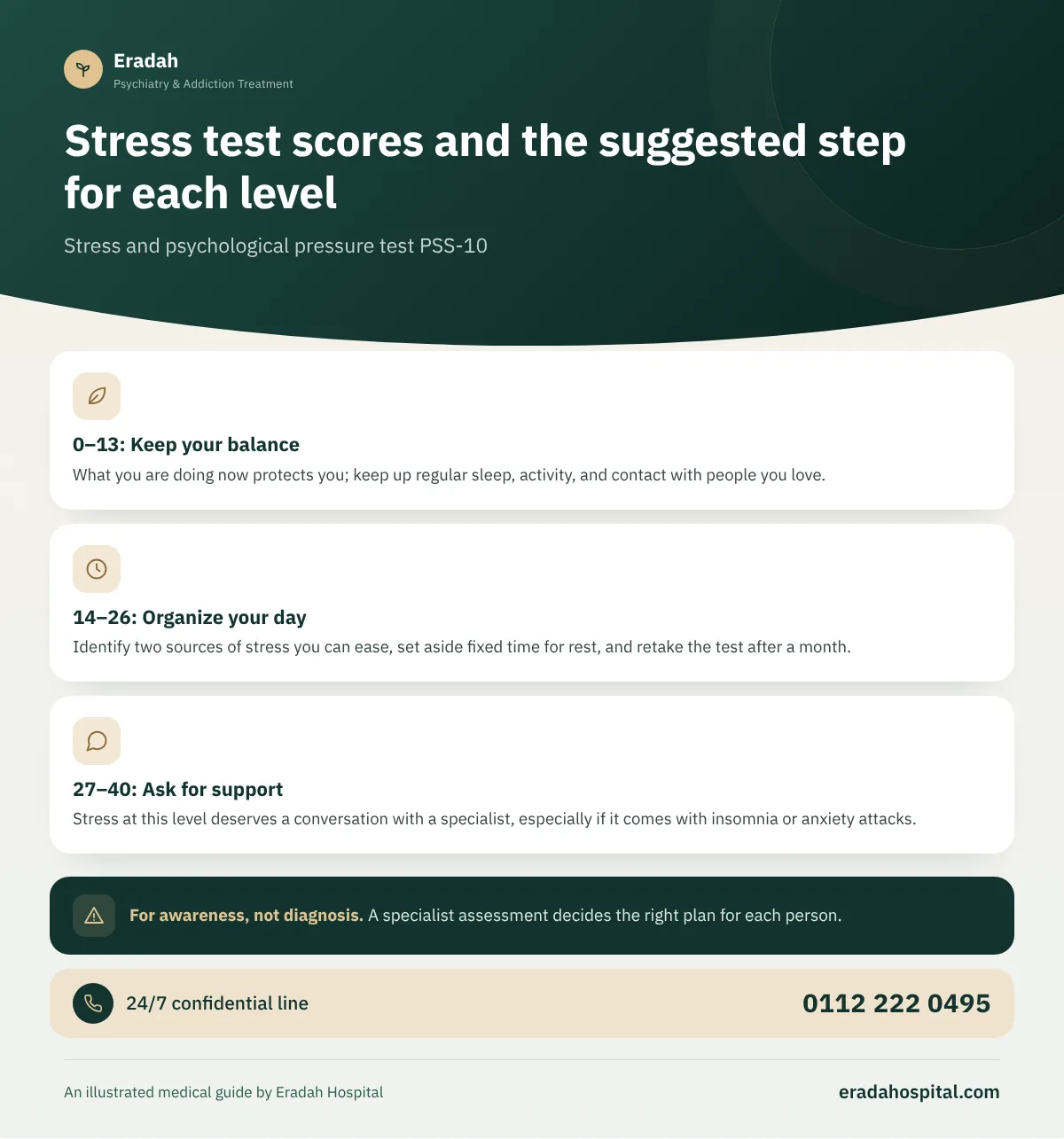
What you are doing now protects you; keep up regular sleep, activity, and contact with people you love.
Identify two sources of stress you can ease, set aside fixed time for rest, and retake the test after a month.
Stress at this level deserves a conversation with a specialist, especially if it comes with insomnia or anxiety attacks.
What is the PSS-10?
The American psychologist Sheldon Cohen and his colleagues created the Perceived Stress Scale in 1983 with fourteen questions, and the shortened ten-question version later became the most widely used because its statistical properties are better. Its idea is that it does not ask about particular events, but about how much you feel your life is unpredictable, uncontrollable, and overloaded. It has been translated into dozens of languages, including Arabic, and scientific reviews have shown good reliability in its results.
Its value lies in the fact that two people going through the same circumstances may experience them in completely different ways; one sees them as a challenge that can be managed, and the other feels crushed by them. This subjective sense of control is what studies have linked to disturbed sleep, weakened immunity, and a lower mood, more than the number of stressful events themselves.
Practical steps to ease stress
- Write down what is stressing you on paper, and separate what you can change from what is out of your hands.
- Break big tasks into small steps, and start with the one closest to being done.
- Move for half an hour a day; walking alone clearly lowers stress.
- Protect your sleep with a fixed schedule, because lack of sleep makes every stress seem bigger.
- Talk with someone you trust instead of keeping everything inside.
- Cut back on caffeine and cigarettes, which increase physical tension and do not relieve it.
Limits of the stress test
- It measures your sense of stress, and it does not diagnose anxiety, depression, or any disorder.
- It is affected by the circumstances of the last month, such as exams, the loss of a loved one, or a financial crisis.
- It has no official diagnostic cutoffs, and the grouping used is for reading only.
- Physical illness and lack of sleep may raise the sense of stress.
- A low score does not mean you should bear what hurts you alone.
If your score is high and you notice constant fear or sadness that does not go away, the anxiety test may help you find out whether it has gone beyond ordinary stress.
Stress and addiction
Chronic stress is one of the strongest reasons that drive people to look for a quick escape: an extra cigarette, a sedative pill, or hashish “to switch the brain off.” The solution feels comforting at first, but the substance gradually loses its effect so use increases, and it becomes a new source of stress. Stress also remains one of the main triggers of relapse even after stopping use, which is why good recovery programs include practical training in coping with stress instead of escaping from it.
If you notice that you turn to a substance whenever stress intensifies, read about the causes of addiction and how it begins as an attempt to escape.
Free confidential consultation
You do not have to carry stress alone. Contact the Eradah team on 01122220495 for a free, confidential consultation that helps you understand what you are going through and choose your next step.