How do opioids mimic endorphins?
Endorphins and opioids are “keys” that fit the same “locks,” the opioid receptors, the most important of which is the mu receptor. But the difference is huge: the body releases endorphins in small amounts, in specific situations, and clears them quickly. The outside substance floods the receptors at a higher concentration and for longer, and bypasses the natural control systems.
That is why the person at first feels strong pain relief, calm and detachment from problems, a state doctors describe as a temporary drug-induced euphoria that is followed by a high price. The same receptors are present in the breathing centers of the brainstem, which is why an excess of opioids can slow breathing until it stops, something that does not happen with natural endorphins.
Opioids also raise dopamine in the reward circuit indirectly, by lifting the brake on its cells, so pain relief is combined with the power of reward learning. We explain the dopamine side in detail in Dopamine and Addiction.
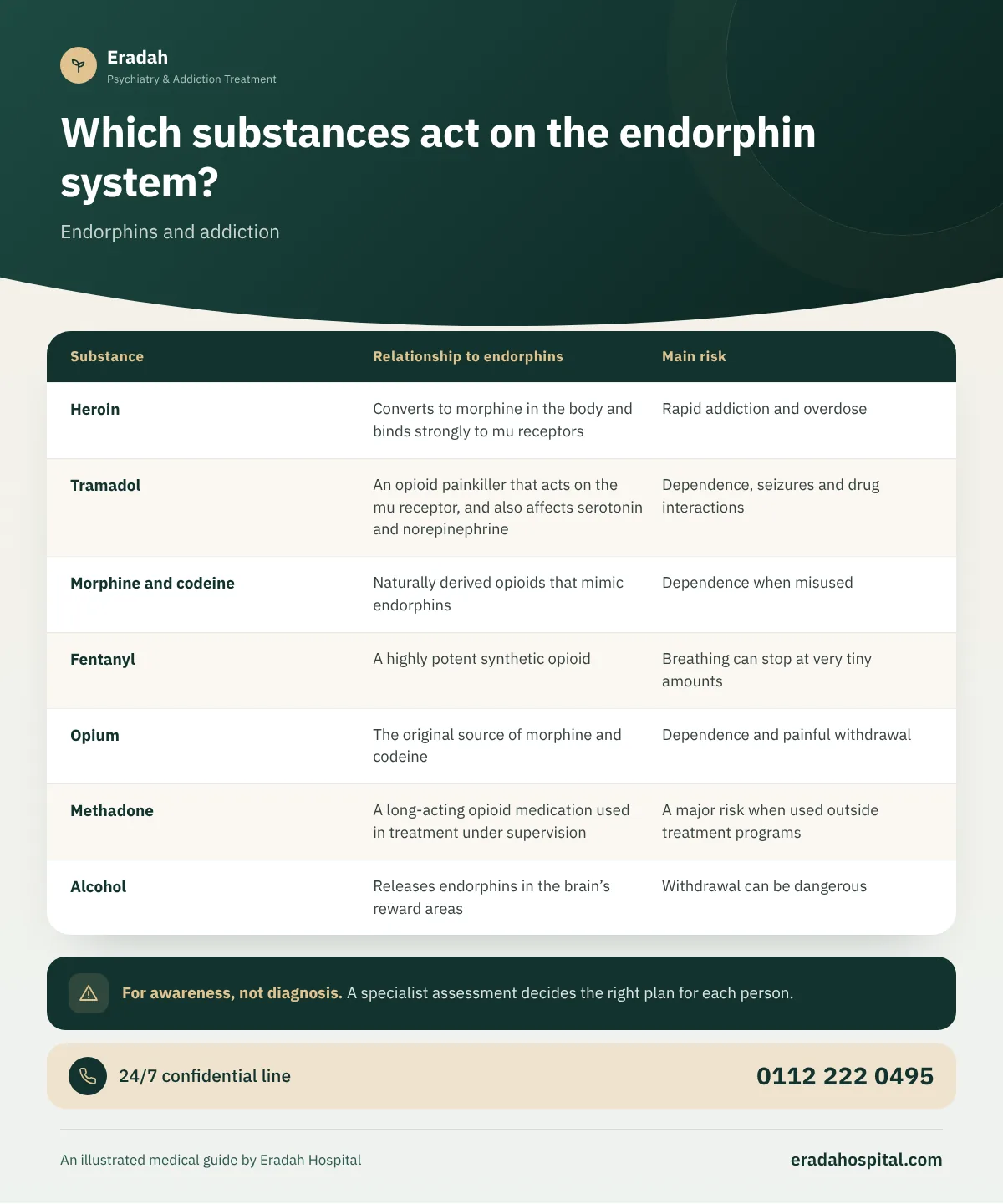
Which substances act on the endorphin system?
| Substance | Relationship to endorphins | Main risk |
|---|---|---|
| Heroin | Converts to morphine in the body and binds strongly to mu receptors | Rapid addiction and overdose |
| Tramadol | An opioid painkiller that acts on the mu receptor, and also affects serotonin and norepinephrine | Dependence, seizures and drug interactions |
| Morphine and codeine | Naturally derived opioids that mimic endorphins | Dependence when misused |
| Fentanyl | A highly potent synthetic opioid | Breathing can stop at very tiny amounts |
| Opium | The original source of morphine and codeine | Dependence and painful withdrawal |
| Methadone | A long-acting opioid medication used in treatment under supervision | A major risk when used outside treatment programs |
| Alcohol | Releases endorphins in the brain’s reward areas | Withdrawal can be dangerous |
Why does tolerance develop with opioids?
When opioid receptors are flooded day after day, the body defends its balance: the receptors become less sensitive, some are pulled inside the cell, and opposing systems become active to try to offset the effect. The result is tolerance: the amount that used to be enough no longer gives the same effect.
The endogenous opioid system itself is believed to be disrupted with long-term use, so the body becomes dependent on the outside substance to feel “normal.” The exact details of what happens to endorphin production are still being researched, but what is certain is that the whole system is thrown off and needs time to regain its balance.
What happens to the endorphin system in opioid withdrawal?
When use stops suddenly, the body faces poorly sensitive receptors with no substance to occupy them, and opposing systems that are still active. Effects flip: instead of calm there is anxiety and tension, instead of constipation there is diarrhea, and instead of pain relief there are bone and muscle aches. Norepinephrine surges, causing sweating, chills, a racing heart and insomnia, while severe distress is partly linked to the activity of “dynorphin,” which is related to endorphins and opposite to them in its effect on mood.
- The first hoursOnset of craving and anxiety
Starts depending on the substance: faster with short-acting opioids and slower with long-acting ones.
- The first daysPeak of physical symptoms
Muscle and bone aches, diarrhea, chills, runny nose, insomnia and severe tension.
- The following weeksGradual physical improvement
Physical symptoms settle, while insomnia, fatigue and cravings remain to varying degrees.
- The first monthsProtracted withdrawal
Mood swings and sensitivity to pain and stress in some people in recovery, which improve with treatment and time.
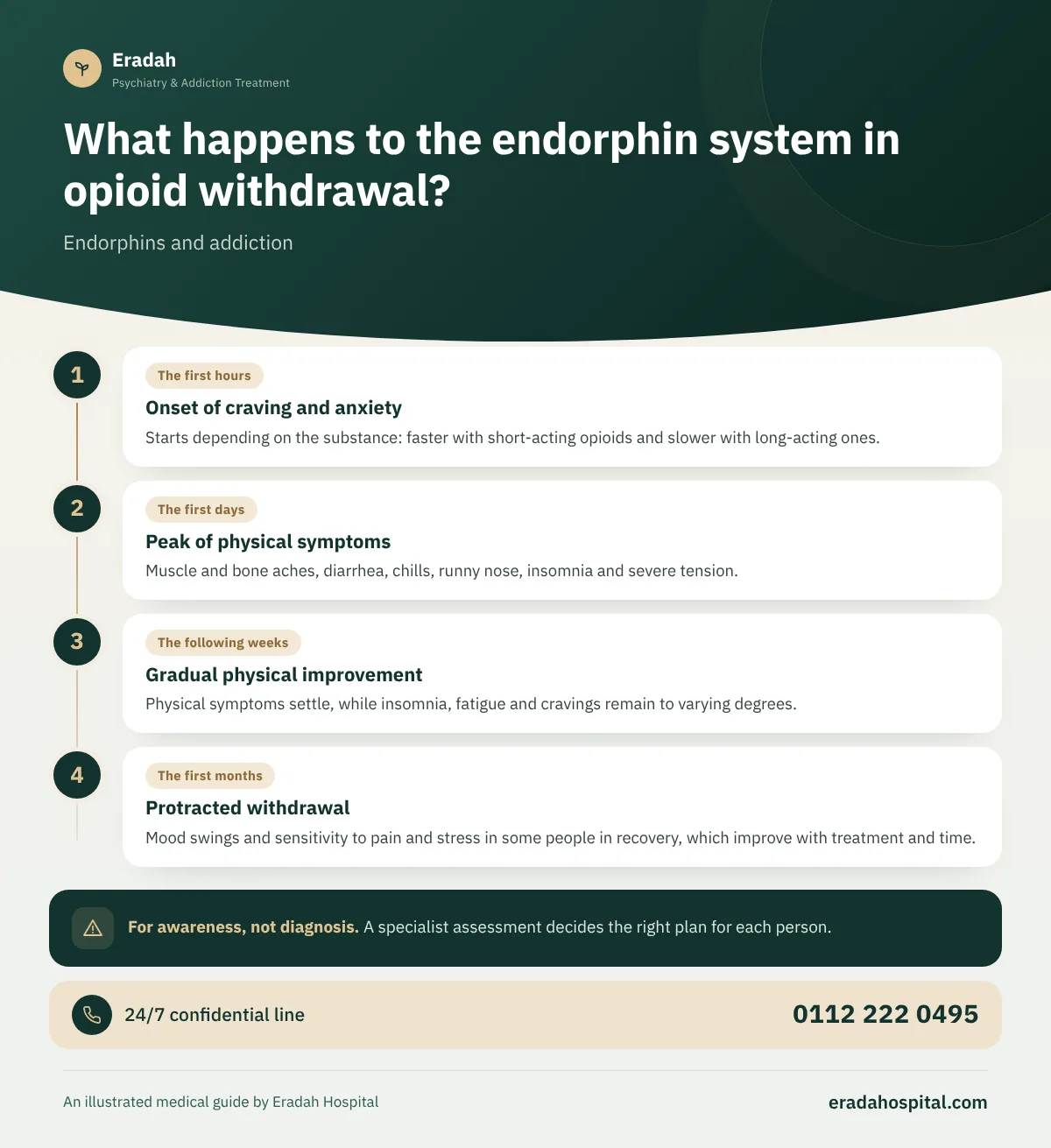
The time frames are approximate and vary with the substance, the length of use and health status. Details are on pages such as heroin withdrawal and tramadol withdrawal. Opioid withdrawal is painful but rarely directly life-threatening in a healthy person, unlike alcohol and sedative withdrawal, yet it is still best done under medical supervision.
Why does pain sensitivity increase after opioids?
One of the strangest things doctors notice is that long-term opioid use can make a person more sensitive to pain, not less, a phenomenon called “opioid-induced hyperalgesia.” The person complains of widespread pain in the back, bones and joints, assumes they need more to relieve it, and enters a vicious circle.
This explains why many people who use tramadol say they “hurt everywhere” after stopping. Pain sensitivity improves gradually with abstinence and treatment, and graded exercise, physical therapy and regular sleep help the body regain its natural pain-relief system, as we explain in Natural Ways to Boost Endorphins.
What is the link between alcohol and endorphins?
Alcohol is not an opioid, but it releases endorphins in the brain. In an imaging study published in 2012, drinking alcohol led to the release of endogenous opioids in the nucleus accumbens and the orbitofrontal cortex, and the pleasure associated with it was greater in heavy drinkers than in others.
This partly explains why the medication naltrexone, which blocks opioid receptors, is used in the treatment of alcohol addiction: it reduces the reward that drinking gives some patients and helps reduce cravings. It is prescribed only after a medical assessment, and has contraindications determined by the doctor.
Is endorphin involved in behavioral addiction?
Research suggests that endogenous opioids take part in the reward linked to some behaviors, and naltrexone has been studied in the treatment of gambling and betting addiction with encouraging results in some patients. Its role in compulsive exercise that harms the body is also discussed. But dopamine remains the clearer player in most behavioral addictions, such as video game addiction, and the evidence for endorphin in them is weaker.
Why does the danger of overdose rise after a period of abstinence?
After weeks of stopping, whether in prison, in hospital or in a treatment center, tolerance falls and the receptors regain part of their sensitivity. If the person relapses and returns to the amount they used before, it may be enough to slow their breathing until it stops. That is why the period after leaving treatment or custody is among the most dangerous.
How do the endorphin system and the body recover with treatment?
The body gradually regains the balance of its opioid system after stopping, and receptor sensitivity, sleep, mood and pain perception improve over weeks to months. There is no single exact timeline, because it varies with the substance, length of use, age and health. The following treatments help get through this stage safely:
| Treatment | Its role (without doses) | Note |
|---|---|---|
| Buprenorphine and methadone | Regulated opioids that occupy the receptors steadily, preventing withdrawal and craving without fluctuating euphoria | An internationally approved treatment under strict medical supervision |
| Naltrexone | Blocks opioid receptors, reducing the reward from opioids and alcohol | Starts after withdrawal ends, following a medical assessment |
| Naloxone | Temporarily reverses an overdose in an emergency | Life-saving, but does not treat addiction |
| Psychological therapy | Addresses the causes and triggers of use and builds relapse prevention skills | Essential alongside any medication treatment |
| Treating chronic pain by alternative means | Physical therapy, graded exercise and non-opioid painkillers depending on the case | Important for people whose addiction began with a painkiller |
At Eradah, we design a detox plan for each substance that eases withdrawal symptoms safely, then treat the accompanying pain, insomnia and depression, and build a relapse prevention plan with the patient and their family. We explain these stages in detail in heroin addiction treatment and tramadol addiction treatment.
How can the family help with recovery from opioid addiction?
- Take complaints of pain and insomnia seriously; they are real in withdrawal and not an act.
- Encourage activities that release endogenous opioids naturally: walking, laughing and warm family time.
- Don’t keep spare opioid painkillers at home, and dispose of old ones safely.
- Learn the signs of overdose and keep the ambulance number (123) at hand.
- Support sticking to the prescribed medication treatment without stigmatizing it as a “substitute addiction.”
- Seek support for yourselves; a stable family is the strongest support for a person in recovery.
Opioid overdose? Call an ambulance (123) immediately
- Extreme drowsiness, or no response to calling or shaking
- Very slow or irregular breathing, odd snoring sounds, or breathing that has stopped
- Pupils that are extremely small, like pinpoints
- Bluish lips or nails, and cold, clammy skin
- Vomiting while unconscious, or choking sounds
Call an ambulance (123) immediately and try to wake the person with a loud voice. If they are breathing, place them on their side so they do not choke, and stay with them until help arrives. Emergency departments have a medicine called naloxone that temporarily reverses the effects of opioids. Do not give the person anything else, including water or coffee. If there are thoughts of self-harm, call the mental health support line 16328.
Ambulance 123 Mental health support line 16328