What does norepinephrine deficiency mean?
When someone is said to have a “norepinephrine deficiency,” it usually means one of two completely different things: either weak activity of norepinephrine circuits in the brain, a concept researchers use to explain some symptoms of depression and attention problems, or failure of the sympathetic nerves to release it in the body, a real neurological condition that shows up as a drop in blood pressure on standing.
The first kind is not measured by a test and is not diagnosed on its own; it is inferred from how symptoms respond to medications that act on this system. The second can be assessed by a neurologist or cardiologist with specialized tests. It is important not to confuse the two, and not to explain every tiredness or boredom as a shortage of a chemical.
What are the possible symptoms of norepinephrine deficiency?
There is no set of symptoms specific to norepinephrine alone, but conditions in which its activity is lower share signs that can be divided as follows:
| Area | Examples of symptoms | Note |
|---|---|---|
| Attention and thinking | Distractibility, difficulty concentrating and starting tasks, and slow responses | Also seen in ADHD and lack of sleep |
| Mood and energy | Lethargy, low interest and motivation, and a feeling of heaviness and exhaustion | Part of the picture of depression along with many other factors |
| Body and circulation | Dizziness, blurred vision or fainting on standing, and poor exercise tolerance | An important sign of a fault in the autonomic nerves |
| Sleep and wakefulness | Daytime sleepiness and difficulty waking fully | Has many causes, including sleep apnea |
| Other autonomic symptoms | Constipation, disturbed sweating, and erection problems in men | Appear with autonomic nerve diseases |
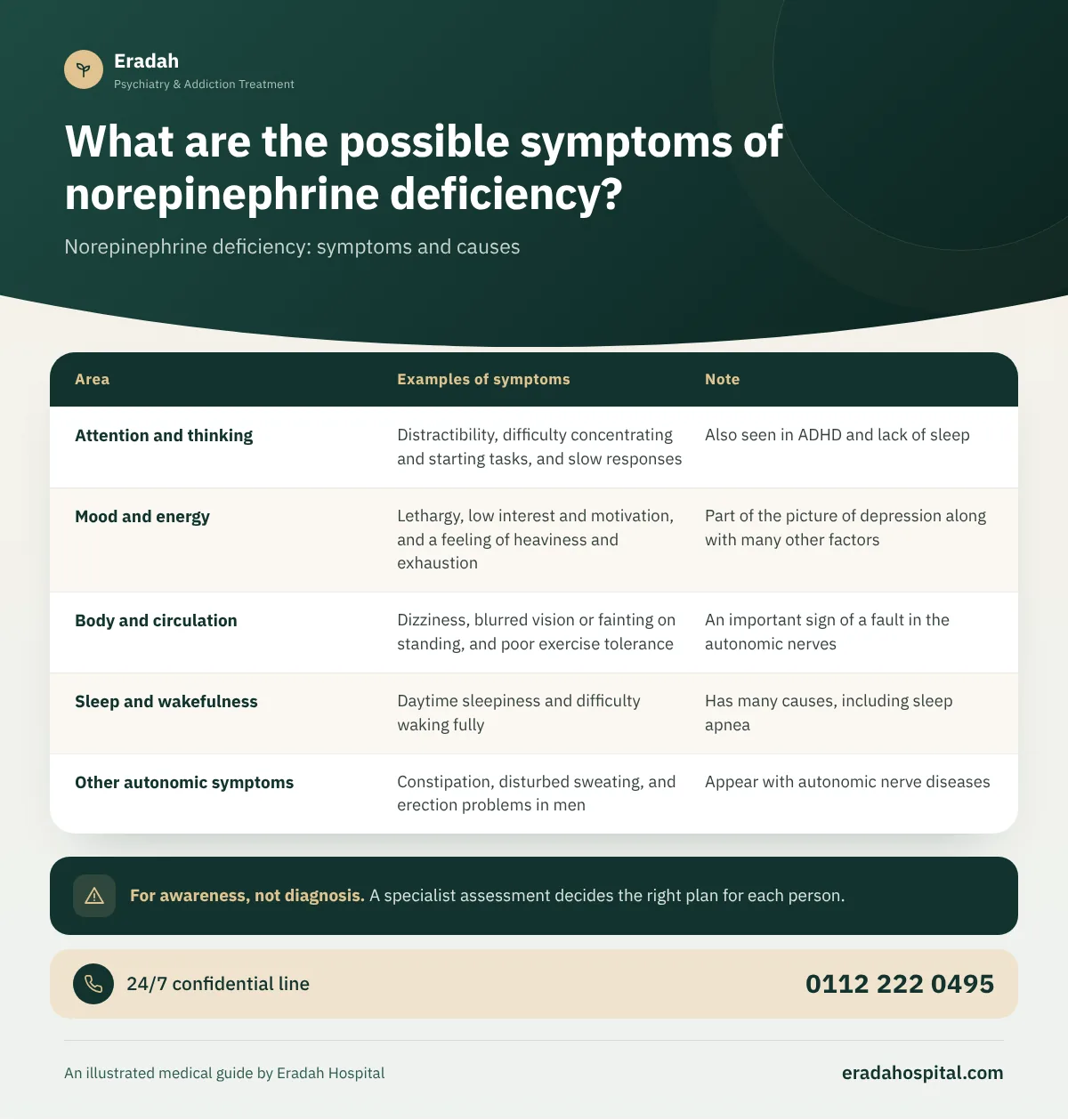
The clearest of these symptoms medically is a drop in blood pressure on standing; when you stand, some blood sinks to the legs, and the sympathetic nerves are supposed to release norepinephrine immediately to narrow the vessels. If they fail to, blood pressure drops and the person feels dizzy, has pain in the neck and shoulders, or faints.
What causes norepinephrine deficiency?
| Cause | What happens? | Example |
|---|---|---|
| Degenerative diseases of the autonomic nerves | Damage the sympathetic nerves or the cells that release norepinephrine | Parkinson’s disease, multiple system atrophy, and pure autonomic failure |
| Diabetic neuropathy | Small nerves, including autonomic nerves, are affected with long-standing disease and poor sugar control | Dizziness on standing in a patient with long-standing diabetes |
| Dopamine beta-hydroxylase deficiency | A very rare genetic fault that prevents dopamine from being converted into norepinephrine | Severe drop in blood pressure on standing since childhood |
| Medications | Medications that reduce its release or block its receptors | Some blood pressure and prostate medications, especially in older adults |
| The period after stopping stimulants | Temporary exhaustion of the dopamine and norepinephrine systems | Lethargy, long sleep and tiredness after stopping shabu or Captagon |
| Factors that take part in depression | Disturbed regulation of several neurotransmitters, including norepinephrine | Lethargy, low interest and slowed thinking |
Note that in some neurological diseases such as Parkinson’s and Alzheimer’s, damage affects early the cells of the locus coeruleus itself, the brain’s main source of norepinephrine, and researchers are studying how this relates to some non-motor symptoms such as disturbed sleep and mood.
Does norepinephrine deficiency cause depression?
This question deserves an honest answer. Since the 1960s the “monoamine hypothesis” has held that depression results from a shortage of serotonin or norepinephrine. As research advanced it became clear that this picture is too simple: depression is a complex illness involving genetics, chronic stress, inflammation, sleep, circumstances and thoughts, and norepinephrine is not measured to diagnose it.
Even so, research points to a real role for norepinephrine in some symptoms of depression, especially low energy, low interest, poor concentration and slowed thinking. That is why classes of antidepressants act on it alongside serotonin, and they genuinely help many people. What matters is that no one stops their treatment on the grounds that “the theory is unproven,” and that any concern is discussed with their doctor. To understand depression fully, read our depression guide.
How is norepinephrine deficiency related to ADHD?
In attention-deficit/hyperactivity disorder (ADHD), research points to a difference in how dopamine and norepinephrine circuits work in the prefrontal cortex, the region for planning, impulse control and keeping attention. This does not mean the child or adult “lacks” norepinephrine in a measurable sense, but that signal regulation in these circuits is different.
This understanding is supported by the fact that ADHD medications act on these two neurotransmitters: stimulant medications such as methylphenidates raise dopamine and norepinephrine, and some non-stimulant medications such as atomoxetine increase norepinephrine specifically by blocking its reuptake. Diagnosis and treatment are the psychiatrist’s decision after a full assessment, not the result of an online test.
Who is most prone to norepinephrine deficiency?
- Older adults, especially with multiple medications, including blood pressure and prostate medications
- People with Parkinson’s disease and other degenerative diseases of the nervous system
- People with diabetes of many years with poor sugar control
- People in the period after stopping stimulants, as they go through a temporary period of lethargy and exhaustion
- People with depression or ADHD, according to the research understanding of norepinephrine’s role in them
- Very rare children born with a genetic fault in the enzyme that makes it
Is there a test for norepinephrine deficiency?
For mental and cognitive symptoms the answer is no: there is no blood or urine test that measures norepinephrine in your brain or diagnoses depression or ADHD. Diagnosis is made through a clinical interview, validated scales and ruling out physical causes.
When a fault in the autonomic nerves is suspected, the doctor uses clear steps:
- Measuring blood pressure and pulse lying down and then after standing for several minutes, to detect the drop on standing.
- Reviewing medications that may cause the drop, among the most common causes and the easiest to treat.
- General tests such as a blood count, sugar, salts and thyroid function.
- Specialized autonomic nerve tests such as the tilt table test, and sometimes measuring norepinephrine in the blood lying down and then standing in specialized centers.
- Neurological assessment to look for a disease such as Parkinson’s if other signs are present.
How is norepinephrine deficiency treated medically?
There is no “norepinephrine treatment” in itself, but treatment of the condition with which its lowering is linked. We mention only the general categories, since the choice and dose are the doctor’s decision alone:
| The situation | Focus of treatment |
|---|---|
| Depression | Psychotherapy such as cognitive behavioral therapy, and antidepressants that may act on serotonin and norepinephrine together |
| ADHD (attention-deficit/hyperactivity disorder) | Behavioral training and family and school support, and stimulant or non-stimulant medications prescribed by the doctor |
| Drop in blood pressure on standing | Reviewing causative medications, guidance such as rising slowly and drinking fluids, and medications that raise blood pressure or turn into norepinephrine in the body when needed |
| Lethargy after stopping stimulants | Medical and psychological support, regulating sleep, food and activity, and monitoring for depression if it appears |
Regular sleep, moderate physical activity and exposure to daylight are habits that support alertness and mood in general, but they do not replace treatment when there is an illness. Do not use stimulants or “energy and focus boosting” supplements without a doctor; some interact with antidepressants and raise blood pressure.
When should you see a doctor about possible symptoms of norepinephrine deficiency?
- If dizziness or fainting on standing keeps recurring, or you have fallen more than once.
- If lethargy and loss of interest continue for more than two weeks and affect your work, studies or relationships.
- If you or your family notice persistent distractibility and impulsivity since childhood that disrupt your life.
- If tremor, slowed movement, or a sleep disturbance in which you act out your dreams appears along with dizziness.
- If thoughts of death or self-harm appear: call the mental health support line 16328 or the ambulance on 123 immediately.
Chest pain, very high blood pressure or signs of a stroke? Call the ambulance (123) immediately
- Pain or pressure in the chest that may spread to the arm or jaw, with sweating or shortness of breath, especially after using stimulants
- A sudden, severe headache unlike any before, with a big rise in blood pressure, blurred vision or vomiting
- Sudden drooping of the face, weakness in an arm or leg, or sudden difficulty speaking (signs of a stroke)
- A very fast or irregular heartbeat with severe dizziness or fainting
- Severe agitation with high temperature, or seizures after using stimulants or during alcohol withdrawal
Call the ambulance (123) immediately and do not wait for the symptoms to settle, and do not try to lower the blood pressure at home with medicines the doctor has not prescribed. Have the person sit or lie down in a quiet place and stay beside them, and note the time the symptoms began, because it matters for stroke treatment. Tell the ambulance team honestly about every medicine or substance the person has taken, because it changes the treatment and may save their life.
Ambulance 123 Mental health support line 16328