How is buprenorphine broken down in the body?
“I take Suboxone with a prescription. Will it show up in my work drug test?” A common question, and the answer depends more on the type of test requested than on the medication itself.
According to Mayo Clinic Laboratories, buprenorphine is broken down in the liver by the enzyme CYP3A4 into an active metabolite called norbuprenorphine, and then both bind to other substances that make it easier to eliminate them from the body. Because this enzyme's activity is affected by other medications and by liver function, the speed of eliminating buprenorphine varies from person to person.
Its presence in a sample indicates exposure to the drug in the preceding days.
A breakdown product of buprenorphine in the body; measuring it helps confirm that the drug was actually metabolized in the body.
Anything that slows or speeds up the CYP3A4 enzyme may change how fast buprenorphine is eliminated, so tell the doctor about all your medications.
What is the half-life of buprenorphine?
Half-life is the time the body needs to eliminate half the amount of a substance in the blood. A StatPearls review states that for buprenorphine the average is about 38 hours after sublingual dosing, with a range of roughly 25 to 70 hours. Mayo Clinic Laboratories states that it is much shorter with intravenous injection, ranging from about 1 hour to 7 hours, while it is longer with forms that dissolve under the tongue or with patches.
The body usually needs several half-lives to eliminate a substance almost completely, which is why buprenorphine remains detectable for days after the last dose, unlike heroin, which breaks down within minutes.
How long does buprenorphine stay in urine, blood, saliva, and hair?
| Sample type | What it detects | Approximate duration |
|---|---|---|
| Urine | Buprenorphine and its metabolite norbuprenorphine | Their presence indicates exposure within about 7 days, according to Mayo Clinic |
| Blood | Recent exposure or drug level | Shorter than urine; mostly used in emergencies or to measure the level |
| Saliva | Recent exposure | A short window that varies by laboratory |
| Hair | Pattern of use over an earlier period | Much longer, and does not detect use in the last few days |
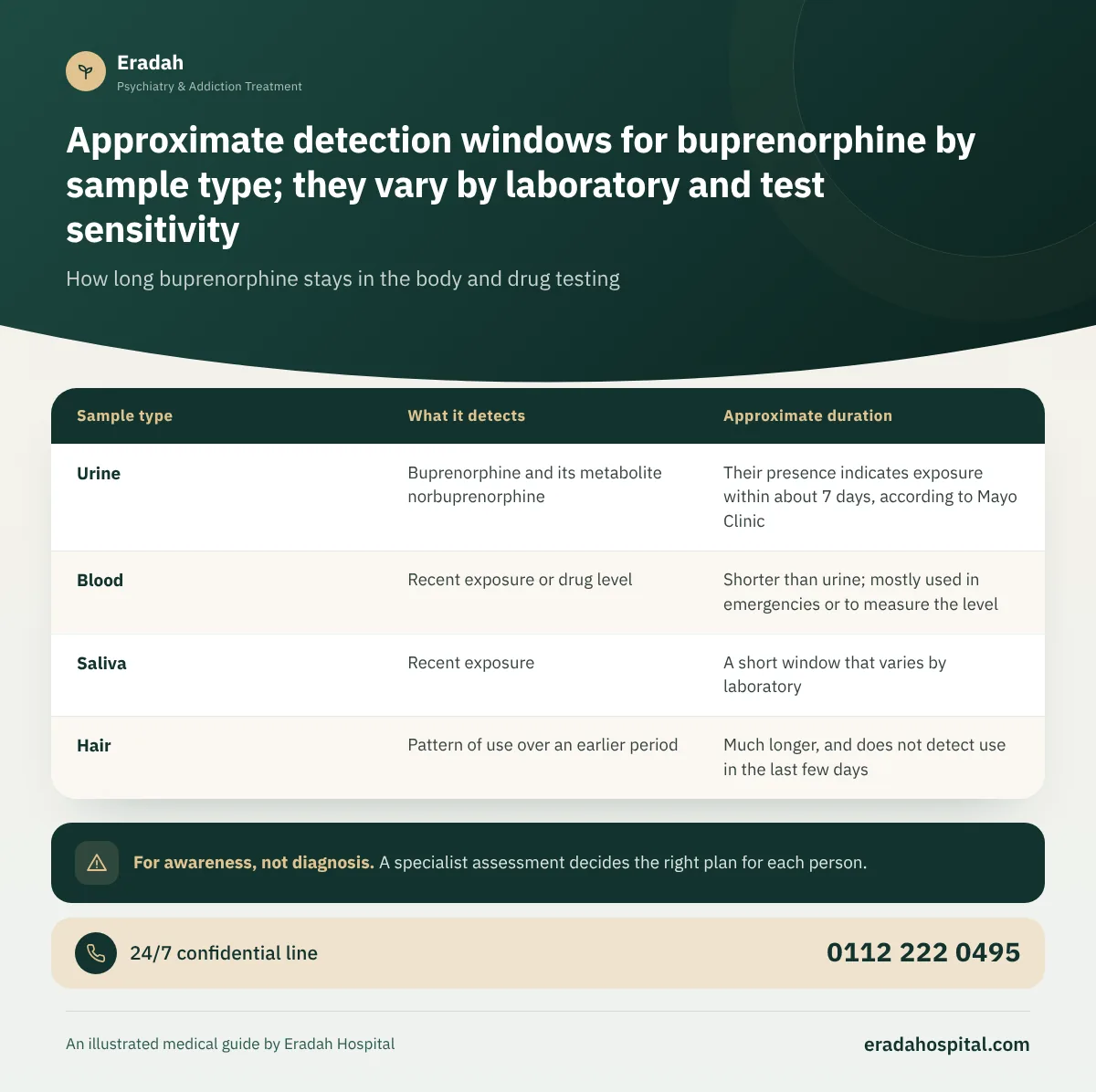
Durations are approximate, and laboratories differ in their detection limits. For an accurate interpretation of a specific result, consult the doctor or the laboratory.
Does buprenorphine show up on a regular opiate test?
Usually not. A StatPearls review on drug testing explains that the initial “opiate” test is designed mainly to detect morphine, so it does not reliably detect opioids that differ in structure, including buprenorphine, methadone, and fentanyl. It adds that expanded panels may include buprenorphine as a separate item.
What factors affect how long buprenorphine stays?
- Length and regularity of use: Long daily use extends the detection window compared with a single dose.
- Amount: Detection time is affected by the amount taken, as Mayo Clinic notes.
- Route of use: Under the tongue, by injection, or by patch; each has a different half-life.
- Liver function: because it is broken down mainly in the liver.
- Other medications: some slow or speed up the CYP3A4 enzyme.
- Individual differences: age and general health.
What is the difference between a screening test and a confirmatory test?
| Type | How it works | When it is used |
|---|---|---|
| Buprenorphine-specific screening test | Rapid strips or devices that look for it specifically | In clinics, treatment programs, and emergency departments |
| Confirmatory test | Precise laboratory instruments that identify buprenorphine and its metabolite and their concentrations | When a positive result needs confirmation or for official purposes |
| Interpreting the result with the doctor | Linking the result to the prescription, dose, and timing | In treatment programs, to confirm adherence and detect mixing |
Any positive result on a screening test needs laboratory confirmation before an important decision is made, as the drug testing guide explains.
What should you do if you take buprenorphine with a prescription and are asked for a test?
If you take it as part of a treatment plan, it is expected to show up on any test that looks for it, and this is not evidence of misuse. MedlinePlus advises telling the doctor and the laboratory that you take it before any test. The right course:
- Keep a copy of the prescription or a letter from the treatment program.
- Inform the party requesting the test before the sample is taken.
- If an unexpected result appears, ask to discuss it with your doctor and for a confirmatory test if needed.
- Do not stop the medication before or after the test on your own; abrupt discontinuation causes withdrawal and raises the risk of relapse.
When are buprenorphine tests requested?
- In treatment programs, to make sure the patient is actually taking their medication and not using other substances.
- In emergencies, with unexplained drowsiness or respiratory depression, especially in children.
- When starting any addiction treatment program, to assess the substances used accurately.
- In some workplace screenings or official bodies that request expanded panels.
Why do we not offer tips for getting around the test?
Because in the context of treatment, testing is a tool to protect the patient, not to condemn them; it detects dangerous mixing with sedatives early and helps the doctor adjust the plan. Attempts to “clean” the body quickly do not change the fact that a problem exists, and may be harmful. If you are using buprenorphine without a prescription and want to stop, the safe route is a specialist assessment and a tapering plan; read about buprenorphine withdrawal and its duration.