How does heroin change inside the body?
Once it enters the body, heroin is converted within minutes into an intermediate substance called 6-monoacetylmorphine (6-MAM), and then into morphine. This is why tests usually do not look for heroin itself, but for these two byproducts:
A byproduct specific to heroin alone. Its presence confirms heroin use specifically, but it disappears quickly, within hours.
It lasts longer, but it can also come from medications such as codeine and morphine, so it does not confirm heroin on its own.
Why does heroin disappear from the blood so quickly?
Heroin has a very short half-life of no more than a few minutes, meaning that half of the amount in the blood is converted into other substances within minutes. This is why heroin itself is rarely detected, and tests rely on its byproducts, which stay longer. It also explains why the effect comes on fast and wears off fast, so the person goes back to the drug within hours.
How long heroin stays, by type of test
Urine
Blood
Saliva
Hair
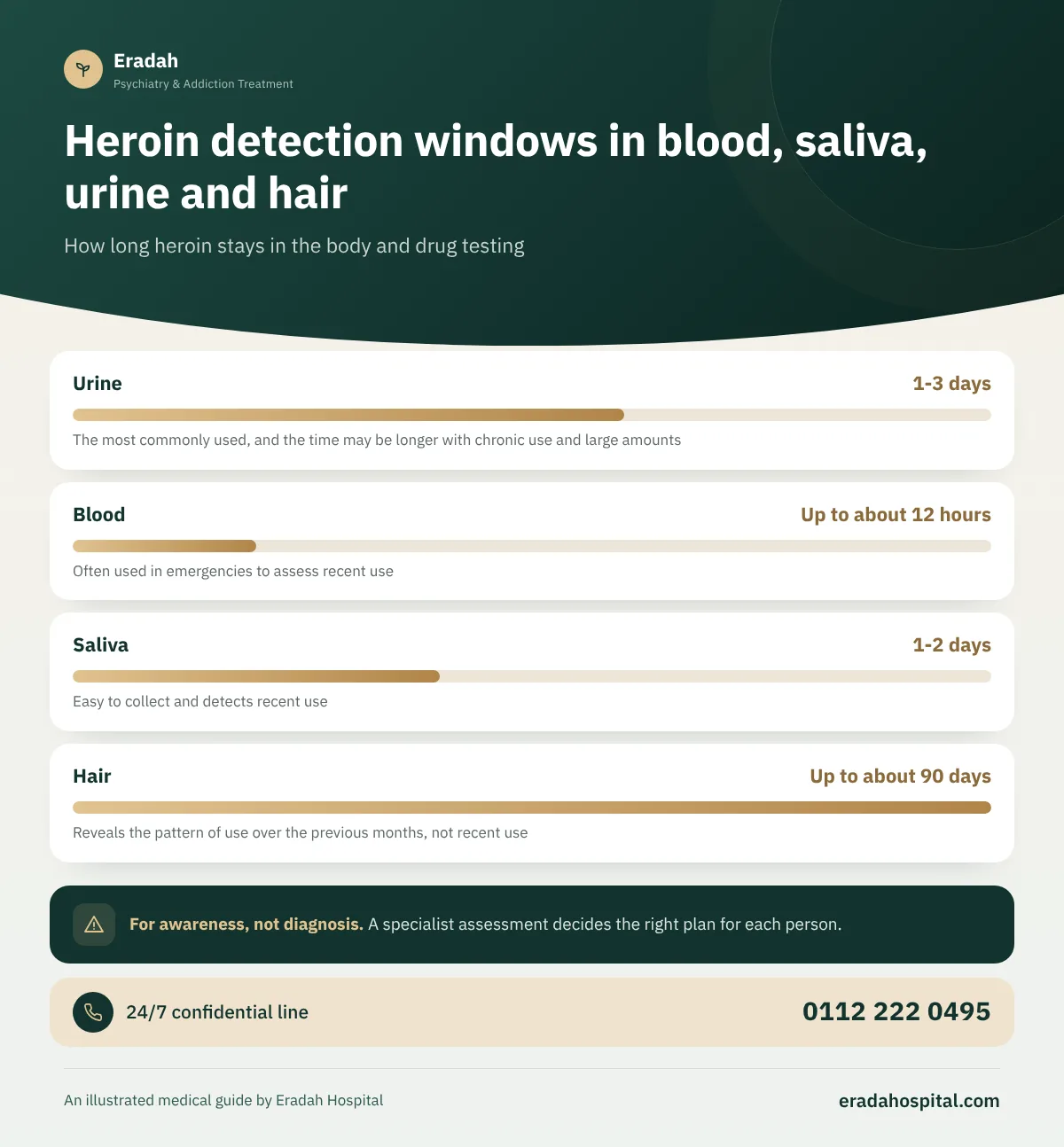
These times are approximate and vary with the sensitivity of the test and the laboratory. For an accurate interpretation of a specific result, consult a doctor or the laboratory.
Factors that affect how long heroin stays
- How often and how long the person has used: Chronic use lengthens the detection time compared with a single use.
- Amount and purity: Larger amounts take longer to clear.
- Liver and kidney function: weakness in either slows the clearing of metabolites.
- Age and metabolism: Elimination usually slows with age.
- General health and the body's fluid levels.
Screening test and confirmatory test
Quick and inexpensive, it detects opioids in general, but it can give a false positive result and does not distinguish heroin from other opioids.
Performed in a specialized laboratory with precise equipment, it identifies the specific substance and its amount, and it is requested after any positive preliminary result.
Does a heroin test detect other opioids?
The usual opioid test is designed to detect morphine, codeine and heroin byproducts, but it does not always detect synthetic opioids such as tramadol, methadone and fentanyl, which need their own tests. This is why the doctor chooses the type of test according to the case and the suspected substance.
Which sample is used, and when?
| Purpose | The most suitable sample, usually |
|---|---|
| Assessing an emergency or loss of consciousness | Blood or urine |
| Regular monitoring during treatment | Urine, and sometimes saliva |
| Learning the pattern of use over the previous months | Hair |
| Confirming a positive preliminary result | The same sample, sent to a specialized laboratory for a confirmatory test |
The doctor or laboratory chooses the sample type and the test according to the question that needs answering, not just according to how easy the procedure is.
Can a result be positive without heroin use?
Yes. Morphine may show up in a urine test after taking medications that contain codeine or morphine, or even after eating a quantity of poppy seeds. This is why a positive preliminary result needs a confirmatory test in a specialized laboratory, and testing for 6-MAM can help distinguish heroin from other sources.
What can a test not tell you?
A test is an important tool, but it has limits that families should know before basing a decision on it:
- It does not determine the amount accurately in the preliminary test: It only shows whether opioids are present or absent, and the confirmatory test gives more detail.
- It does not determine exactly when the drug was used: It gives an approximate window that varies from person to person.
- It does not measure how affected the person is or how severe the addiction is: That is determined by a comprehensive medical and psychological assessment.
- A negative result does not rule out a problem: The detection window may have passed, or the substance used may be a synthetic opioid that the usual test does not detect.
Are quick home tests enough?
Quick test strips are available for use at home, and they are preliminary tests like those done in laboratories. They may be useful as an initial indication, but any positive result needs laboratory confirmation, and it is best to consult a doctor before using them and in interpreting the result. Using them as a way of monitoring and checking up can also damage trust within the family, and it is better for testing to be part of an agreed treatment plan.
When are heroin tests requested?
- In emergencies, when an overdose or unexplained loss of consciousness is suspected.
- When starting an addiction treatment program, and during it to follow adherence.
- In some job, licensing, or legal procedures.
How are tests used within a treatment program?
In addiction treatment programs, testing is not a tool for punishment but a way of monitoring that the treatment team agrees on with the patient from the start. It helps confirm that the body is free of the substance before starting certain medications, follow adherence during treatment, and detect relapse early so the team can step in before it gets worse.
When a positive result appears during treatment, the team treats it as information that calls for reviewing the plan and discussing what happened, not as a reason to expel or condemn the patient. This approach encourages the patient to be honest, which is the foundation of any real recovery.
What does a test result mean for the family?
A positive result is useful for starting treatment, but it is not a verdict on the person or the end of the road. A negative result does not rule out a problem if the signs are clear, because the detection window is short. More important than the test is a calm conversation and a specialist assessment that looks at the whole picture.