Why do buprenorphine withdrawal symptoms happen?
“I've been stable on Subutex for a year, and I want to be done with it.” This is an understandable and legitimate wish, but how you stop makes the difference between recovery that lasts and a relapse within weeks.
With regular use, the brain adapts to the presence of buprenorphine on opioid receptors: it reduces the activity of the natural calming systems and raises the activity of the alerting systems to compensate. When the drug level falls, this balance is upset, and symptoms opposite to its effect appear. This physical dependence is expected in anyone who takes an opioid regularly and does not necessarily mean addiction; a patient who follows their prescription has the same physical dependence, but stops with a plan.
Withdrawal from stopping versus precipitated withdrawal: what is the difference?
Many people confuse two completely different types of withdrawal associated with buprenorphine:
| Point of comparison | Withdrawal from stopping | Precipitated withdrawal |
|---|---|---|
| Cause | Stopping buprenorphine or reducing it quickly | Taking buprenorphine while a full-effect opioid is still in the body |
| The start | Gradual, because the drug leaves the body slowly | Sudden and rapid after taking it |
| Severity | Usually milder than heroin withdrawal but may last longer | Can be severe and very distressing |
| Prevention | Gradual tapering with a plan set by the doctor | The right starting time, determined by the doctor |
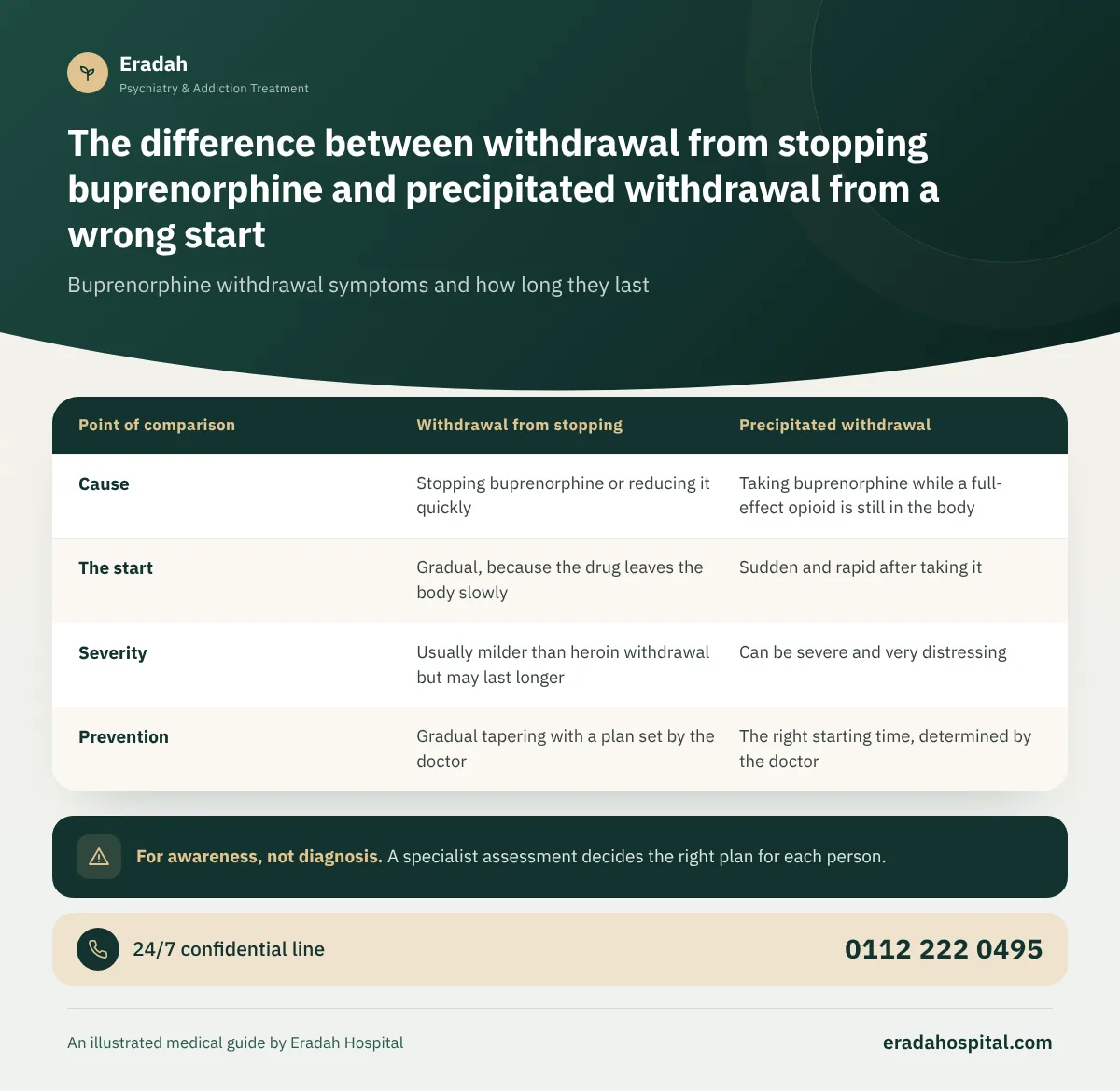
A StatPearls review states that giving buprenorphine too soon after a full-effect opioid can cause precipitated withdrawal, which is why treatment is not usually started until clear signs of withdrawal appear. If it happens, do not try to stop it with more opioids or sedatives; seek medical help.
What are the physical and psychological symptoms of buprenorphine withdrawal?
MedlinePlus states that abruptly stopping buprenorphine may cause the following symptoms, which overlap with opioid withdrawal symptoms in general:
| Type | Symptoms |
|---|---|
| Early physical | Hot or cold flashes, sweating, chills, runny nose, watery eyes, yawning, muscle aches |
| Digestive | Nausea, vomiting, diarrhea, abdominal cramps, and poor appetite |
| Psychological | Restlessness, anxiety, irritability, insomnia, mood swings, and cravings for opioids |
When do buprenorphine withdrawal symptoms start and how long do they last?
Frankly: there is no single agreed timeline in the medical literature for buprenorphine withdrawal, because the duration is affected by the length of treatment, the amount, the speed of tapering, and liver function. But the long half-life, averaging about 38 hours according to a StatPearls review, means the drug leaves the body slowly, so symptoms are relatively delayed and milder than heroin withdrawal. Withdrawal often passes through the following stages:
- The startRelative delay
A period without obvious symptoms may pass, then anxiety, restlessness, a runny nose, and sweating begin.
- The peakPhysical symptoms
Muscle aches, chills, stomach upset, and insomnia, with cravings that may be strong.
- EasingGradual improvement
Physical symptoms ease gradually, while fatigue and disturbed sleep and mood remain.
- AfterwardProtracted withdrawal
Insomnia, anxiety, low mood, and cravings that come in waves, and may last weeks or longer.
These are approximate descriptive stages, not fixed schedules, and they vary greatly from person to person.
Why is gradual tapering preferred over abrupt discontinuation?
MedlinePlus states that buprenorphine should not be stopped without talking to the doctor, because stopping quickly causes withdrawal symptoms, and that the doctor decides when and how to stop. A StatPearls review describes tapering as a gradual process that needs careful monitoring and usually extends over several months.
The data support this caution: in a population-based study from Ontario, Canada, published in 2022, of 5,774 people who tapered buprenorphine after at least 60 days of treatment, starting the taper after more than a year of treatment, and tapering more slowly, were associated with a lower risk of overdose in the 18 months after stopping.
- The decision to taper is made together with the doctor when the patient is psychologically and socially stable.
- The plan is slowed or paused if symptoms become severe or cravings return strongly.
- Psychotherapy and family support continue throughout the taper and after it.
- Staying on treatment longer is a legitimate medical choice, not a failure.
What is the risk of relapse after stopping buprenorphine?
This is the real challenge. A systematic review published in 2015 examined outcomes of discontinuing buprenorphine replacement therapy and found that rates of return to illicit opioids one month after stopping exceeded 50% in all the studies it included, and that many discontinuations were involuntary. That is why success is measured not by how quickly the drug is cleared, but by how stable recovery is afterward.
Can you stop buprenorphine at home?
Abruptly stopping at home means facing symptoms without treatment to ease them and without protection against relapse. A structured taper, by contrast, can be done with outpatient follow-up for some stable patients, while others need a treatment setting according to their condition. In both cases the doctor can:
- Set a tapering plan that suits the length of treatment and the patient's history.
- Prescribe medications that ease specific symptoms such as insomnia, anxiety, diarrhea, and cramps.
- Monitor mental state and dehydration if symptoms become severe.
- Start a relapse prevention plan before the taper ends, not after, with the possibility of naltrexone for some patients once the body is free of opioids.
Eradah's detox program and outpatient treatment offer both settings depending on what the assessment determines.
How can the family support someone stopping buprenorphine?
Irritability, insomnia, and mood swings are part of withdrawal, not a personal stance against you.
Encourage them not to adjust the taper on their own, and to attend follow-up appointments.
Keep unprescribed sedatives away and maintain a regular sleep and eating routine.
Returning to use after stopping may cause an overdose; know its signs and the ambulance number, 123.
Danger signs during or after buprenorphine withdrawal: call the ambulance (123) immediately
- Severe drowsiness and slow breathing after returning to heroin or another opioid
- Not responding when called, or blue lips
- Severe, persistent vomiting or diarrhea with dizziness, dehydration, and little urine
- Suicidal thoughts or severe mental disturbance
- Seizures or severe confusion, especially with sedatives or alcohol present
Call ambulance (123) immediately. If the person is unconscious but breathing, place them on their side so they do not choke on vomit. Stay with them and do not leave them alone. Do not give them food or drink, and tell the paramedics everything they took or used, and the amount and time if you know them.
Call the ambulance 123