Why do people ask about the difference between pregabalin and gabapentin?
“The pharmacist told me Neurontin is exactly like Lyrica, take it instead.” This sentence has been repeated since pregabalin became harder to get in Egypt. The two drugs are indeed from the same family, but “exactly like” is not accurate, and the difference between them changes how they are used and the risk.
The section on the difference between gabapentin and Lyrica in the gabapentin guide compares them pharmacologically: absorption, concentration and half-life. This page answers the questions patients and families ask: when the doctor chooses each one, what changes for you when you switch, and which is riskier for dependence.
What do the two drugs have in common?
According to a pharmacological comparison published in the journal Clinical Pharmacokinetics, the two drugs share the same mechanism: they block calcium entry into the nerve cell, which reduces the release of excitatory neurotransmitters. Neither binds to blood proteins or passes through the liver enzymes that handle other drugs, both leave the body through the kidneys, and the half-life of each is about 6 hours. So they share many side effects, such as dizziness, drowsiness and swelling.
The difference between pregabalin and gabapentin from the patient's point of view
| Pregabalin (Lyrica) | Gabapentin (Neurontin) | |
|---|---|---|
| Uses licensed in the US | Diabetic nerve pain, shingles pain, spinal cord pain, fibromyalgia, and epilepsy | Pain after shingles, and epilepsy |
| Generalized anxiety | Licensed for it in Europe | Not licensed for it |
| Usual number of doses per day | Two or three | Three |
| Consistency of effect | Consistent and predictable | Absorption falls as the dose rises |
| Link to misuse | More in reports | Present, and it rose where pregabalin was restricted |
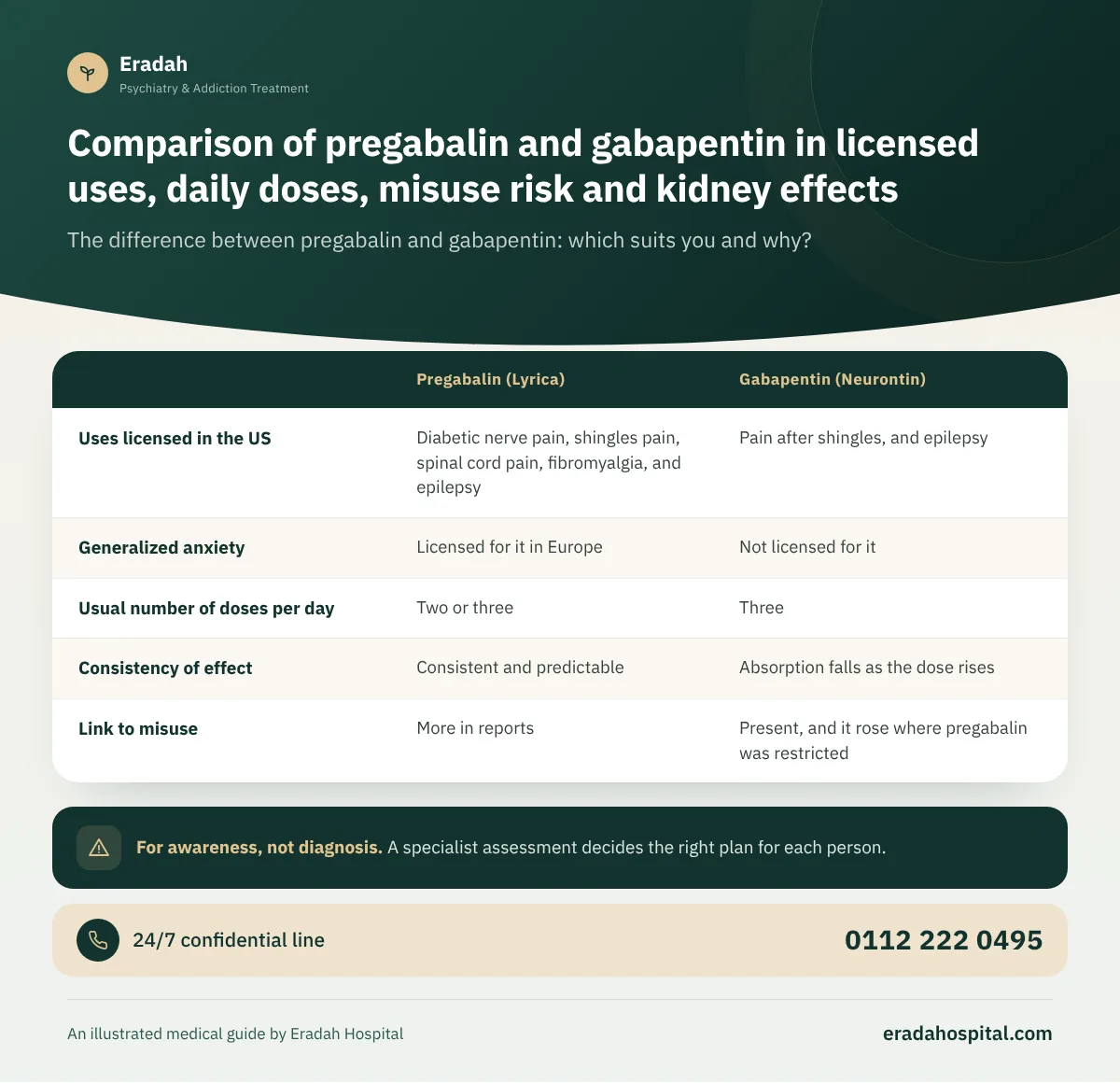
This comparison does not mean that one is better in every case. According to the same pharmacological comparison, pregabalin may be more effective at reducing epileptic seizures, and certain doses of it give pain relief close to the most gabapentin achieves for nerve pain. But British guidelines place both among the first-line options for nerve pain, and the doctor chooses according to the patient's response, tolerance and condition.
When does the doctor choose each one?
- When three daily doses are hard to keep up with: the doctor may lean toward pregabalin because its schedule is simpler.
- With a past history of opioids or misuse: the doctor weighs the risk carefully and may choose a drug from a completely different class.
- For generalized anxiety: pregabalin may be offered in countries that license it, after trying antidepressants, as the pregabalin for anxiety page explains.
- With reduced kidney function: both drugs need a dose adjustment calculated by the doctor.
- When there is no response or there are side effects: British guidelines recommend trying another drug from the first-line list.
What happened in Egypt after pregabalin was restricted?
A research paper published in 2025 in the journal PLoS One studied drug sales in Egypt between 2012 and 2023. After pregabalin was placed among the controlled drugs in August 2019, its sales fell by 99%, while gabapentin sales rose by 198%, and opioid sales rose by as much as 49.5% a year after the decision. The researchers concluded that the decision reduced pregabalin use but pushed a shift toward gabapentin.
The practical lesson is that gabapentin is not a “safe” way out for someone used to pregabalin. A systematic review published in 2026 found that both drugs are misused for therapeutic and non-therapeutic purposes, often with opioids or other substances, with growing evidence of this in the Middle East and North Africa. The causes of gabapentin addiction page covers this side.
Is it appropriate to switch between pregabalin and gabapentin?
Switching is medically possible, but it is not pill for pill. Differences in absorption make working out the equivalent amount a medical question, and the doctor may choose a direct or a gradual switch depending on the case. We give no doses here because they are a medical decision for a specific patient.
Shared warnings you should know
- The official US leaflets for both drugs warn of serious, potentially life-threatening respiratory depression when they are combined with nervous system depressants, including opioids, or in people with impaired breathing.
- Both drugs can cause dizziness and drowsiness, so avoid driving until you know how they affect you.
- Tell your doctor if you are pregnant, planning a pregnancy or breastfeeding.
- Epilepsy medications may be linked to suicidal thoughts in a small number of patients, so tell the doctor immediately about any worrying change in mood.
If use of either one turns into dependence, the treatment plans are similar, and you can find them in pregabalin addiction treatment and gabapentin addiction treatment. At Eradah the first consultation is free and confidential.
Danger signs after taking pregabalin: call an ambulance (123) immediately
- Deep drowsiness or difficulty waking.
- Slow or weak breathing, especially with tramadol, sedatives or alcohol.
- Severe confusion, unsteadiness or slurred speech.
- Swelling of the face, lips or tongue, or difficulty breathing.
- Seizures.
Call ambulance (123) immediately. If the person is unconscious but breathing, place them on their side so they do not choke on vomit. Stay with them and do not leave them alone. Do not give them food or drink, and tell the paramedics everything they took or used, and the amount and time if you know them.
Call the ambulance 123