Why are the harms of krokodil so severe?
A person who injects heroin injects a dangerous substance, but a person who injects krokodil injects a dangerous substance along with caustic chemical residues that were not removed. This difference is what makes krokodil images look different from images of any other opioid.
A 2013 review notes that the injected liquid may contain high concentrations of the substances used in preparation, and that they are responsible for both local and general harm. A 2015 review confirms that the severe symptoms are believed to result from toxic by-products formed during home preparation. In other words, the harm is not about the dose alone, but about every injection.
Krokodil harms to the skin and tissues
The 2015 review describes a wide range of serious signs in people who inject krokodil, including:
Inflammation and clotting in the veins at the injection site.
Open sores that may appear around the injection site and away from it.
Tissue dies from interrupted blood flow or inflammation, and the damage may extend deep.
Injuries can progress quickly to amputation of a limb.
A review published in 2017 describes these injuries as more severe and aggressive than those caused by morphine, and says they can reach the bone at the injection site. But a systematic review published in 2025 observed that well-documented cases of limb and skin injuries are few compared with what is circulated, and called for more rigorous studies.
Jaw bone erosion: the best-documented krokodil harm
In a systematic review published in 2019 that covered 13 studies describing 684 patients, 11 of the studies addressed jawbone death, describing it as a serious, disfiguring harm, along with changes in the lining of the mouth and a higher risk of tooth decay and gum disease. In the more recent 2025 systematic review, 247 of the 251 cases included involved death of facial bones, which makes the jaw the most documented harm of krokodil in the medical literature. Treating it often requires surgery.
Krokodil harms to the body's organ systems
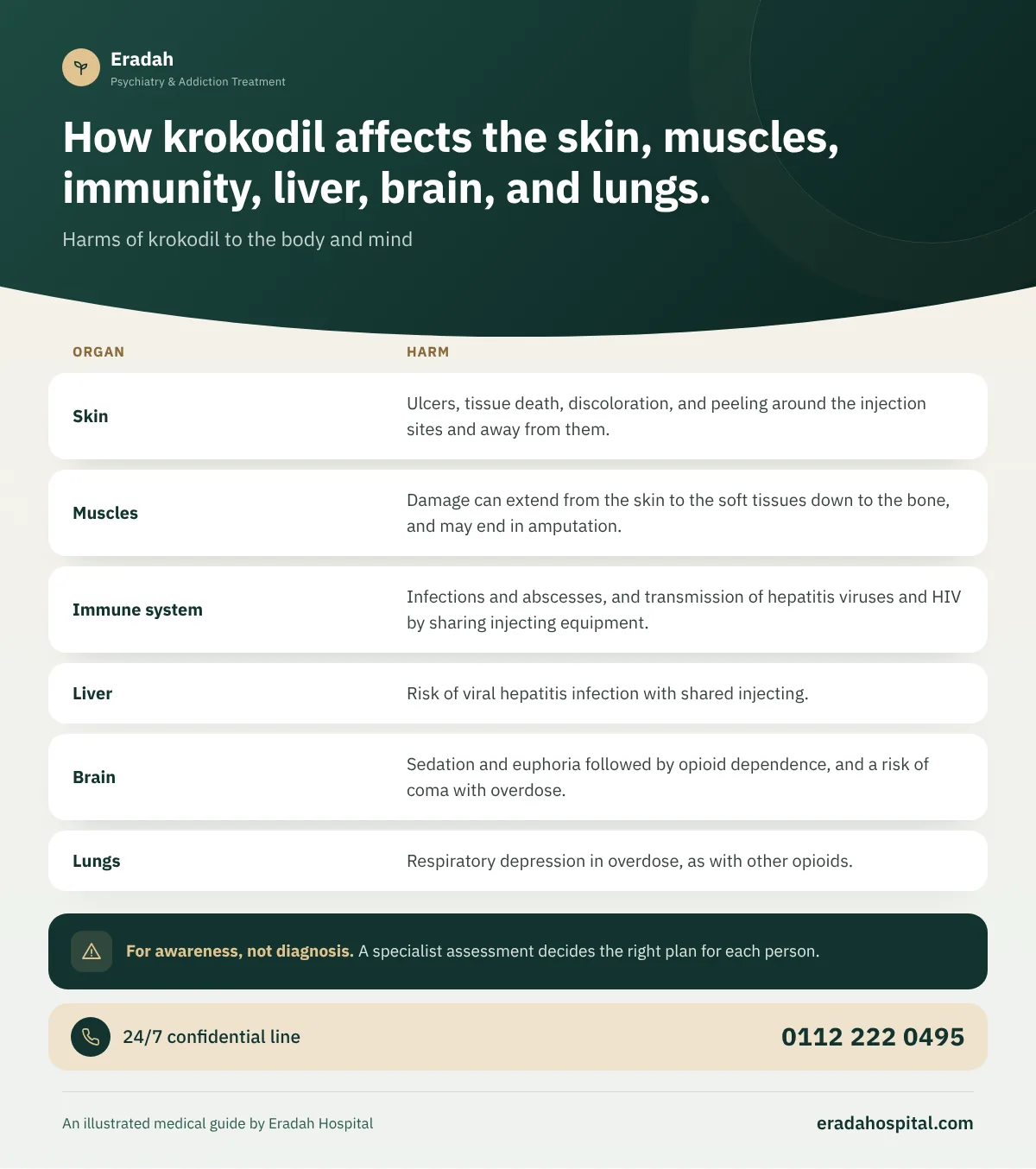
| Organ | Harm |
|---|---|
| Skin | Ulcers, tissue death, discoloration, and peeling around the injection sites and away from them. |
| Muscles | Damage can extend from the skin to the soft tissues down to the bone, and may end in amputation. |
| Immune system | Infections and abscesses, and transmission of hepatitis viruses and HIV by sharing injecting equipment. |
| Liver | Risk of viral hepatitis infection with shared injecting. |
| Brain | Sedation and euphoria followed by opioid dependence, and a risk of coma with overdose. |
| Lungs | Respiratory depression in overdose, as with other opioids. |
Infection: the risk that accompanies every injection
The 2013 review places the appearance of krokodil in the context of an “interlinked epidemic” in the region of drug injecting, HIV, hepatitis C, tuberculosis, and sexually transmitted infections. Repeated injecting with shared or unsterilized equipment opens the door to infection, open wounds raise the risk, and infection may spread to the blood and become life-threatening.
Overdose and addiction
Desomorphine is an opioid, so it carries the overdose risk that opioids carry, which can stop breathing according to NIDA. And because the mixture is prepared at home, no one knows its concentration, so the strength of an injection can differ from one time to the next. With repetition dependence develops, and a 2012 review describes desomorphine as highly likely to cause dependence, with withdrawal similar to heroin withdrawal.
Stigma: an invisible harm that adds to the visible ones
The 2013 review noted that the link between health care and law enforcement, and stigma and mistreatment by some care providers, can keep people who use drugs from seeking medical help in time. The result is that a wound that could have been treated turns into an amputation. This is why humane, non-judgmental treatment is part of care, not a courtesy.
Can krokodil harms be treated?
Many wounds improve with early medical care and stopping injecting, while advanced bone and tissue damage may need surgery. Most importantly, the addiction itself must be treated in parallel, otherwise the wounds return with the first injection. This includes supervised detox, then opioid addiction treatment and long-term follow-up, with testing for hepatitis viruses and HIV.
Danger signs after using krokodil: call an ambulance (123) immediately
- Slow, shallow, or stopped breathing, or no response when called
- Pinpoint pupils with blue lips and fingernails and cold skin
- A wound that is spreading quickly, turning black, or giving off a foul smell
- Fever and chills with severe pain or swelling in a limb
- Exposed bone in the mouth, or severe facial swelling with fever
Call an ambulance on 123 immediately. If the person is unconscious but breathing, place them on their side (recovery position) so they do not choke on vomit, stay with them and do not leave them alone, and give them nothing by mouth. Tell the paramedics that they injected a home-made substance and any other substances they used. Infected wounds cannot wait: seek medical care the same day.
Call the ambulance 123