How does the body clear lorazepam?
How long lorazepam stays in the body is intermediate among benzodiazepines, but the way the body clears it is what makes it a special case in testing.
According to the Ativan label, the body absorbs about 90% of the dose and it peaks in the blood after about two hours, then the liver quickly binds it to glucuronic acid to make an inactive substance called lorazepam glucuronide, which leaves in the urine. Lorazepam's half-life is about 12 hours, and that of its metabolite about 18 hours. The StatPearls review says 94% to 97% of a drug is eliminated after 4 to 5 half-lives, which for lorazepam is about two to three days in most adults.
How long lorazepam works compared with how long it stays
The UK's National Health Service states that the calming effect lasts about 6 to 8 hours, much shorter than the time the drug stays in the body. So the feeling of calm may wear off while the drug remains in the blood, and it may accumulate if doses are repeated.
Does lorazepam show up on a drug test?
| Rapid benzodiazepine strip | Precise laboratory test | |
|---|---|---|
| Does it detect it? | It may not, especially strips aimed at diazepam metabolites | Yes, with instruments such as LC-MS/MS |
| Cause | Lorazepam is not converted to oxazepam and leaves bound to glucuronide | Measures the drug itself accurately |
| Detection time in urine | Not reliable | Up to 6 days after a single dose in a small study |
| When is it used? | Initial assessment | Confirmation, forensic work, and poisoning cases |
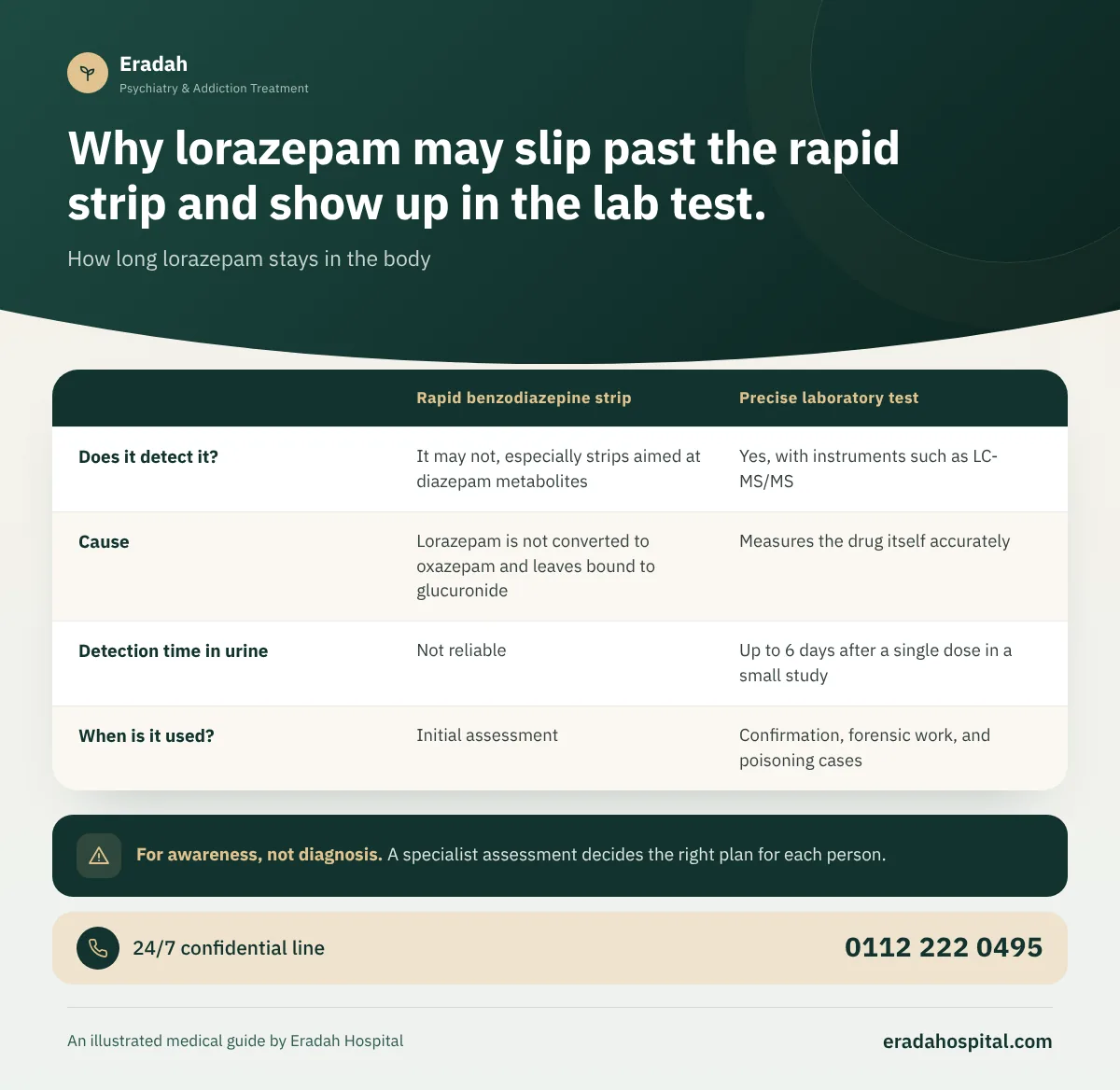
The StatPearls review of drug testing explains that the benzodiazepine immunoassay mostly targets oxazepam, so it is expected to give a negative result with benzodiazepines that are not converted to it, including lorazepam, clonazepam, and alprazolam. False negatives on rapid strips have been reported despite confirmed lorazepam poisoning, including two cases of children in France and an overdose case in the United States.
How long does lorazepam stay in urine, saliva, and hair?
- Urine: in a French study in which volunteers took a single dose, lorazepam stayed detectable in urine throughout the follow-up period of 144 hours, or 6 days, by LC-MS/MS, and peaked at 24 hours.
- Saliva: in the same study it appeared in saliva for up to 8 hours.
- Hair: the researchers could not detect a single dose in hair despite the instrument's high sensitivity, unlike most other benzodiazepines.
- Blood: useful mainly in the first hours and days and in assessing poisoning cases.
These figures reflect a single dose in a small number of volunteers; with long daily use the detection time may be longer.
What factors affect how long lorazepam stays?
- Length of use and amount: daily use and higher doses lengthen detection.
- Age: the label states that age does not much change how it is cleared, with a slight drop in clearance in some older adults.
- Liver and kidneys: diseases of these organs may change the clearance of the drug and its metabolites.
- Type of test: the biggest factor, because some strips do not detect it at all.
What if you take lorazepam by prescription?
Tell the lab about the medication before the test and keep the prescription. If an unexpected result appears, negative or positive, ask for a confirmatory test that identifies the substance by name. You will find broader details in the guide to medications that show up on drug tests.
The role of testing in poisoning cases
In an emergency, doctors do not wait for a test to begin treatment, and a negative strip result does not rule out lorazepam poisoning. So telling paramedics what the person took and bringing the medication box matters more than any test, and you will find what to do in the guide to overdose.
What does a test result mean for the family?
A positive test proves the presence of the drug, not addiction, and a negative result on a rapid strip does not rule out lorazepam use. It is more useful to observe behavior and mood and ask for a medical assessment, as the guide to lorazepam addiction symptoms explains.