Why do lorazepam withdrawal symptoms happen?
Lorazepam withdrawal symptoms are the voice of a brain that grew used to relying on an external sedative to restrain its activity, then lost it suddenly before it regained the ability to calm itself.
The drug label explains that continued use may cause clinically significant physical dependence, and that the risk of dependence and withdrawal rises with longer treatment and a higher daily dose. Ashton's manual states that lorazepam is considered a potent benzodiazepine and that the body clears it relatively quickly, so some users go through a mini-withdrawal even between doses.
Lorazepam withdrawal timeline
This is an approximate timeline of what may happen with sudden stopping after long use, which we never recommend:
- While usingWithdrawal between doses
Anxiety and craving for the drug before dose time in some users.
- Within 2 to 10 daysAcute withdrawal
Anxiety, insomnia, tremor, sweating, palpitations, and nausea, with a risk of seizures in severe cases.
- The following weeksGradual decline
Physical symptoms ease gradually, while anxiety, sleep disturbance, and poor concentration remain.
- After 4 to 6 weeksProtracted withdrawal
In some people, symptoms of anxiety, insomnia, numbness and tingling, and tinnitus continue, and may last weeks or more than 12 months.
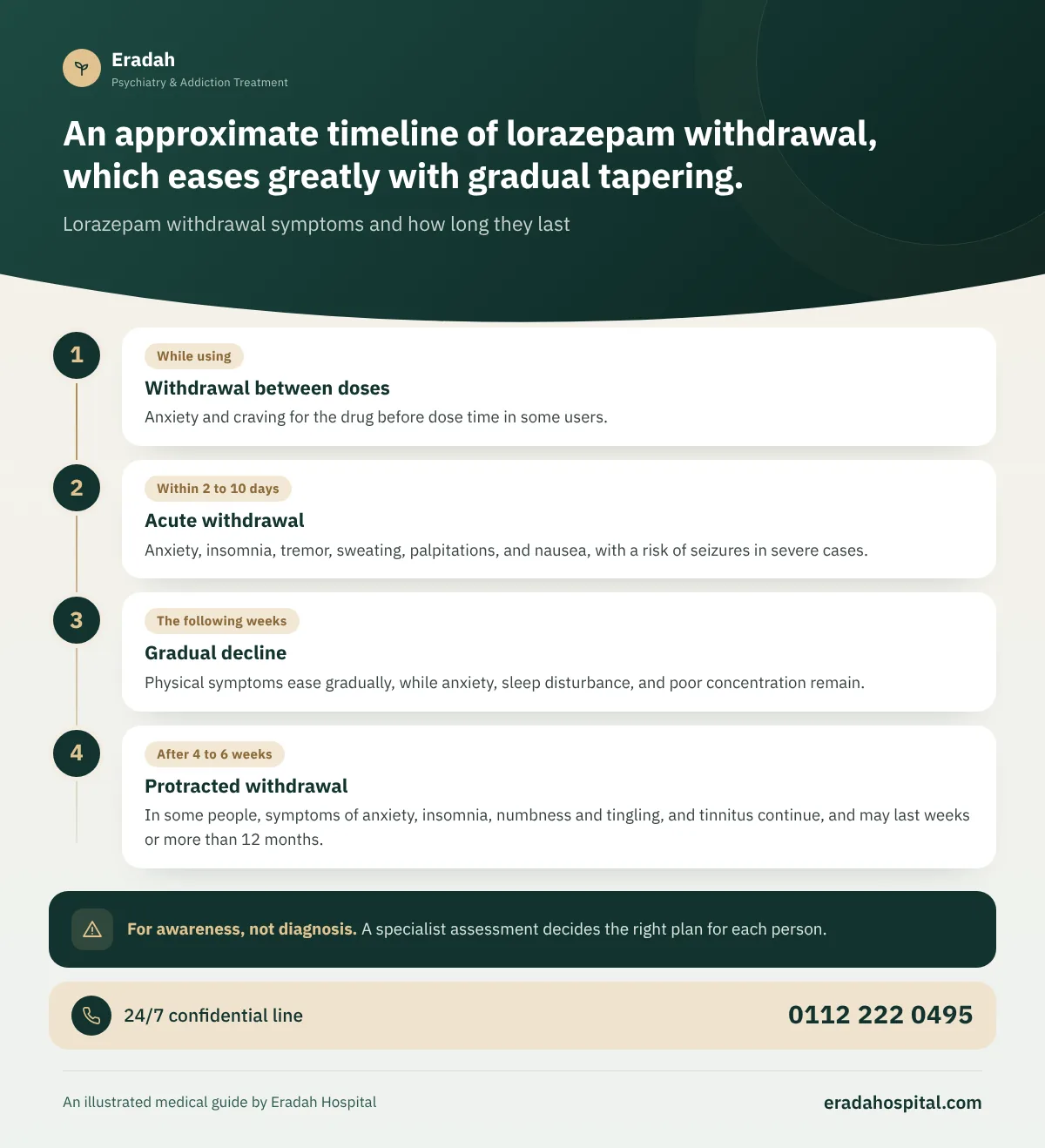
The 2 to 10 day window is from StatPearls for sedative withdrawal in general, and protracted withdrawal is from the Ativan label and the US Food and Drug Administration.
What are the symptoms of lorazepam withdrawal?
| Type | Symptoms |
|---|---|
| Psychological | Anxiety, panic attacks, irritability, depression, and a sense of unreality about oneself or the world. |
| Physical | Tremor, sweating, headache, aches and muscle stiffness, palpitations and high blood pressure, nausea, vomiting, and diarrhea. |
| Sensory | Extreme sensitivity to light and sound, blurred vision, and dizziness. |
| Sleep and memory | Severe insomnia and impaired memory and concentration. |
| Severe and dangerous | Seizures, delirium, hallucinations, psychosis, and suicidal thoughts. |
This list is taken from the US Ativan label. Any thoughts of self-harm during withdrawal call for seeking help immediately through the mental health support line 16328 or ambulance (123).
Is lorazepam withdrawal dangerous?
Yes, and it can be life-threatening. The US boxed warning states explicitly that stopping lorazepam suddenly or reducing it rapidly after continued use can cause severe withdrawal reactions that may be life-threatening, and the StatPearls review describes benzodiazepine withdrawal as potentially life-threatening and requiring serious management.
What is protracted withdrawal from lorazepam?
The US Food and Drug Administration describes protracted withdrawal as symptoms that continue beyond 4 to 6 weeks after stopping, including anxiety, impaired cognition, depression, insomnia, numbness and tingling, tinnitus, and motor symptoms such as weakness and tremor, which may last weeks to 12 months. Ashton's manual estimates that about 10% to 15% of long-term users may go through what is called “post-withdrawal syndrome.” What matters is that these symptoms usually improve with time, and knowing this prevents despair and a return to the drug.
Withdrawal anxiety or return of the original anxiety?
After stopping it can be hard to tell temporary withdrawal anxiety from the return of an anxiety disorder that the drug had been covering. The drug label points out how hard it is to make this distinction in protracted withdrawal. The deciding factor is follow-up over time with a psychiatrist, because each case needs different treatment.
Who is most at risk of severe withdrawal?
People who take higher doses or take them more often, according to the drug label.
The longer the period of use, the greater the risk of withdrawal.
Overlapping alcohol and sedative withdrawal raises the risk of seizures and delirium.
They need slower tapering, closer follow-up, and a shared decision with the doctor.
You will find the safe tapering plan on the page for lorazepam addiction treatment, and details of detox in the guide to medically supervised detox.
How can the family support someone going through lorazepam withdrawal?
- Understand that irritability and insomnia are part of withdrawal, not an attitude toward you.
- Help them stick to the taper plan as the doctor set it.
- Provide a calm environment and cut back on caffeine at home.
- Watch for any seizure or severe confusion and call ambulance (123) immediately.
- Remind them that protracted symptoms improve with time.
Danger signs after taking lorazepam: call an ambulance (123) immediately
- Extreme drowsiness from which the person cannot be roused, or a coma.
- Slow or weak breathing, or blue lips.
- Severe confusion, unintelligible speech, or unsteadiness so bad that they cannot stand.
- Taking it with an opioid painkiller, alcohol, or another sedative.
- A seizure or hallucinations after suddenly stopping it.
Call ambulance (123) immediately and do not wait for them to “sleep it off.” If the person is unconscious but breathing, place them on their side in the recovery position, stay with them and watch their breathing until the paramedics arrive, and do not give them any sedative, stimulant or food. Tell the paramedics what they took, the approximate amount and the time, bring the medicine box if you find it, and tell them if the person also drank alcohol or took an opioid painkiller.
Call the ambulance 123