What is lorazepam?
“The doctor prescribed it for only two weeks for my anxiety, and for a year now I haven't been able to sleep without it.” This sentence sums up the story of many lorazepam users: an effective medicine that calms anxiety quickly, but one designed for short-term use, and when it goes on too long without follow-up it turns from a treatment into a habit that is hard to break.
Lorazepam is a medicine from the benzodiazepine family, the same family that includes Xanax, Valium, and Rivotril. Its best-known brand name worldwide is “Ativan.” According to the US Food and Drug Administration, lorazepam alone accounted for about 20% of benzodiazepine prescriptions dispensed in the United States in 2019, which makes it one of the most widely used members of this family.
What sets lorazepam apart is that the liver clears it by attaching it directly to a substance that makes it inactive, without turning it into long-lasting active products as happens with Valium. For this reason doctors may prefer it in certain cases, such as some older adults or people with liver disease, a decision that is theirs alone.
When does a doctor prescribe lorazepam?
- Severe anxiety for a short period, until a long-term treatment such as antidepressants or psychotherapy starts to work.
- Insomnia linked to anxiety.
- Calming before surgery, medical procedures, and dental treatment.
- Prolonged seizures, for which it is given by injection in hospital.
- Agitation accompanying alcohol withdrawal under a medical protocol, with details in the guide to alcohol withdrawal symptoms.
The UK National Health Service says it is not advised for more than 4 weeks, and that the chance of addiction is small with a low dose taken for a short time, from two to four weeks. Its US label states that its effectiveness in long-term use beyond 4 months has not been evaluated in systematic studies, and that the doctor should periodically reassess its benefit.
How does lorazepam affect the brain?
Lorazepam strengthens the effect of GABA, the chemical messenger responsible for calming brain activity. According to its label, the body absorbs about 90% of it, it peaks in the blood after about two hours, and its half-life is about 12 hours. The UK National Health Service states that its sedative effect begins within 20 to 30 minutes and lasts about 6 to 8 hours. The result is:
- Rapid calming of anxiety and physical tension, which is both the reason it helps and the reason people become attached to it.
- Drowsiness, its most common side effect.
- Impaired memory for what happens after taking it, an effect that is put to use before surgery but is troublesome in daily life.
- Muscle relaxation and prevention of spasms and seizures, which is why it is used by injection in seizures.
Forms and names of lorazepam
Lorazepam comes as tablets and a drinkable liquid, and is given by injection in hospitals only. MedlinePlus also mentions extended-release capsules in some countries. Its brand names include Ativan, and the available names differ from country to country. It has no common street names, but it is sometimes sold outside pharmacies, and the contents of those tablets cannot be verified.
Why is lorazepam misused?
- Staying on it for months after the crisis it was prescribed for has passed.
- Using it to numb everyday anxiety instead of treating it.
- Raising the dose on one's own after its effect weakens.
- Mixing it with alcohol, painkillers, or other substances in search of a “buzz.”
- Believing it is safe because it is a prescription medicine.
The medicine label warns that use as prescribed can also expose some patients to the risk of misuse, and that most serious cases and deaths occur when a benzodiazepine is combined with other medicines, alcohol, or illicit substances. The US agency states that about 5.4 million Americans aged 12 and older misused benzodiazepines in 2018.
Lorazepam compared with Xanax and Valium
| Lorazepam | Xanax | Valium | |
|---|---|---|---|
| Approximate half-life | 10 to 20 hours | 6 to 12 hours | 20 to 100 hours, and longer for its active product |
| Best-known uses | Anxiety, calming, and stopping seizures by injection | Anxiety and panic attacks | Anxiety, spasms, and some cases of alcohol withdrawal |
| How the liver clears it | Direct attachment with no active products | Through liver enzymes | Through liver enzymes with a long-lasting active product |
| Dependence risk | High with daily use | High and appears quickly | Present, and withdrawal is slow to appear |
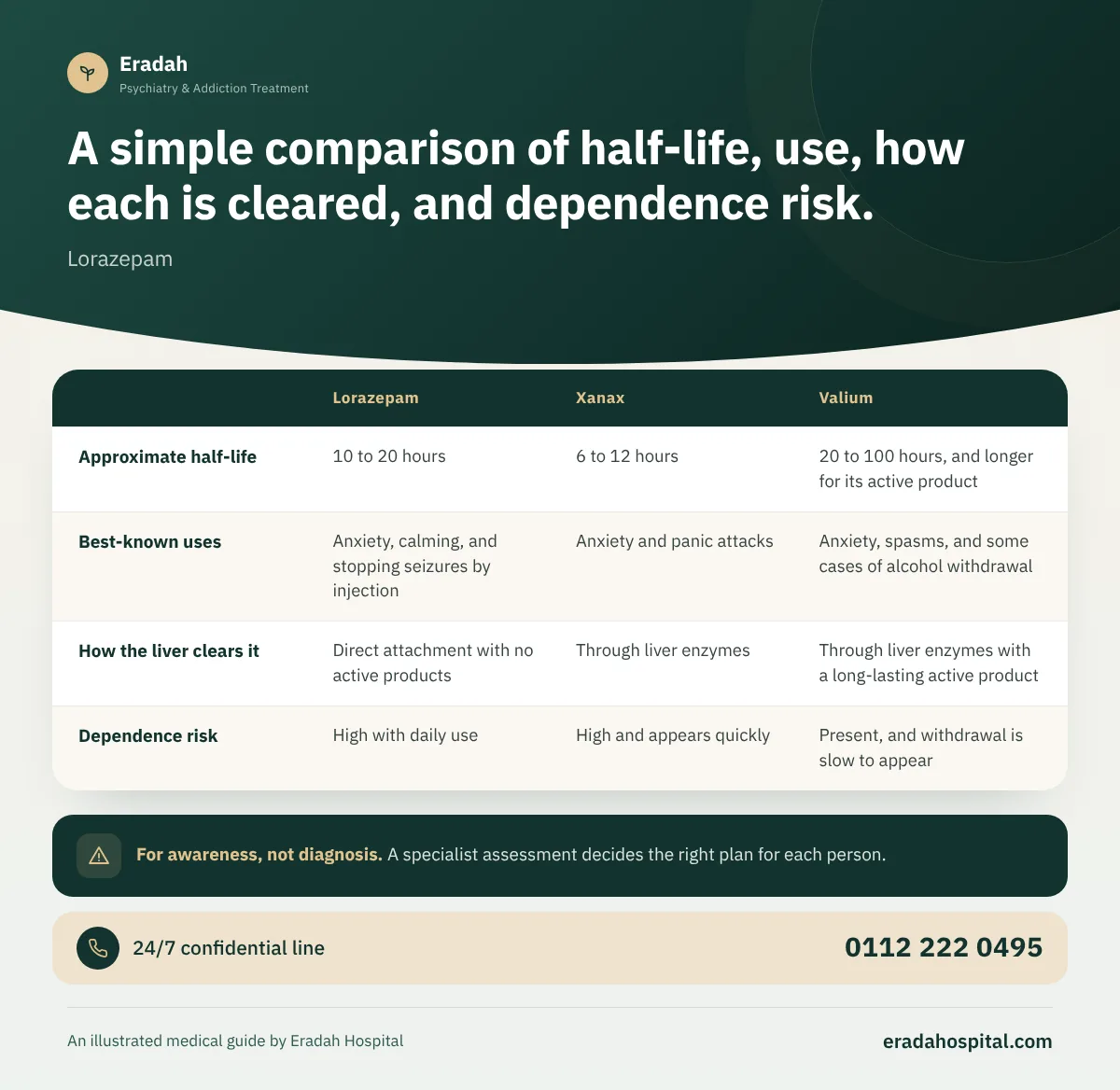
Half-lives are from Professor Heather Ashton's guide to benzodiazepines and are approximate.
The legal status of lorazepam in Egypt
Lorazepam is a prescription-only medicine, and dispensing or trading in it outside medical settings is an offense. In the United States its label lists it under Schedule IV of controlled substances, and in 2020 the Food and Drug Administration required a boxed warning on abuse, dependence, and withdrawal for all benzodiazepines. For anyone who needs help, the Fund for Drug Control and Treatment of Addiction offers the hotline 16023.
This is general educational information and not legal advice.
Lorazepam in numbers
Sources: US Food and Drug Administration 2020, and the US Ativan label.
Lorazepam in brief: harms, symptoms, withdrawal, and treatment
Drowsiness, memory problems, and falls, and fatal respiratory depression when combined with opioids or alcohol.
Rising doses, running out of the prescription early, slurred speech and forgetfulness, and severe anxiety before the dose.
Anxiety, insomnia, and tremor, possibly progressing to seizures, and sometimes symptoms lasting for months.
Slow, gradual dose reduction, sometimes switching to a longer-acting sedative, along with treatment of the underlying anxiety.
Each topic has a detailed page: lorazepam harms, symptoms of lorazepam addiction, lorazepam withdrawal symptoms, lorazepam addiction treatment, and how long lorazepam stays in the body.
The lorazepam guide: everything you need to know
We have gathered everything about lorazepam into 5 pages, each answering one question in detail. Choose what you are looking for:
Harms of lorazepam to the body and mind
Learn about lorazepam harms: drowsiness, memory problems and falls, its effect on older adults, pregnancy, and breastfeeding, and why mixing it with opioids or alcohol is life-threatening.
Lorazepam addiction symptoms and signs of use
What are the symptoms of lorazepam (Ativan) addiction? The physical, behavioral, and psychological signs, the difference between dependence on a prescribed medicine and addiction, and how a family can talk to the person who is struggling.
Lorazepam withdrawal symptoms and how long they last
Lorazepam (Ativan) withdrawal symptoms: when they start and how long they last, the risk of seizures and delirium, withdrawal lasting for months, and why gradual dose reduction under medical supervision is necessary.
Lorazepam addiction treatment: stages and duration
How is lorazepam (Ativan) addiction treated? Assessment, slow gradual dose reduction or switching to a longer-acting sedative, treatment of the underlying anxiety, how long treatment takes, and when residential care is needed.
How long lorazepam stays in the body
How long does lorazepam stay in the body? Its half-life, how long it can be detected in urine, saliva, and hair, why it may not show up on a rapid benzodiazepine test strip, and what prolongs its stay.
Do you suspect a family member is dependent on lorazepam?
- Remember that many people started it with a prescription, so begin with questions and understanding, not accusations.
- Notice: do the tablets run out before they should? Are they taking it with alcohol or painkillers?
- Do not suddenly stop them taking it and do not hide the tablets; abrupt stopping can cause seizures.
- Encourage them to see a psychiatrist who will treat the anxiety itself and set up a safe reduction plan.
- Learn the emergency signs and the ambulance number, 123, especially when it is mixed with opioids.
Danger signs after taking lorazepam: call an ambulance (123) immediately
- Extreme drowsiness from which the person cannot be roused, or a coma.
- Slow or weak breathing, or blue lips.
- Severe confusion, unintelligible speech, or unsteadiness so bad that they cannot stand.
- Taking it with an opioid painkiller, alcohol, or another sedative.
- A seizure or hallucinations after suddenly stopping it.
Call ambulance (123) immediately and do not wait for them to “sleep it off.” If the person is unconscious but breathing, place them on their side in the recovery position, stay with them and watch their breathing until the paramedics arrive, and do not give them any sedative, stimulant or food. Tell the paramedics what they took, the approximate amount and the time, bring the medicine box if you find it, and tell them if the person also drank alcohol or took an opioid painkiller.
Call the ambulance 123