Stage one: assessment
Lorazepam addiction treatment starts with a simple question: why was the drug started? The anxiety, panic, or insomnia it was prescribed for is often still there, and if not treated it will return as soon as the drug is stopped.
- The actual dose, length of use, and how many times a day it is taken.
- Alcohol, opioid painkillers, and other sedatives.
- A history of seizures or earlier withdrawal symptoms.
- Accompanying disorders such as panic attacks or depression.
Stages of lorazepam addiction treatment
- The startAssessment and planning
A comprehensive examination and deciding the right place of treatment and the speed of reduction.
- The first weeksStabilization or switching
Stabilizing the dose, and sometimes switching to a longer-acting benzodiazepine by the doctor's decision.
- Weeks to monthsGradual reduction
Slow reduction in stages with monitoring of symptoms and adjusting the speed when needed.
- In parallelTreating the original anxiety
Cognitive behavioral therapy and medications that do not cause dependence.
- After stoppingRelapse prevention
Regular follow-up and a plan for handling anxiety attacks without going back to the sedative.
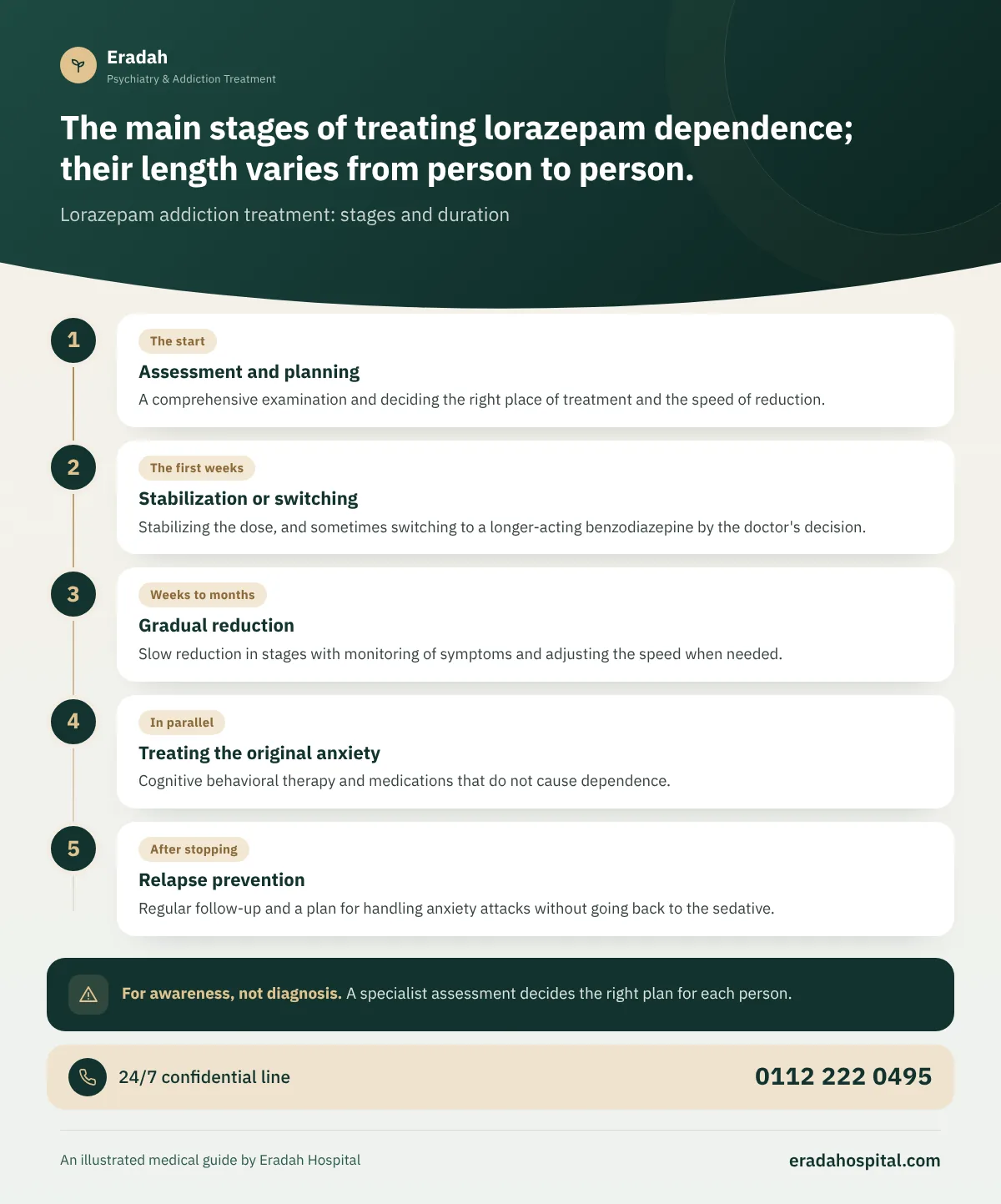
Durations are approximate and vary widely with the dose and length of use.
Why do doctors sometimes switch to diazepam?
Professor Ashton's manual explains that benzodiazepines the body clears relatively quickly, such as lorazepam, do not allow a smooth fall in their blood level, so the user goes through a “mini-withdrawal” and sometimes a craving for the drug between doses. For this reason the manual recommends switching to a long-acting, slowly cleared benzodiazepine such as diazepam, then reducing it gradually. The StatPearls review notes that using a long-acting benzodiazepine with a slow taper is one of the approaches used in outpatient treatment.
The US boxed warning stresses using a gradual taper when stopping lorazepam or lowering its dose, because stopping suddenly or reducing quickly can cause severe withdrawal reactions that may be life-threatening.
How long does lorazepam addiction treatment take?
There is no single duration. Ashton's manual says the length of the taper, whether six, twelve, or eighteen months, matters little for someone who has used benzodiazepines for years; the main thing is to get there safely. Someone who has used it for only a few weeks may need a much shorter plan set by the doctor.
Psychological therapy during and after the taper
Cognitive behavioral therapy teaches the patient how to deal with anxiety without a tablet: understanding its physical symptoms, gradually facing the situations they avoid, and reorganizing their sleep. Because anxiety is often the original cause, successful treatment combines coming off the sedative with treating generalized anxiety disorder or panic within a dual diagnosis program.
Outpatient or residential?
| The situation | Most suitable setting |
|---|---|
| Dependence on a prescribed dose with no other substances | Outpatient treatment with regular follow-up |
| High doses or use from multiple sources | Closer follow-up, and a residential stay may be needed to start the taper |
| A history of seizures or severe withdrawal | Medically supervised detox |
| Mixing with alcohol or opioids | A comprehensive residential program |
Treating lorazepam dependence in older adults
Older adults are more sensitive to sedation and falls, and withdrawal in them may take the form of confusion. So the taper is slower, follow-up closer, and all other medications are reviewed. Stopping a sedative safely often improves their concentration and balance.
Relapse prevention after quitting lorazepam
- Keep a written plan for what to do during an anxiety attack.
- Do not keep old tablets at home.
- Avoid alcohol, since it increases anxiety in the long run.
- Continue psychological therapy even after improvement.
- See your doctor as soon as symptoms return instead of going back to the medication.
Lorazepam addiction treatment at Eradah
The journey at Eradah begins with a free, confidential first consultation in which the psychiatrist assesses the anxiety, the medication, and any other substances, then sets an individual taper plan with cognitive behavioral therapy sessions. Most cases are treated in outpatient clinics, while cases of high doses or mixing are admitted to the psychiatric hospital for men with round-the-clock supervision.