Stage one: assessment
Treating Night Calm addiction does not begin by taking the box away. It begins with understanding the whole story: why the medication was started, how the use developed, and what stands in the way of sleeping without it.
The 2025 guidelines of the Brazilian Academy of Neurology on Z-drug dependence recommend that any discontinuation be preceded by a comprehensive assessment of the person’s mental state, sleep disorders and coexisting conditions, and degree of dependence on the medication. In practice this includes:
- How long it has been used and the actual dose, not only the prescribed one.
- Any use of alcohol, painkillers or other sedatives.
- Untreated depression, anxiety or panic attacks.
- Other sleep disorders such as sleep apnea, which a sleeping pill does not treat and may make worse.
Stages of Night Calm addiction treatment
- The first weekAssessment and planning
A full examination, working out the real dose, and agreeing on a clear goal and a suitable pace of reduction.
- The first weeksGradual reduction
A slow reduction set by the doctor, with monitoring of sleep, anxiety and any withdrawal symptoms.
- In parallelBehavioral treatment of insomnia
Sessions of cognitive behavioral therapy for insomnia, and regulating sleep and wake times.
- After stoppingTreating what lies behind the insomnia
Treating anxiety or depression with non-habit-forming medications and psychotherapy.
- The following monthsRelapse prevention
Regular follow-up and a plan for handling hard nights without going back to the tablets.
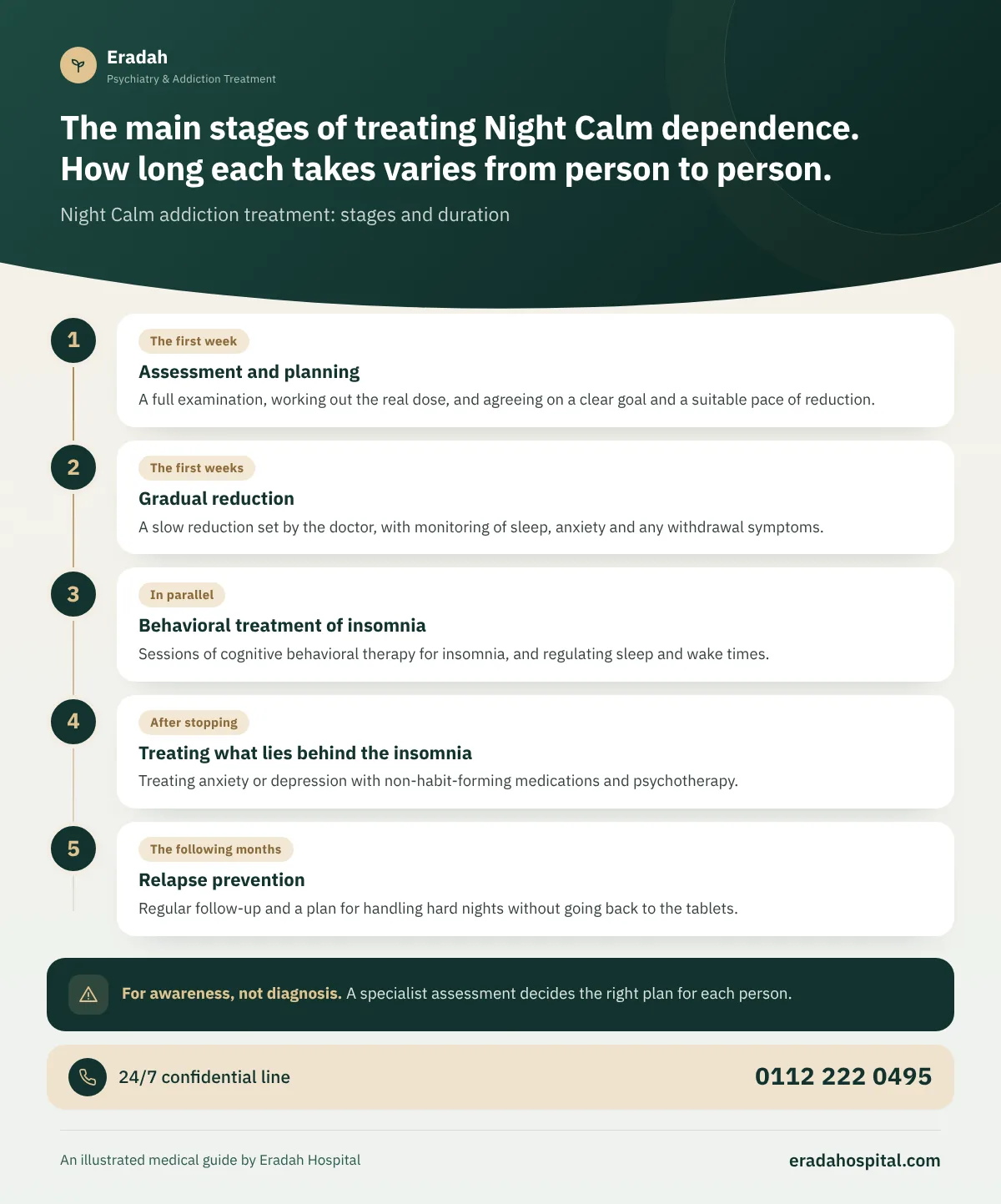
Time frames are approximate and vary with how long the medication was used, the dose, and whether other substances are involved.
Why gradual tapering rather than abrupt discontinuation?
The eszopiclone leaflet warns that withdrawal symptoms can appear with sudden discontinuation or rapid reduction, and MedlinePlus lists among them anxiety, unpleasant dreams, cramps, nausea, sweating and tremor, and rarely seizures. Gradual reduction gives the brain time to reset and reduces the rebound insomnia that drives many people back to the medication. The Brazilian guidelines recommend gradual reduction and note that, in some cases of Z-drug dependence, the doctor may temporarily switch the patient to an intermediate- or long-acting benzodiazepine and then reduce it, while advising against short-acting benzodiazepines. These are purely medical decisions made after an assessment.
Cognitive behavioral therapy for insomnia: does it help you stop the sleeping pill?
Cognitive behavioral therapy for insomnia is a structured program that rebuilds a person’s relationship with the bed and with sleep: a fixed wake-up time, not lying awake in bed for long periods, and adjusting the thoughts that magnify the fear of “I won’t sleep.” The Brazilian guidelines recommend it as part of a plan to come off Z-drugs.
Because honesty is part of treatment: a systematic review published in 2026 found that the evidence that this therapy alone raises the rate of fully stopping sleeping pills is still uncertain. However, it reduced the severity of insomnia after treatment in the small trials available, and the researchers considered it useful as part of an individual reduction plan. In other words, it does not replace medical supervision, but it makes the road easier. You will find details in the guide to treating chronic insomnia.
Treating coexisting anxiety and depression
Many people who depend on Night Calm are, without realizing it, using it to treat chronic anxiety or depression that shows up as insomnia. If the cause is not treated, the insomnia returns, and with it the return to the tablets. That is why successful treatment combines coming off the sleeping pill with treating the underlying disorder in a dual diagnosis program, using non-habit-forming medications and regular psychotherapy.
Outpatient or residential?
| The situation | Most suitable setting |
|---|---|
| Dependence on Night Calm alone at a dose close to the prescribed one | Outpatient treatment with regular follow-up |
| Doses far above the prescribed amount, or daytime use | Closer follow-up, and a short stay may be needed |
| Mixing with alcohol, opioids or other sedatives | Medically supervised detox followed by a residential program |
| Severe depression or thoughts of self-harm | Urgent assessment at a psychiatric hospital |
How long does Night Calm addiction treatment take?
There is no single timeline for everyone. Someone who used it for a few weeks may finish reducing in a short time, while someone who used it for years or at high doses needs weeks to months, followed by several months of follow-up after stopping. What matters is that the pace is set by the patient’s comfort and safety, not by a fixed date.
Preventing relapse after coming off Night Calm
- Keep a steady sleep routine, even on vacation.
- Do not keep “spare” tablets at home.
- Agree with your doctor in advance on what to do on a hard night of insomnia.
- Cut back on caffeine after the afternoon and avoid alcohol completely.
- See the doctor as soon as anxiety or low mood returns, rather than going back to the sleeping pill.
You will find the signs of relapse and how to deal with them in the guide to relapse.
Treatment for Night Calm dependence at Eradah
At Eradah, treatment begins with a free, confidential first consultation in which the psychiatrist assesses the sleep, the medication and what lies behind them. The doctor then sets an individual reduction plan with sessions of behavioral therapy for insomnia, plus treatment for anxiety or depression if present. Most cases are managed in outpatient clinics, while cases involving mixing or high doses are admitted to the psychiatric hospital for men, with round-the-clock supervision.