How does the body get rid of Night Calm?
How long Night Calm stays in the body differs from how long it works and from how long it shows up on a test, and confusing the three is the source of most questions.
According to the official label, eszopiclone is absorbed quickly and peaks in the blood within about an hour, then the liver converts it, through the enzymes CYP3A4 and CYP2E1, into metabolites that are mostly weak or inactive. Less than 10% of it leaves unchanged in the urine, while the larger part leaves as breakdown products.
The StatPearls review on half-life says that 94% to 97% of a drug is eliminated after 4 to 5 half-lives. Applying this rule to a half-life of about 6 hours, a healthy adult clears most of the eszopiclone in roughly a day and a half, and the time is longer in older adults and people with liver disease.
How long Night Calm acts compared with how long it stays
The intended sleep-inducing effect lasts through the night hours, but the unintended effect may linger beyond it: in a study cited by the official label, impairment of memory and motor skills was still present 11.5 hours after taking the highest strength. In other words, a person may wake up feeling alert while their ability to drive is still weaker than usual.
Does Night Calm show up on a drug test?
| Usual rapid test | Specialized laboratory test | |
|---|---|---|
| Does it detect it? | Usually not, unless it includes a strip designed for zopiclone | Yes, with instruments such as LC-MS/MS |
| What does it measure? | The presence of a predetermined group of substances | The drug and its breakdown products, precisely |
| Detection time in urine | Not fixed; depends on the type of strip | May reach 6 days or more after a single dose |
| When is it used? | Quick initial screening | Confirmation, forensic work, and poisoning cases |
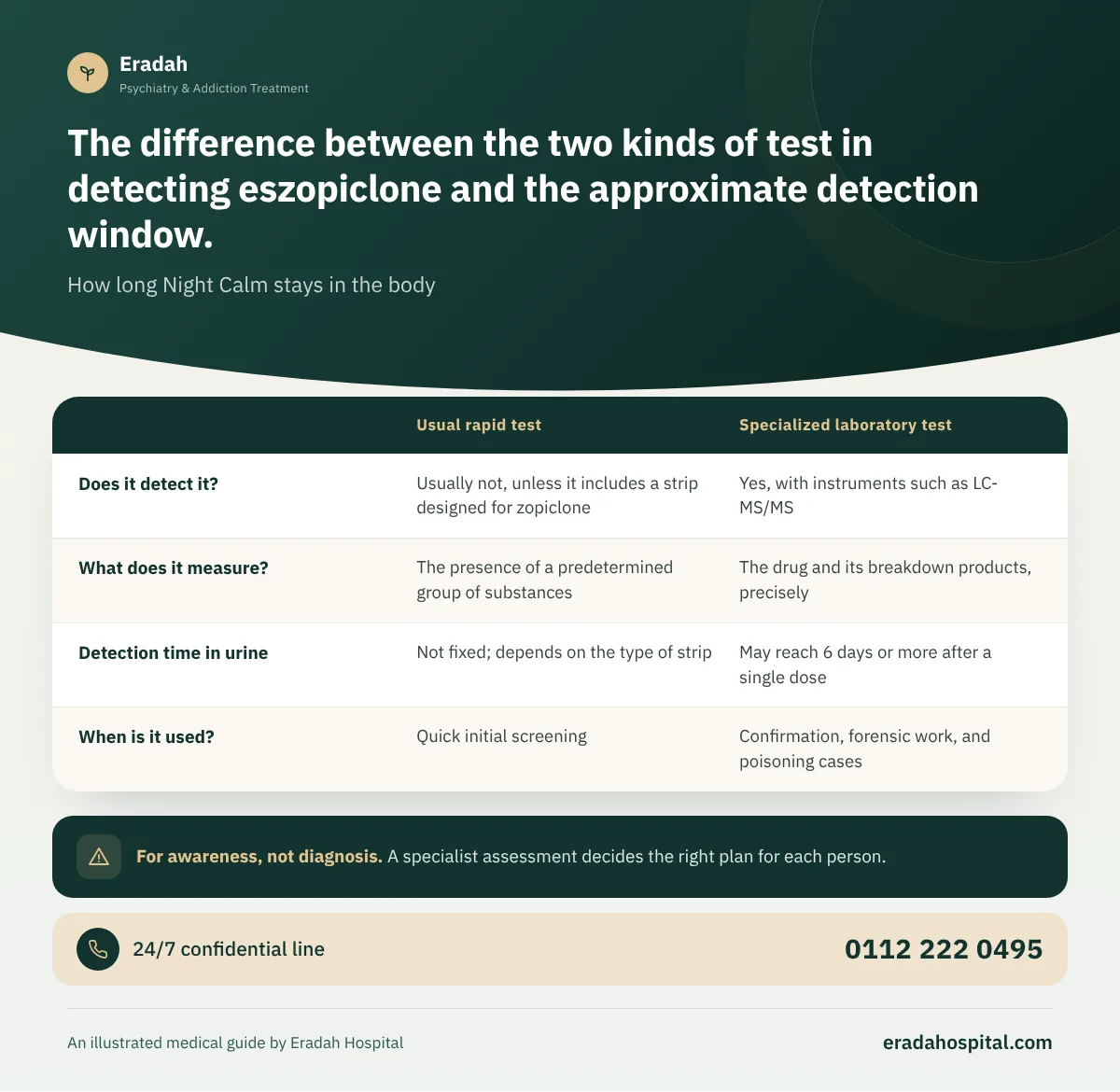
Most rapid strips were designed for groups such as benzodiazepines, opiates and cannabis, and eszopiclone is not chemically a benzodiazepine. But immunoassay strips designed for zopiclone are on the market, and a Japanese paper published in 2026 studied how zopiclone and eszopiclone react with them and found that storing a sample for a long time may cause false negative results. Laboratory tests using chromatography and mass spectrometry are the accepted way to detect Z-drugs accurately, according to a recent scientific review.
How long does Night Calm stay in urine, blood and hair?
- Urine: In a French study of volunteers who took a single therapeutic dose of several sedatives, including zopiclone, all of them remained detectable for at least 6 days using LC-MS/MS, and the more sensitive the instrument, the longer the detection window.
- Blood: Levels fall quickly because of the short half-life, so a blood test is mainly useful in the first hours and in assessing poisoning.
- Hair: Used in forensic medicine to show past exposure with highly sensitive instruments; it is not a routine test.
All of these time frames are approximate, because the studies are small, and because eszopiclone itself is less studied in this respect than zopiclone, the parent drug of which it is one of the two mirror-image halves.
What makes Night Calm stay longer in the body?
- Age: After 65, exposure to the drug rises by about 41% and the half-life lengthens to about 9 hours.
- Liver: Exposure doubles in people with severe liver disease, according to the label.
- Other medicines: CYP3A4 enzyme inhibitors such as ketoconazole raise its level, and inducers such as rifampin lower it.
- Amount and length of use: Doses higher than prescribed lengthen the detection window.
- Type of test and its sensitivity: This is the biggest factor in deciding whether the drug will show up or not.
What if you take Night Calm by prescription?
Tell the laboratory or your employer about the medicine before the test, and keep a copy of the prescription. If an unexpected result appears, ask for a confirmatory test that identifies the substance by name. You will find fuller details in the guide to medicines that show up on drug tests.
The role of testing in poisoning cases
In the emergency room, doctors do not wait for a test result to start treatment; they deal with breathing and consciousness first. But knowing what the person took, especially if alcohol or an opioid painkiller was involved, changes the approach a great deal. That is why bringing the medicine box to the hospital matters more than any rapid test, and you will find details in the overdose guide.
What does a test result mean for the family?
A positive test proves the presence of the drug, not addiction, and a negative test does not rule out use if the strip does not cover zopiclone at all. More useful than focusing on the test is noticing behavior, sleep and mood, and turning to a calm medical assessment, as the guide to Night Calm addiction symptoms explains.