Short-term harms of Night Calm
Most people who take Night Calm by prescription face only mild side effects, but knowing its harms precisely helps tell an annoying symptom from a danger sign that means stopping.
A 2018 Cochrane review that pooled 14 trials of eszopiclone found that the most frequent effects compared with placebo were:
- A bitter or metallic taste in the mouth, which was the clearest difference between the drug and placebo.
- Dry mouth.
- Drowsiness, which may extend into the daytime.
- Dizziness and unsteadiness.
MedlinePlus adds headache and daytime drowsiness, and warns that taking it without enough time for sleep may cause dizziness, hallucinations and poor coordination.
Complex behaviors during sleep: the most serious sudden harm
In 2019 the US Food and Drug Administration added a “boxed warning,” its highest level of warning, to eszopiclone, zolpidem and zaleplon. According to RAPS reporting on the agency, over 26 years there were 66 cases of complex sleep behaviors that ended in serious injury or death, including 20 deaths, and 3 of the people involved were taking eszopiclone. Injuries included falls, burns, drowning and exposure to extreme cold.
Complex behaviors means that the person walks, drives, cooks or makes phone calls while not fully awake, and then remembers nothing. The drug label confirms that this can happen from the first time, at the recommended dose, and without alcohol.
The morning-after effect: why do doctors warn against driving?
The official label for eszopiclone describes a study of 91 healthy adults that showed impaired memory, motor skills and driving skills the next morning, worst at 7.5 hours and still present at 11.5 hours with the highest strength. More worrying, the participants’ sense of drowsiness did not differ clearly from placebo despite their real impairment. That is why the label recommends starting with a low dose, and the doctor decides any increase.
That is why the label advises people taking the highest strength not to drive or operate machinery the next day, and the risk rises if the tablet is taken with less than a full night of sleep ahead, or with another sedative or alcohol.
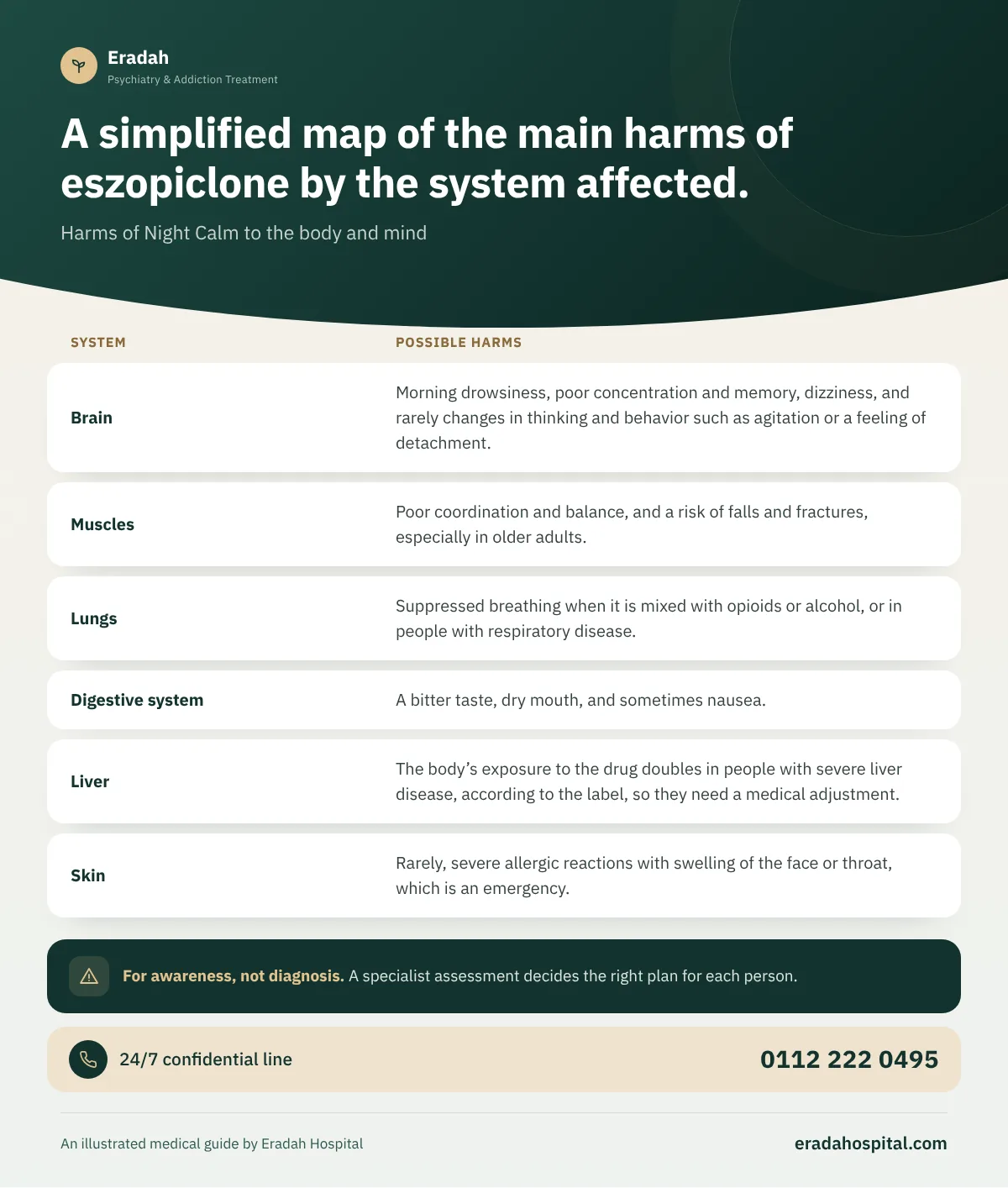
Harms of Night Calm to the body’s systems
| System | Possible harms |
|---|---|
| Brain | Morning drowsiness, poor concentration and memory, dizziness, and rarely changes in thinking and behavior such as agitation or a feeling of detachment. |
| Muscles | Poor coordination and balance, and a risk of falls and fractures, especially in older adults. |
| Lungs | Suppressed breathing when it is mixed with opioids or alcohol, or in people with respiratory disease. |
| Digestive system | A bitter taste, dry mouth, and sometimes nausea. |
| Liver | The body’s exposure to the drug doubles in people with severe liver disease, according to the label, so they need a medical adjustment. |
| Skin | Rarely, severe allergic reactions with swelling of the face or throat, which is an emergency. |
Psychological and behavioral harms
The drug label states that sleeping pills can cause changes in thinking and behavior, such as reduced inhibitions, strange behavior, agitation and a feeling of unreality, and that depression may get worse in some patients. And because insomnia itself is often an early sign of depression or anxiety, relying on a sleeping pill alone may delay treatment of the real problem. Any sudden change in mood or behavior calls for seeing the doctor right away.
Harms of mixing Night Calm with other substances
| The mix | The main risk |
|---|---|
| Night Calm + alcohol | Doubled impairment of awareness and movement, and a greater chance of behaviors during sleep. |
| Night Calm + opioid painkillers such as tramadol | Suppressed breathing and a coma that may be fatal. |
| Night Calm + benzodiazepines or another sleeping pill | Excessive sedation and memory loss; the label does not recommend combining two sleeping pills on the same night. |
| Night Calm + pregabalin or gabapentin | More drowsiness and dizziness, and a risk of slow breathing. |
| Night Calm + medicines that raise its level, such as ketoconazole | The drug stays longer and its effect is stronger than expected. |
The label notes that deaths linked to eszopiclone overdoses were recorded only when it was combined with other depressant drugs or alcohol, which makes mixing the number one danger. You will find details on handling these situations in the overdose guide.
Harms of Night Calm in older adults and during pregnancy
After the age of 65, the body’s exposure to eszopiclone rises by about 41% and the half-life lengthens to about 9 hours according to the label, so older adults are more prone to morning drowsiness, falls and confusion, and the label recommends a lower dose for them. In pregnancy, human data are not sufficient to determine the risk, so any decision to use or stop it during pregnancy or breastfeeding should follow consulting the doctor.
Long-term harms: dependence and rebound insomnia
With daily use over months, the brain may get used to the presence of the sleeping pill, so sleeping without it becomes hard, and the nights after stopping bring insomnia worse than the original. People usually interpret this as their insomnia having “come back,” so they return to the medicine and the cycle continues. The page on Night Calm withdrawal symptoms explains this stage in detail.
Do the harms of Night Calm go away after stopping?
Mostly yes: morning drowsiness, the bitter taste and poor concentration usually go away once the drug leaves the body, and natural sleep gradually returns with behavioral therapy for insomnia. Injuries that happen during complex behaviors or accidents, however, may be permanent, so preventing them matters more than treating them. You will find the full plan for stopping safely on the page about Night Calm addiction treatment.
Danger signs after using Night Calm: call an ambulance (123) immediately
- Deep drowsiness from which the person cannot be woken by calling or shaking.
- Slow or weak breathing or unusual snoring, or blue lips.
- Severe confusion, agitation or hallucinations after taking a large number of tablets.
- Taking it with alcohol or an opioid painkiller such as tramadol, or with another sedative.
- An injury, fall or accident during sleep behavior the person does not remember.
Call ambulance (123) immediately and do not wait for them to “sleep it off.” If the person is unconscious but breathing, place them on their side in the recovery position, stay with them and watch their breathing until the paramedics arrive, and do not give them any sedative, stimulant or food. Tell the paramedics what they took, the approximate amount and the time, bring the medicine box if you find it, and tell them if the person also drank alcohol or took an opioid painkiller.
Call the ambulance 123