Physical signs of Night Calm misuse
The symptoms of Night Calm addiction usually begin quietly, so neither the person nor the family notices that the “sleeping pill” has become the center of their nights and days. Physical signs are often the first thing that draws attention.
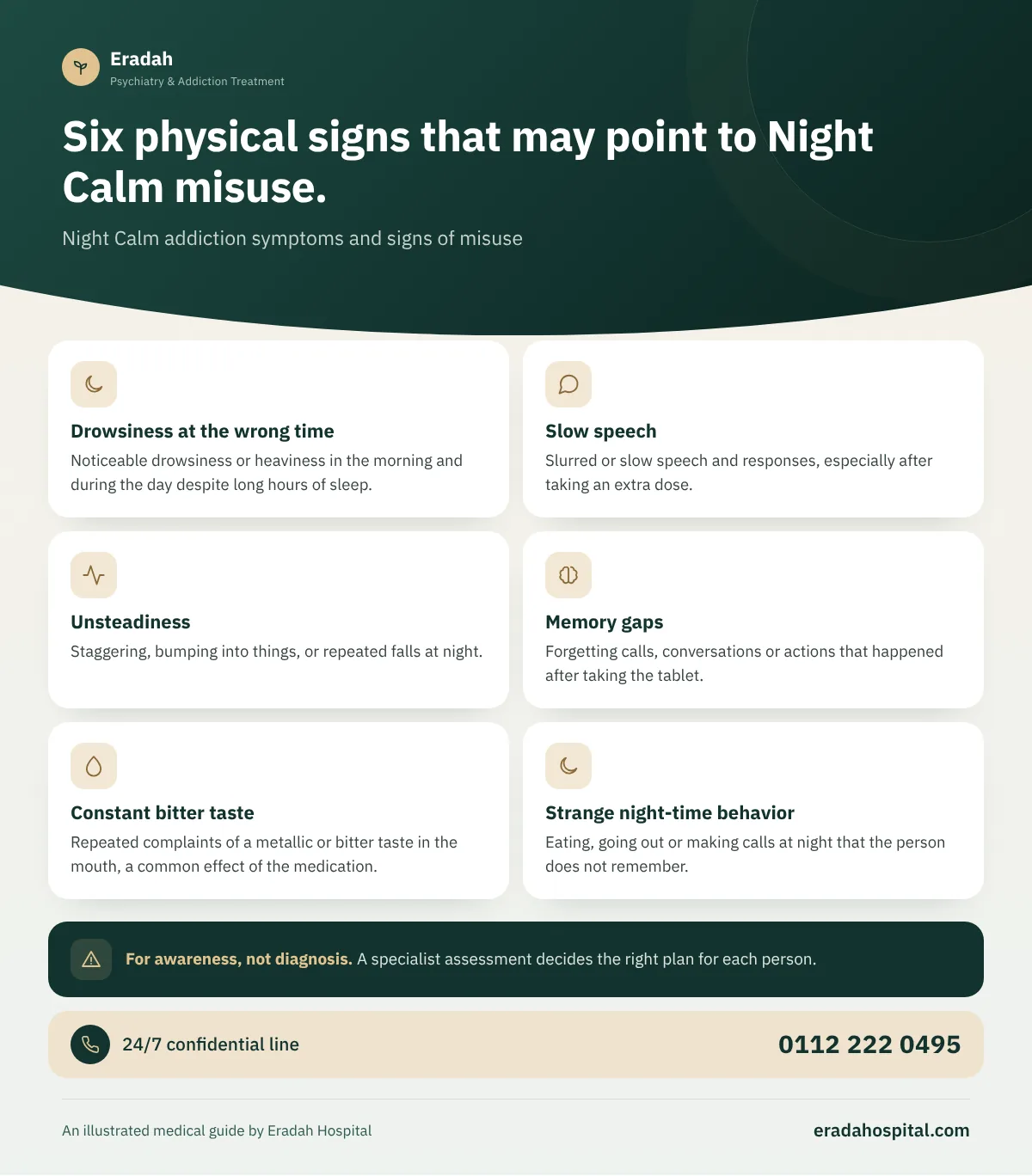
Noticeable drowsiness or heaviness in the morning and during the day despite long hours of sleep.
Slurred or slow speech and responses, especially after taking an extra dose.
Staggering, bumping into things, or repeated falls at night.
Forgetting calls, conversations or actions that happened after taking the tablet.
Repeated complaints of a metallic or bitter taste in the mouth, a common effect of the medication.
Eating, going out or making calls at night that the person does not remember.
Behavioral signs
- Running out of the box early and asking for a new prescription ahead of schedule.
- Going to more than one doctor or pharmacy to get the medication.
- Taking it during the day to calm down or “zone out” rather than to sleep.
- Hiding the tablets, or always carrying them for fear of running out.
- Mixing it with alcohol, sedatives or painkillers to strengthen the effect.
- Intense irritability if getting it is delayed or if someone suggests cutting down.
Psychological and cognitive signs
- Growing anxiety as night approaches, and fear of not being able to sleep.
- Poor concentration and slowed thinking at work or school.
- Mood swings and irritability, especially on days when there is less of the medication.
- Constant preoccupation with the medication: when to take it, how much is left, and where to get more.
The medication leaflet notes that sleeping pills can also cause behavior changes such as loss of inhibition, agitation and strange behavior, and may worsen depression in some patients. These are signs that call for seeing a doctor right away.
How is Night Calm addiction diagnosed?
The official medication leaflet distinguishes between two things: physical dependence, which is the body adapting and shows up as withdrawal symptoms when the drug is stopped or reduced too quickly, and addiction, a disorder marked by one or more of the following: loss of control over use, compulsive use, continued use despite harm, and cravings. The psychiatrist assesses this through:
- A detailed interview about how long the medication has been used, how much, and how it is obtained.
- Asking about other substances, especially alcohol, painkillers and sedatives.
- Assessing the insomnia itself and its causes, and any accompanying depression or anxiety.
- Speaking with the family, with the patient’s consent, to complete the picture.
Dependence on a prescribed drug or addiction?
Not everyone who needs Night Calm to sleep is addicted. Physical dependence can occur in someone who follows their doctor’s prescription, and it is handled simply with a gradual reduction. Addiction shows up in behavior: lying, multiple sources, higher doses, and use for reasons other than sleep. In a Japanese study of patients who took eszopiclone for 24 weeks and then stopped abruptly, noticeable withdrawal symptoms appeared in 10.5% of those who completed the study, and they were linked more to signs of problematic use and poor adherence to the dose.
How do Night Calm symptoms differ from other substances?
| Substance | The clearest signs |
|---|---|
| Night Calm and Z-drug sleeping pills | Drowsiness, slurred speech and forgetfulness, plus night-time behavior the person does not remember. |
| Xanax and benzodiazepines | Similar sedation and slurred speech, with clearer daytime use for anxiety. |
| Tramadol and opioids | Pinpoint pupils, constipation, and sometimes energy rather than drowsiness. |
| Alcohol | A noticeable smell and flushed face, with similar staggering. |
More than one substance is often involved, which is why a medical assessment is more useful than trying to guess.
Signs that are easy to mix up in older adults and young people
In older adults, the symptoms may be put down to “old age”: forgetfulness, falls and morning confusion, when the cause may be a sleeping pill that stays in their bodies longer. Young people may use it to experiment or together with alcohol on nights out, and the clearest signs are unexplained drowsiness, a decline in school performance, and tablets going missing from a family member’s medication.
How do you talk to someone you suspect depends on Night Calm?
- Choose a calm time during the day, not at night or while the person is under the influence.
- Describe what you have noticed with specific facts rather than judgments: “I noticed the box runs out in two weeks.”
- Acknowledge that the insomnia is real, and suggest treating it rather than simply taking the medication away.
- Suggest seeing a psychiatrist together, and stress that the first step is an assessment, not a punishment.
- Use the guide for the family of a person with addiction to help you stay calm and keep your boundaries.
If your suspicions are confirmed, the next step is a safe plan, which you will find on the Night Calm addiction treatment page.
Danger signs after using Night Calm: call an ambulance (123) immediately
- Deep drowsiness from which the person cannot be woken by calling or shaking.
- Slow or weak breathing or unusual snoring, or blue lips.
- Severe confusion, agitation or hallucinations after taking a large number of tablets.
- Taking it with alcohol or an opioid painkiller such as tramadol, or with another sedative.
- An injury, fall or accident during sleep behavior the person does not remember.
Call ambulance (123) immediately and do not wait for them to “sleep it off.” If the person is unconscious but breathing, place them on their side in the recovery position, stay with them and watch their breathing until the paramedics arrive, and do not give them any sedative, stimulant or food. Tell the paramedics what they took, the approximate amount and the time, bring the medicine box if you find it, and tell them if the person also drank alcohol or took an opioid painkiller.
Call the ambulance 123