What is opium?
Opium is a natural substance extracted from the opium poppy, whose scientific name is Papaver somniferum. When the unripe capsules of the plant are scored, a milky white sap oozes out, which solidifies on contact with air into a sticky brown mass. This mass is raw opium.
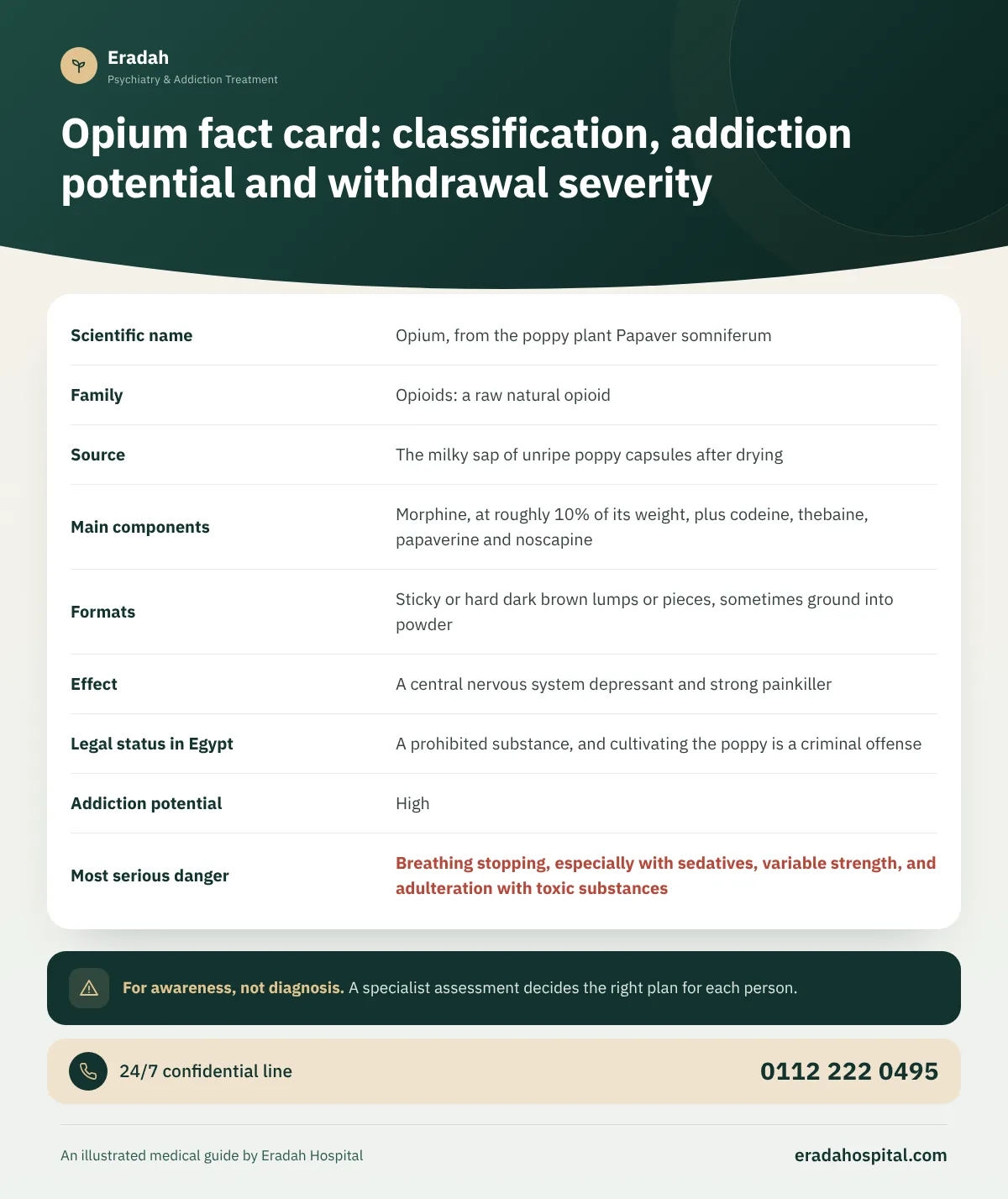
Opium is a mixture of dozens of natural compounds called alkaloids, the most important being morphine, which gives opium most of its pain-relieving and narcotic effect. That is why opium is considered the “mother” from which the whole opioid family came, both natural and semi-synthetic.
Opium differs from the poppy seeds used in baking; the seeds themselves are not considered a narcotic, although their surface may carry trace amounts of alkaloids.
What is opium made of?
The proportions of its components vary with the type of plant, where it is grown and how it is harvested, but the most important alkaloids in it are:
| Compound | Effect | Medical use |
|---|---|---|
| Morphine | The main painkiller and narcotic, making up about 10% of the weight of opium | Relief of severe pain in hospitals |
| Codeine | An opioid weaker than morphine | Some cough medicines and painkillers |
| Thebaine | Affects the nervous system | A raw material for making other opioid medicines |
| Papaverine | Relaxes smooth muscle and does not cause a narcotic effect | Limited uses to widen blood vessels |
| Noscapine | Relaxes smooth muscle and does not cause a narcotic effect | In some cough suppressants |
Because the proportion of morphine varies greatly from one piece to another, a person who uses opium never knows the true strength of what they are taking, and this is one reason it is so dangerous. Learn more about morphine and codeine.
How did opium go from an ancient medicine to a banned drug?
- About 3400 BCMesopotamia
The poppy was cultivated in southern ancient Iraq, and the Sumerians called it the “joy plant”; knowledge of it then passed to the Assyrians and the ancient Egyptians.
- The Middle Ages and afterThe Silk Road
Opium spread across Asia as far as China, and in the 19th century it became linked to the Opium Wars.
- 1803Extraction of morphine
Morphine was isolated from opium for the first time, making it possible to use the active substance instead of the raw sap.
- 1874 – 1898The arrival of heroin
Heroin was made from morphine and launched as a medicine before it became clear that it was even more addictive.
- The 20th centuryInternational control
Opium and its derivatives came under international conventions that limit their use to medical and scientific purposes.
How does opium affect the brain and body?
The morphine and codeine in opium act on opioid receptors in the brain, spinal cord and gut, the same receptors on which the body’s natural endorphins act. This produces several effects:
- Pain relief: it strongly reduces the sensation of pain, which made opium a popular remedy for pain throughout history.
- In the reward circuits: it raises dopamine, causing a feeling of comfort, warmth and euphoria, followed by drowsiness and lethargy.
- In the brainstem: it depresses the breathing and cough centers, which is what can kill in an overdose.
- In the gut: it slows movement and causes constipation, an effect once used to treat diarrhea.
- With repeated use: the brain adapts, so tolerance and then physical dependence develop, and the person needs a larger amount for the same effect.
Is opium “natural” and less dangerous than other drugs?
In some communities, including some rural areas, there is a belief that opium is less harmful because it is “from a plant” or because it has traditionally been used across generations to relieve pain or to endure hard labor. But a substance being natural does not mean it is safe; opium contains the same morphine used in hospitals, with no control over its strength or purity.
| The myth | The truth |
|---|---|
| Opium is natural, so it is safe | It contains morphine, and causes addiction and overdose like any other opioid. |
| It treats diabetes, blood pressure and heart disease | There is no evidence for this, and it can delay real treatment and mask symptoms. |
| It makes the body stronger for hard work | It hides fatigue and pain temporarily, then weakens the body and causes dependence. |
| It improves sexual performance | Repeated opioid use lowers sex hormones and reduces desire and performance. |
| Older people tolerate it better | Older adults and people with lung and heart disease are more prone to respiratory depression, falls and complications. |
What is the difference between opium, morphine, codeine and heroin?
| Substance | Relationship to opium | Medical use | Strength and speed of effect |
|---|---|---|---|
| Opium | The raw sap itself | Not used raw in modern medicine | Variable and unknown |
| Morphine | The main active substance extracted from it | Relief of severe pain | Strong and medically dosed |
| Codeine | Extracted from it | Cough and some painkillers | Weaker |
| Heroin | Made chemically from morphine | Not permitted medically in Egypt | Much stronger and faster |
Read more about heroin, and why it is so strong and so quickly addictive.
Does opium have a medical use today?
Raw opium is no longer used in modern medicine because its strength varies and is hard to control, but the alkaloids extracted from it are still essential medicines: morphine for severe pain, codeine in some cough medicines and painkillers, and thebaine as a raw material for making other opioid medicines. These medicines are produced under strict international control and are dispensed by prescription only.
What is the legal status of opium in Egypt?
Opium is a prohibited substance in Egypt under Law No. 182 of 1960 on drug control and its amendments. The law criminalizes possessing, using and trafficking it, and also criminalizes cultivating the poppy plant. The Fund for Drug Control and Treatment of Addiction provides free, confidential treatment through hotline 16023, alongside specialized centers.
This is general educational information and not legal advice.
What should a family do if they discover opium use?
- Do not treat it as an innocent traditional habit: even if it is common in the surrounding environment, this is dependence on an opioid that needs an assessment.
- Talk calmly and without accusation: focus on concern for his health, not on blame.
- Do not ask him to stop suddenly on his own: especially if he is elderly or has heart or lung disease; stopping needs a medical plan.
- Watch out for mixing: sedatives, pregabalin and alcohol with opium can be fatal.
- Ask for a specialist assessment: treatment is available and effective, and the earlier it starts, the easier it is.
Opium guide: everything you need to know
We have gathered everything about opium into 6 pages, each answering one question in detail. Choose what you are looking for:
Harms of opium
From respiratory depression and chronic constipation to a higher risk of lung, larynx and bladder cancers, the danger of adulteration with lead, and its effect on pregnancy and mental health.
Causes of opium addiction
Why do people become addicted to opium? The role of morphine, its use to relieve pain and fatigue, popular beliefs, genetics, psychological stress and the environment.
Symptoms of opium addiction
The physical and behavioral signs a family may notice, the criteria for diagnosing addiction, and how to start the conversation with the person.
Opium withdrawal symptoms
They begin within hours of the last use and peak in the first days. The timeline, and why older adults and people with illnesses need special medical supervision.
Treatment of opium addiction
Assessment, detox, approved medications, psychological and family therapy and relapse prevention, and how long each stage lasts.
How long opium stays in the body
It shows up in tests as morphine and codeine. How long it stays in urine, blood, saliva and hair, and the causes of false positive results.
Opium and opioids in numbers
Sources: the International Agency for Research on Cancer (IARC), and the World Drug Report 2025 issued by UNODC.
Signs of opium overdose: call an ambulance (123) immediately
- Pupils that are extremely small, like pinpoints
- Very slow, irregular or stopped breathing
- Loss of consciousness, with no response to calling or touch
- Blue lips and fingernails
- Gurgling or unusual snoring sounds
Call an ambulance on 123, place the person on their side so they do not choke, and stay with them until help arrives. The medicine naloxone reverses the effect of an opioid overdose if given in time, and it is available in emergency departments.
Call the ambulance 123