How is opium broken down in the body?
Opium is a mixture of alkaloids, and the most important ones for testing are morphine and codeine. Morphine is broken down mainly in the liver into compounds bound to glucuronic acid, which leave in the urine, while part of the codeine is converted into morphine in the body. This is why tests usually look for morphine, codeine and their breakdown products, not for “opium” itself.
The main component. It appears on the standard opiate test, but it can also result from morphine medications or heroin.
It often appears alongside morphine, but it can also come from cough medicines and painkillers that contain it.
Such as noscapine and papaverine, which specialized labs may look for in particular cases.
How long does opium stay in urine, blood, saliva and hair?
Urine
Blood
Saliva
Hair
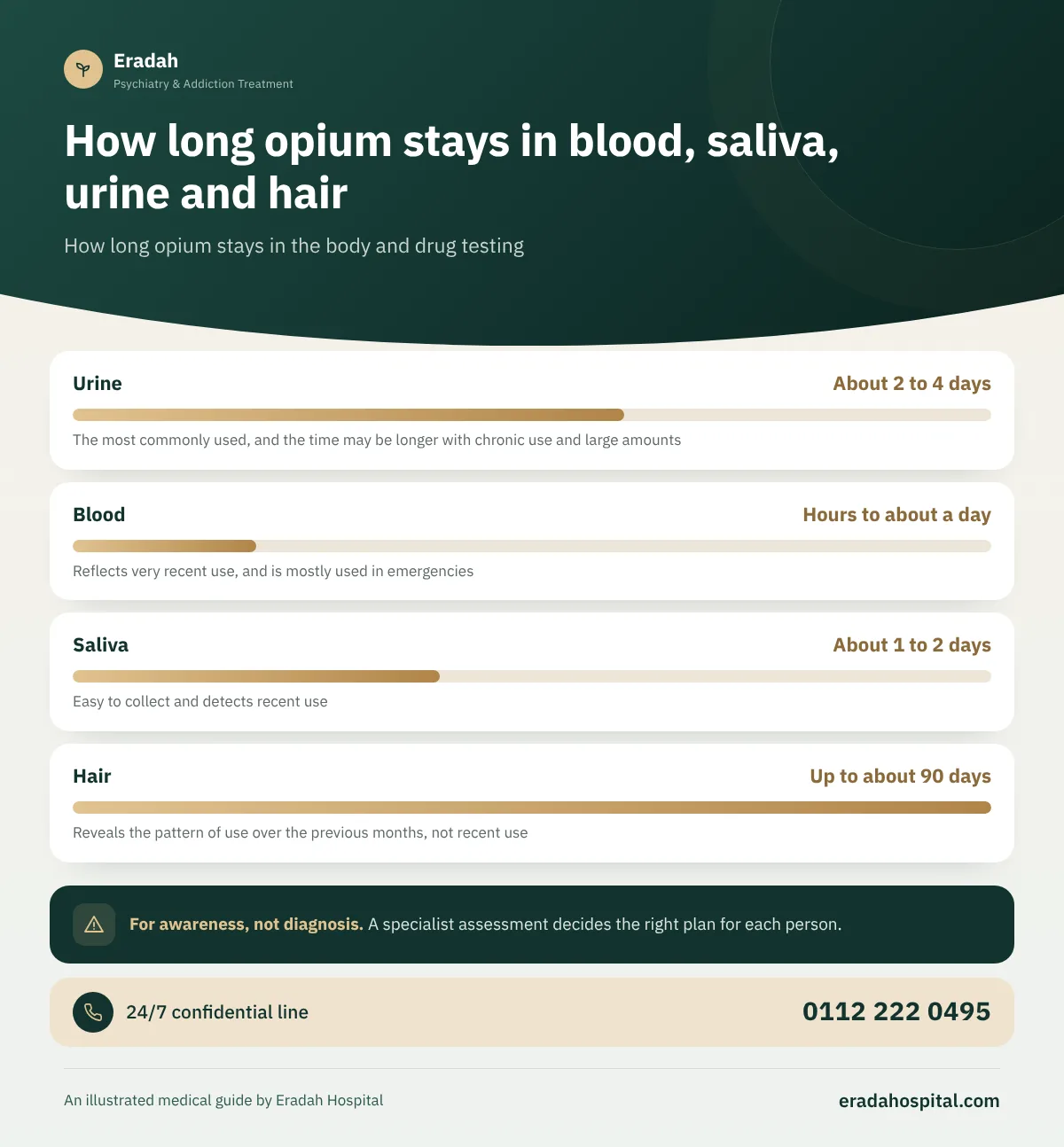
These durations are approximate and vary by laboratory and test sensitivity. For an accurate interpretation of a specific result, consult the doctor or the laboratory.
Does opium show up on a standard drug test?
Usually yes. The initial screening test known as “opiates” is designed mainly to detect morphine, the main component of opium, so opium usually gives a positive result on it. But this test cannot tell whether the morphine came from opium, heroin or a prescribed medication, and it does not reliably detect synthetic opioids such as methadone and fentanyl.
What factors affect how long opium stays in the body?
- How often and how long it is used: daily use over years lengthens the detection time compared with a single use.
- The strength of the opium and its morphine content: this varies greatly from one sample to another.
- Liver and kidney function: when weaker they slow the clearance of breakdown products, which is common in older adults.
- Age, weight and metabolism.
- Other medications and substances used at the same time.
What is the difference between a screening test and a confirmatory test?
| Type | How it works | Limitations |
|---|---|---|
| Initial (immunoassay) test | Rapid strips or devices that detect the presence of morphine and similar substances | May give false positives and does not identify the source |
| Confirmatory test | Precise laboratory instruments that identify each substance and its concentration | More expensive and slower, but far more accurate |
| Targeted testing | Looking for specific breakdown products or alkaloids | Requested in special cases, on the decision of a doctor or the relevant authority |
Can an opiate test be positive without using opium?
Yes. Studies have documented that eating baked goods containing a certain amount of poppy seeds can give a positive urine result for morphine and codeine within hours, and it may last about a day. Cough medicines and painkillers containing codeine, and prescribed morphine medications, give the same result. That is why a positive result on the initial screening test needs a confirmatory test and a medical interpretation.
Are rapid home tests enough to detect opium?
The rapid strips available work in the same way as the initial screening test, so they are useful as a first indication but can give false positive or false negative results, and they do not identify the source of the morphine. Also, testing children or spouses secretly or by force can destroy trust and increase denial. It is better for the test to be part of a medical assessment in which the doctor explains it and interprets the result in context.
When are opiate tests requested?
- In emergencies, when an overdose or unexplained loss of consciousness is suspected.
- When starting an addiction treatment program, and during it to monitor progress.
- In older adults who show unexplained symptoms such as excessive drowsiness or confusion.
- In some job, licensing, or legal procedures.
Does opium stay longer in someone who has used it for years?
Often yes. With long daily use, breakdown products build up in the body, and the test result may stay positive for longer than the usual windows, especially in older adults and people with weakened liver or kidney function. A hair test in these people may also reflect a pattern of continuous use over months. For this reason a single result should not be interpreted in isolation from the medical history and assessment.
What should you do if you take a medication containing codeine and are asked for a test?
- Keep the prescription or the medicine box that shows the active ingredient.
- Tell the lab or the party requesting the test about the medication before the sample is taken.
- If a positive result appears, ask for a confirmatory test and discuss the result with your doctor.
- Do not stop a prescribed medication on your own because of a test. Go back to your doctor first.
Why do we not offer tips for getting around the test?
Because in the context of treatment a test is a tool to protect and help the patient, not to condemn them, and because attempts to get the substance out of the body quickly can be dangerous and do not change the fact that there is a problem. If you truly want to stop opium, the safe route is medically supervised detox. Read about opium addiction treatment.