Why do people confuse Captagon with crystal meth?
“It’s just Captagon, not shabu, so it’s milder.” This is a sentence families sometimes say to reassure themselves, and a young man says to convince himself. The truth is that the difference between Captagon and crystal meth is real, but it is not the difference between “safe” and “dangerous”; it is between a dangerous stimulant and a more dangerous one.
The two belong to the amphetamine family of stimulants and are used for the same reasons: staying awake, working long hours, studying, and feeling energized. A section in the Captagon guide briefly compares them and tramadol, but here we go deeper into the comparison between the two stimulants alone: their composition, why the risk differs, and what that means for the family and for treatment.
What is in each of them?
Captagon was originally a brand name for a drug containing fenethylline, but analysis of seized tablets in recent years shows that fenethylline is rare in them, and that most are a mixture of amphetamine, caffeine and other substances, with some containing no amphetamine at all. In other words, “Captagon” today is a name for the shape of a tablet, not a fixed composition.
Crystal meth (shabu) is methamphetamine, and the crystal meth (shabu) guide explains it. It usually comes as clear crystals or a powder, and is smoked, snorted or injected, and sometimes swallowed.
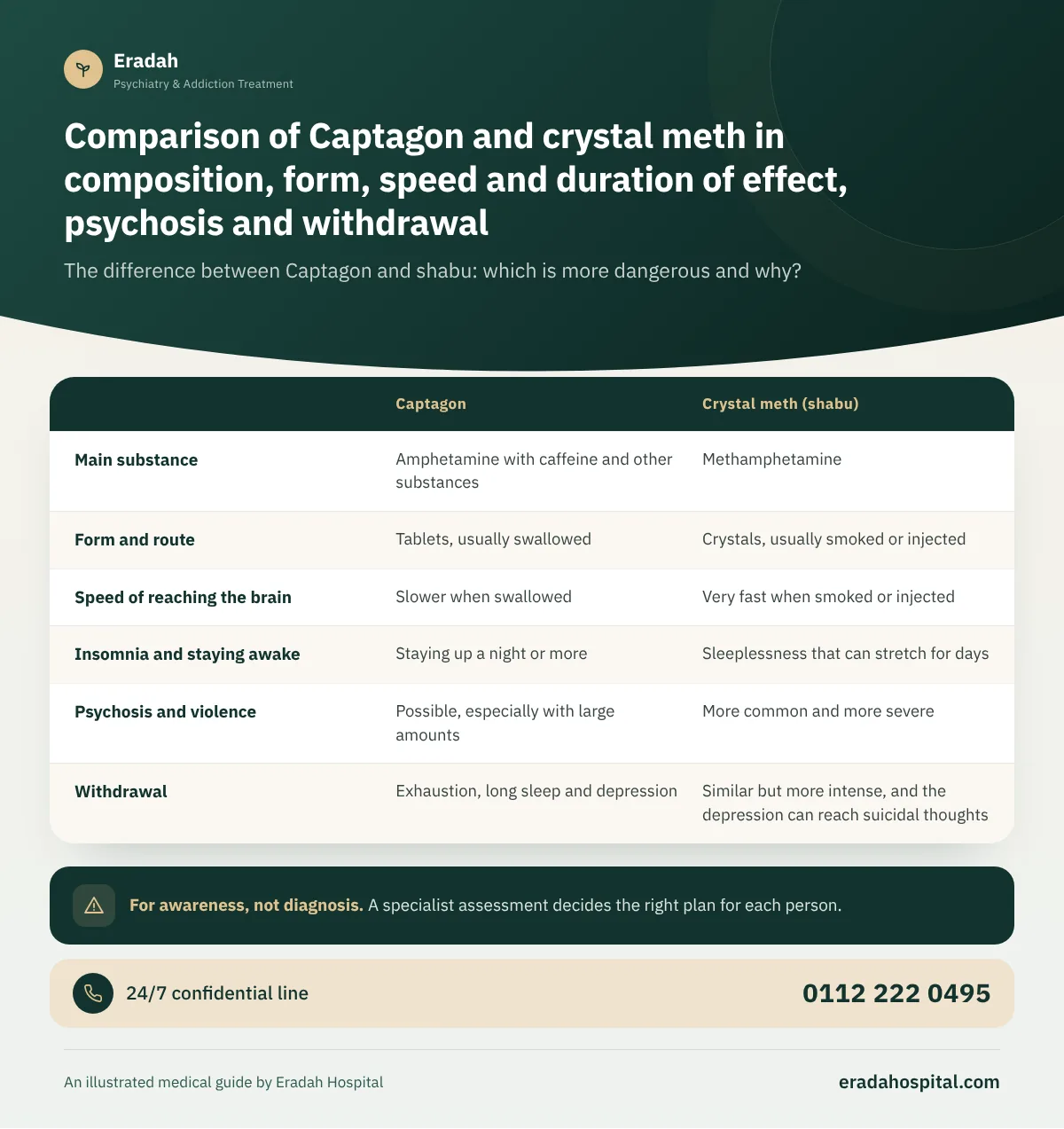
The difference between Captagon and crystal meth in a table
| Captagon | Crystal meth (shabu) | |
|---|---|---|
| Main substance | Amphetamine with caffeine and other substances | Methamphetamine |
| Form and route | Tablets, usually swallowed | Crystals, usually smoked or injected |
| Speed of reaching the brain | Slower when swallowed | Very fast when smoked or injected |
| Insomnia and staying awake | Staying up a night or more | Sleeplessness that can stretch for days |
| Psychosis and violence | Possible, especially with large amounts | More common and more severe |
| Withdrawal | Exhaustion, long sleep and depression | Similar but more intense, and the depression can reach suicidal thoughts |
Is crystal meth really stronger than Captagon?
The precise answer: the two substances are closer than people think, and the biggest difference comes from the form and the way they are used. In a laboratory experiment published in 2012 in the journal Addiction, 13 men were given methamphetamine and amphetamine in the same amounts and through the nose, and no differences appeared in most measures, although methamphetamine had a clearer effect on some of them, such as heart rate and the feeling of euphoria.
On the street the picture is different: crystal meth is usually smoked as high-purity crystals, so it reaches the brain within minutes. An imaging study published in the journal NeuroImage in 2008 found that methamphetamine reaches the brain quickly, peaking within 9 minutes, but leaves it slowly and spreads through wide areas of it. The researchers linked the speed of arrival to the strength of addiction, the slow exit to the long duration of behavioral effects, and the wide spread to its toxic effect on nerves.
The difference in psychosis and violence
Either stimulant can cause drug-induced psychosis: suspicion, hallucinations and a feeling of being watched. In a pooled analysis published in the journal Schizophrenia Bulletin in 2020, 22% of cases of amphetamine-induced psychosis later progressed to schizophrenia, a category that includes both substances. But crystal meth is linked to psychosis and violence to a greater degree because of the long sleeplessness and large amounts, and an Australian longitudinal study found that violence increased during periods of methamphetamine use in proportion to the days of use.
The difference in physical harm
The two substances share harms to the heart and blood vessels: raised blood pressure and heart rate, rhythm disturbances, and the risk of clots with large amounts. The caffeine in Captagon tablets adds a burden on the heart and sleep. Crystal meth is more associated with the harms of long-term use that the US National Institute on Drug Abuse describes, such as tooth decay and tooth loss, stroke and heart failure. The pages on the harms of crystal meth and the harms of Captagon cover this in detail.
Do they show up in a drug test the same way?
Usually both appear on the initial screening for the amphetamine group, because Captagon usually contains amphetamine, and methamphetamine is partly converted to amphetamine in the body. Identifying the substance precisely needs a confirmatory laboratory test. The pages on how long crystal meth stays in the body and how long Captagon stays in the body explain the details.
Does treatment for Captagon addiction differ from crystal meth?
The principles are the same: there is no approved medication that removes stimulant addiction, and the main treatment is behavioral and psychological, with treatment of insomnia, depression and psychosis if present. The US institute notes that contingency management is the most studied behavioral treatment and the one most associated with success in methamphetamine addiction, alongside cognitive behavioral therapy, motivational interviewing and support groups. The difference is that crystal meth cases need residential treatment more often, because of the severity of psychosis and depression after stopping and the risk of violence.
The pages on crystal meth addiction treatment and amphetamine addiction treatment set out the stages in detail. At Eradah, the first consultation is free and confidential, and do not start or stop any medicine without a doctor.
Danger signs after using crystal meth or Captagon: call an ambulance (123) immediately
- Chest pain or pressure, or severe palpitations.
- A sudden violent headache, weakness on one side of the body, or difficulty speaking.
- A very high temperature with agitation or confusion.
- Seizures or loss of consciousness.
- Hallucinations, or threats to harm themselves or others.
Call ambulance (123) immediately. If the person is unconscious but breathing, place them on their side so they do not choke on vomit. Stay with them and do not leave them alone. Do not give them food or drink, and tell the paramedics everything they took or used, and the amount and time if you know them.
Call the ambulance 123