Why is dealing with someone addicted to crystal meth different?
“He started closing the windows and saying there were people watching him, and when I came near him he shouted in my face as if he didn't know me.” This is what many mothers say about their sons after nights awake on crystal meth. And the difference between crystal meth and many substances is that here the danger can reach the family itself.
The US National Institute on Drug Abuse (NIDA) states that repeated use of methamphetamine, the active ingredient in crystal meth or ice, can cause psychotic symptoms such as seeing or hearing things that are not there and being intensely convinced of untrue ideas, even when the person is not under the influence, and that heavy drinking and stress make it more likely these symptoms will return in people who have had them.
In an Australian study published in 2014 that followed 278 people dependent on methamphetamine, the odds of violent behavior rose about 2.8-fold in months when they used between 1 and 15 days, and about 9.5-fold when use exceeded 16 days in the month, compared with months of no use. Psychotic symptoms doubled the odds, and so did heavy alcohol drinking. This is why the explanation on the page about the harms of crystal meth turns here into a practical question: how do you protect yourself and them?
Know which stage they are in
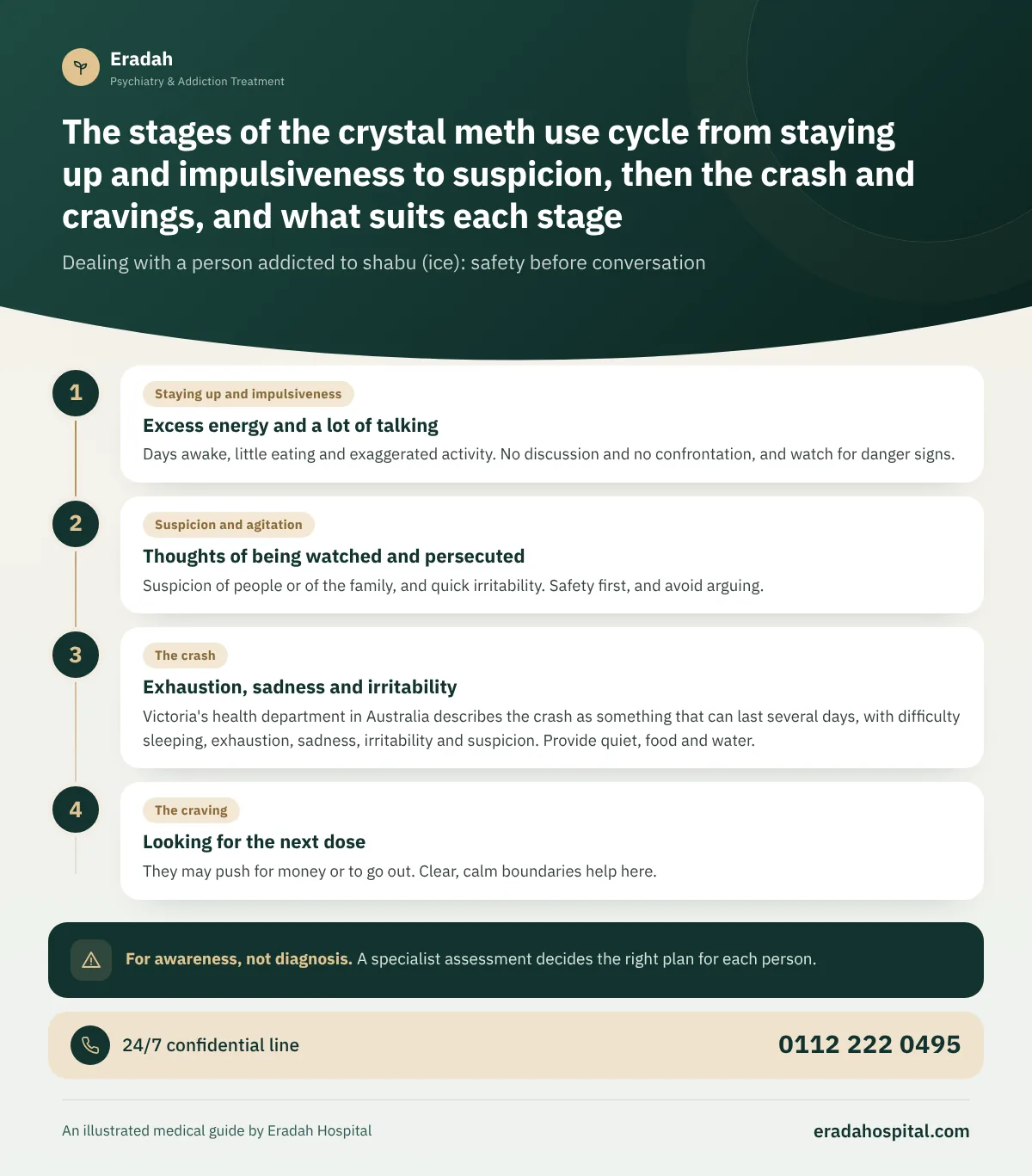
The behavior of a person using crystal meth changes with the stage, and what works in one stage may do harm in another. This cycle helps you read what is happening:
- Staying up and impulsivenessExcess energy and a lot of talking
Days awake, little eating and exaggerated activity. No discussion and no confrontation, and watch for danger signs.
- Suspicion and agitationThoughts of being watched and persecuted
Suspicion of people or of the family, and quick irritability. Safety first, and avoid arguing.
- The crashExhaustion, sadness and irritability
Victoria's health department in Australia describes the crash as something that can last several days, with difficulty sleeping, exhaustion, sadness, irritability and suspicion. Provide quiet, food and water.
- The cravingLooking for the next dose
They may push for money or to go out. Clear, calm boundaries help here.
The same health department notes that the effects of ice usually last up to 12 hours, but sleep problems may continue for days afterward. This is why the best time for a serious conversation is after they have slept, eaten and regained their calm.
Do not argue with delusions: what to say instead?
When they are convinced that the neighbors are watching them or that someone wants to hurt them, trying to prove otherwise raises their tension and may make you part of the “plot” in their eyes. It is more useful to acknowledge their feelings without confirming the idea:
| Instead of saying | Try saying |
|---|---|
| “Nobody is watching you, you're imagining it.” | “I can see you're very scared. I'm here and I won't leave you.” |
| “You're crazy, this is all from the pills.” | “Come and sit in this quiet room for a while.” |
| “Give me your phone, let me see who's calling you.” | “I won't ask you anything right now, I just want you to rest.” |
| Shouting or standing close to them | A low voice, a safe distance and slow movement |
Reduce light, noise and the number of people around them, and do not corner them in a room or stand between them and the door. If suspicion and hallucinations continue after the effect has worn off, this may be drug-induced psychosis, which needs a specialist assessment.
A safety plan for violence
Not everyone who uses crystal meth is violent, but being prepared is a must when danger signs are present. Australia's Cracks in the Ice program advises families to watch for signs of violence, and points to research finding that people who use methamphetamine are also more likely to be victims of violence. Here is a simple plan the family agrees on in advance:
- Keep sharp objects, weapons and car keys out of their reach.
- Identify a safe room with a phone and a door that locks, and a way out of the house.
- Agree with a trusted relative or neighbor on a code word that means “come right away or call the police.”
- Take children out of the place at the first sign of a threat, and do not leave them with the person while they are under the influence.
- Do not try to restrain them or lock them in by force, and do not confront them alone.
- In case of actual violence call the police emergency line (122), and for a medical emergency call the ambulance (123).
The crash days after staying up: how do you handle them?
After days awake comes what people who use call the “crash”: severe exhaustion, disturbed sleep, sadness and irritability, and suspicion or hallucinations may return. Victoria's health department warns that using other substances such as sedatives, hashish or opioids to get through the crash may lead to a cycle of dependence on more than one substance.
- Provide a quiet place, food and water, and let them sleep undisturbed.
- Do not give them sleeping pills or sedatives from home, however much they ask.
- Watch for deep sadness and talk about death; do not leave them alone, and call the mental health support line, 16328.
- Put off big discussions until they have regained their sleep and calm.
- Use the calm after the crash to offer one specific step: an assessment by a psychiatrist.
The page on shabu withdrawal symptoms explains what happens in the weeks after stopping.
When should you call the ambulance (123) or the police (122)?
| The situation | What it does |
|---|---|
| Chest pain, very high temperature, seizures, loss of consciousness | Ambulance 123 immediately |
| Hallucinations or suspicion with a threat of harm but no actual violence | The ambulance (123) or the nearest psychiatric emergency, and move children away |
| Actual violence or a threat with a weapon | Move away first and then call the police emergency line (122) |
| Serious talk of death or self-harm | Do not leave them alone, and call the ambulance and the mental health support line, 16328 |
NIDA states that methamphetamine can cause an irregular heartbeat and stroke, so weakness on one side of the body or difficulty speaking after use is an emergency that cannot wait.
From safety to treatment
When the crisis calms, it is time for treatment. The psychosis that accompanies crystal meth needs a psychiatrist, and a residential stay may be more suitable when there is a risk to themselves or others, followed by continued psychological and behavioral therapy and relapse prevention. You will find the stages and duration in crystal meth addiction treatment, and the evidence-based approach to the conversation in how to convince a person with addiction to seek treatment. At Eradah the family can start with a free confidential consultation, even before they agree.
Danger signs after using crystal meth: call the ambulance (123) immediately
- Chest pain or a very fast or irregular pulse.
- A very high temperature with agitation and heavy sweating.
- Seizures or loss of consciousness.
- Sudden weakness on one side of the body or difficulty speaking.
- Hallucinations or severe suspicion with a threat of harm or violence.
Call ambulance (123) immediately. If the person is unconscious but breathing, place them on their side so they do not choke on vomit. Stay with them and do not leave them alone. Do not give them food or drink, and tell the paramedics everything they took or used, and the amount and time if you know them.
Call the ambulance 123