Why is crystal meth so quickly addictive?
All addictive substances raise dopamine in the brain's reward circuits, but crystal meth does so with exceptional force and for a long time. It does not just block the reuptake of dopamine, as cocaine does; it also drives cells to release their stored dopamine. The result is a feeling of euphoria and power that no natural source of pleasure comes close to.
This enormous difference quickly teaches the brain that crystal meth is “more important” than food, sleep and relationships. With repetition the brain reduces its sensitivity to dopamine, so ordinary things lose their flavor, and crystal meth becomes the only way to feel energy, or even to feel normal.
How does the cycle of staying up and crashing create addiction?
One of the most dangerous features of crystal meth is the pattern of continuous use that doctors call “binges”: the person keeps using to maintain the high and stays awake a day or more without sleep or food. When they stop, they enter a harsh “crash” phase of exhaustion, depression and cravings.
- The startHigh
Energy, confidence and a false sense of focus, and a feeling that anything is possible.
- ContinuingChasing
The high weakens with each dose, so the person uses again to get it back and stays awake for long, unbroken hours.
- AgitationDisorder
Anxiety, irritability and suspicion, and hallucinations may appear with lack of sleep.
- The crashThe crash
Exhaustion, long sleep, depression and emptiness, and cravings that push toward a new binge.
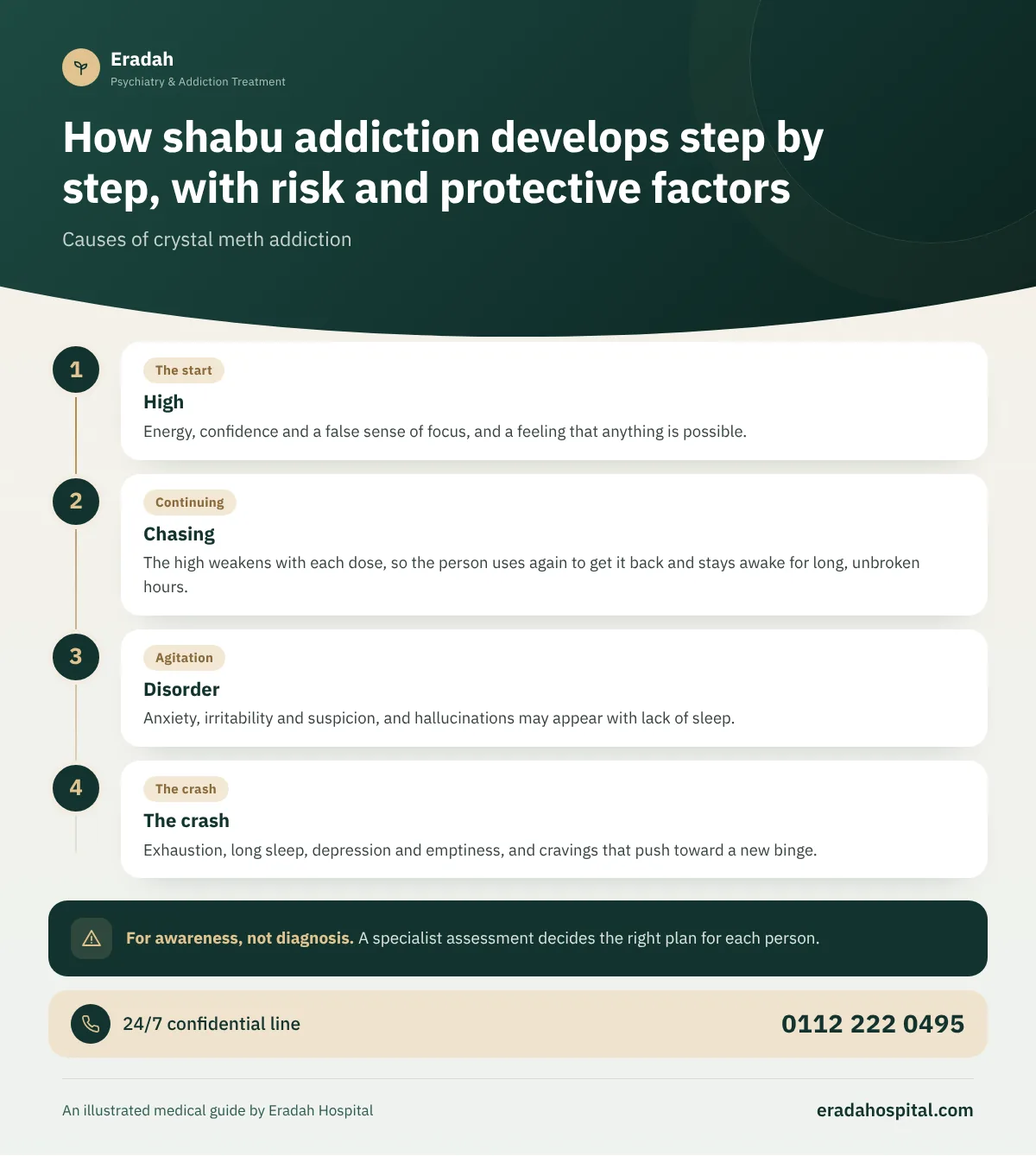
This cycle reinforces itself: the painful crash makes crystal meth seem like the only “solution,” and each new binge deepens the changes in the brain. This is why occasional use turns into addiction faster than many people expect.
Does genetics play a role in shabu addiction?
Research from the US National Institute on Drug Abuse indicates that genetic factors explain a large part of a person's vulnerability to addiction in general. Having a parent or sibling with addiction raises the risk, not because addiction is “inherited” as a specific disease, but because genes influence how the brain responds to substances and traits such as impulsivity and novelty-seeking.
But genetics is not destiny. Many people with a family history never become addicted, and a supportive environment and early education reduce the risk considerably.
How are mental health conditions related to shabu addiction?
Some people turn to crystal meth looking for a fix for a mental health problem that was never diagnosed or treated, which is called “self-medication,” a temporary fix that worsens the original problem:
Crystal meth gives temporary energy and euphoria that mask depression, and then the depression returns worse after the crash.
A person with ADHD may feel that crystal meth helps them concentrate, and so begin a cycle of addiction instead of safe medication under medical supervision.
It gives a false sense of boldness in social situations.
Childhood trauma, loss or abuse raises the risk of turning to substances to escape the pain.
This is why the doctor looks for an accompanying mental health condition in every case of addiction, because treating the addiction alone without treating the psychological cause raises the risk of relapse.
What are the common reasons for trying crystal meth the first time?
The reasons for a first try differ from person to person, but the most common in Egypt and the region are:
- Staying up and working long hours: Some people in exhausting jobs or night shifts look for extra energy.
- Studying and exams: A mistaken belief that stimulants improve performance.
- Weight loss and loss of appetite: Especially among girls and young people who care about their weight.
- Curiosity and peer pressure: The spread of the name among young people also plays a part in normalizing trying it.
- Moving on from other substances: Some people who use hashish or Captagon move to crystal meth looking for a stronger effect.
- Escaping pressure: Family, financial or emotional problems.
Environmental and social factors
- Availability of the drug and easy access to it within the person's circle.
- Friends or family members who use.
- Weak family supervision or a lack of dialogue at home.
- Unemployment and idle time, or conversely, intense work pressure.
- Exposure to violence or neglect in childhood.
- Starting at an early age, since starting in adolescence is linked to a higher risk of later addiction.
Who is most at risk of shabu addiction?
Shabu addiction can affect anyone, but some groups are more at risk because of their circumstances or needs:
Such as drivers and night-shift workers, who look for energy to stay awake.
Especially around exams or in late-night social circles, with a weaker grasp of risks at this stage of life.
Those seeking rapid weight loss, who may also have severe anxiety about body image.
Moving from Captagon or hashish to crystal meth is common in search of a stronger effect.
Belonging to one of these groups does not mean a person will become addicted, but it does mean that early education and follow-up matter more.
Myths about the causes of shabu addiction
| The myth | The truth |
|---|---|
| Addiction only affects people with weak personalities | Addiction is a disease that changes the brain, and it affects successful and strong people too. |
| Someone who becomes addicted to crystal meth chose it of their own free will | The first try may be a choice, but addiction itself takes away the ability to control use. |
| The family alone is to blame | The family plays an important role, but addiction results from genetic, psychological and environmental factors together. |
| There is no point in treatment if the addiction is hereditary | A genetic predisposition does not cancel the chances of recovery, and treatment is effective whatever the causes. |
How does use develop into addiction?
| Stage | What happens |
|---|---|
| Experimentation | Use out of curiosity, peer pressure or staying up late, with a feeling of being in control. |
| Repeated use | Crystal meth becomes tied to particular occasions or pressures, and hiding it from the family begins. |
| Tolerance | The effect of the drug weakens, so the person uses more or lengthens the binges. |
| Dependence | A harsh crash after stopping, cravings, and difficulty getting through daily life without the drug. |
| Addiction | Continued use despite clear harm to health, work and family, and failed attempts to stop. |
Risk factors and protective factors
| Risk factors | Protective factors |
|---|---|
| Family history of addiction | A strong relationship and open dialogue within the family |
| Untreated depression, ADHD or anxiety | Early diagnosis and treatment of mental health disorders |
| Childhood trauma or abuse | Psychological support and skills for coping with stress |
| Friends who use | Friends and healthy sports and social activities |
| Starting at an early age | Early education about the risks of stimulants in language young people understand |
| Idle time or intense work pressure | Clear goals in study or work and a regular sleep routine |
How can families protect their children from crystal meth?
- Talk to your children about crystal meth openly and with accurate information, without exaggeration or excessive scare tactics.
- Pay attention to changes in sleep, appetite, friends and spending money; these are early signs worth a conversation.
- Do not ignore signs of depression, ADHD or anxiety, and ask for an early psychological assessment.
- Set an example in coping with stress without relying on substances or medications without a prescription.
- Make home a safe place to admit mistakes and ask for help without fear of harsh punishment.
And if signs have actually started to appear, read the guide to symptoms of shabu addiction to learn what to look for and how to start the conversation.