What are the dangers of a psychotic episode itself?
The most dangerous moments of this condition are the acute episode, because the person acts on suspicions and hallucinations they believe completely, often under the influence of a substance that increases impulsiveness and weakens judgment:
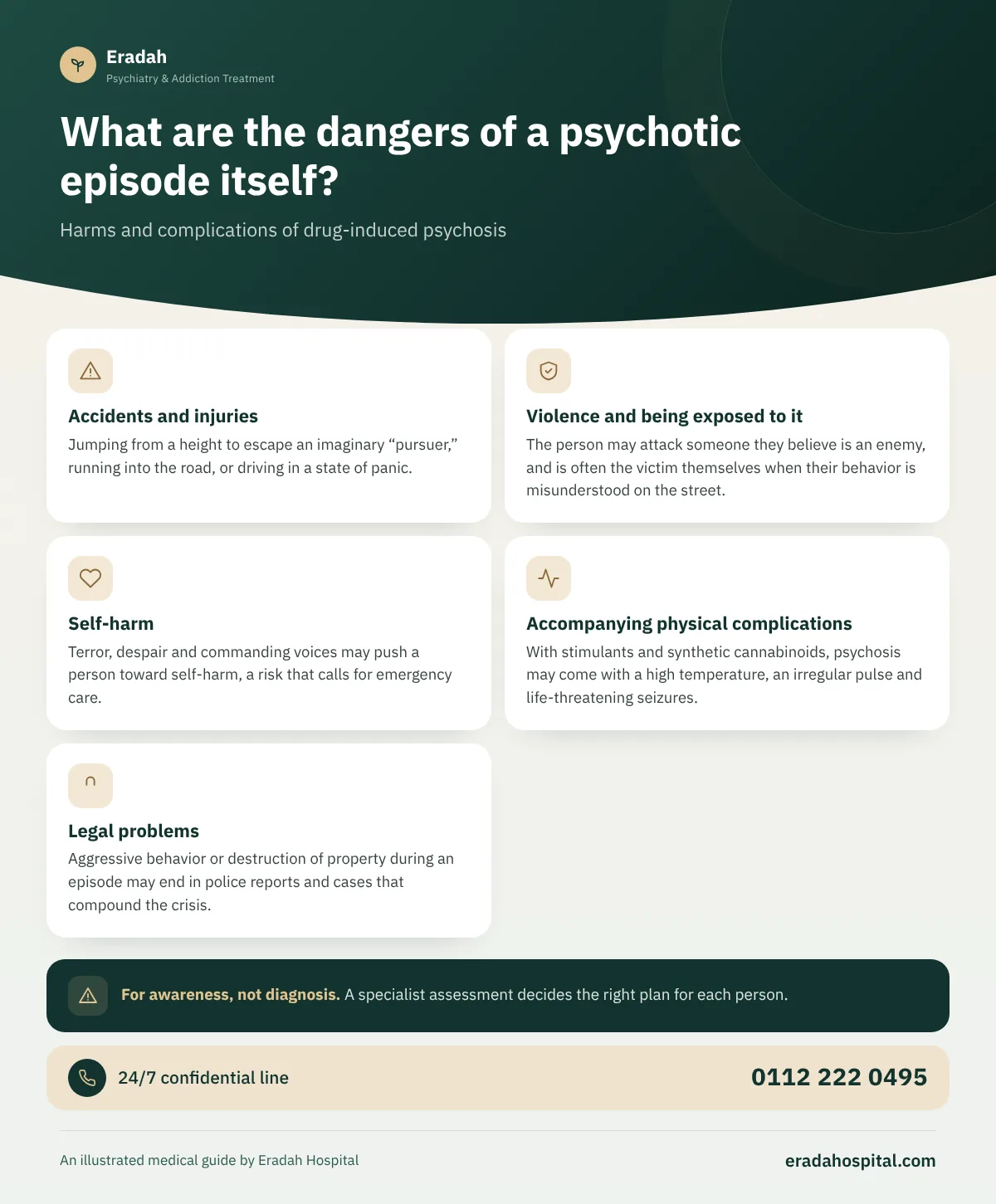
Jumping from a height to escape an imaginary “pursuer,” running into the road, or driving in a state of panic.
The person may attack someone they believe is an enemy, and is often the victim themselves when their behavior is misunderstood on the street.
Terror, despair and commanding voices may push a person toward self-harm, a risk that calls for emergency care.
With stimulants and synthetic cannabinoids, psychosis may come with a high temperature, an irregular pulse and life-threatening seizures.
Aggressive behavior or destruction of property during an episode may end in police reports and cases that compound the crisis.
Do psychotic episodes recur when someone goes back to using?
Yes, and this is among the most important things a person who uses drugs should know. Someone who has had a psychotic episode from a particular substance is more likely to have another if they return to it, and the next episode may come sooner and on a smaller amount. With crystal meth (shabu) in particular, research describes a “sensitization” phenomenon: it is as if the brain learns psychosis, so it enters it more easily each time.
In fact, some people who recovered from shabu psychosis find that suspicions return for short periods under psychological stress or lack of sleep, even after stopping for some time. That is why complete abstinence, not cutting down, is the real protection.
Can psychosis continue after stopping?
In most cases, symptoms fade within days to weeks. But in a proportion of patients, suspicions or hallucinations last longer after stopping and after withdrawal has ended, or turn into a persistent form unrelated to drug use. At that point the doctor reassesses, because long persistence often points to a separate psychotic disorder that the substance uncovered or brought on sooner.
How likely is drug-induced psychosis to turn into schizophrenia?
A Danish study published in the American Journal of Psychiatry followed thousands of people diagnosed with substance-induced psychosis and found that about 32% were later diagnosed with schizophrenia or bipolar disorder. The proportion was highest after cannabis-induced psychosis, when it approached half.
Source: Starzer et al., American Journal of Psychiatry, 2018. The rates come from the registries of a single country and may differ in other populations, but they confirm the importance of follow-up.
In this study, progression was linked to younger age and to self-harm after the episode. This does not mean the substance alone always “created” the schizophrenia; in some cases the episode was the start of an underlying illness, but drug use may bring on its appearance and make its course harder. You can read more in the schizophrenia guide.
What is the effect on mood, memory and thinking?
- Depression after the episode: When the person realizes what they did during the episode, they may feel shame, guilt and despair, and this needs psychological support.
- Ongoing anxiety and fear: of the episode happening again, or leftover suspicions that make trusting people difficult.
- Poor concentration and memory: especially with long-term use of stimulants and cannabis; it improves partially with long abstinence.
- Perceptual disturbances after hallucinogens: in a few people, recurring visual distortions persist after the effect of the substance has worn off.
Does drug-induced psychosis increase the risk of suicide?
Yes. Several factors come together here: commanding voices during the episode, the impulsiveness the substance causes, the depression, despair and shame afterward, and the low mood in stimulant withdrawal. That is why asking directly and calmly about suicidal thoughts after an episode is part of care, not an overstep.
What is the effect of drug-induced psychosis on family and work?
An episode often happens at home in front of the family, and may involve accusations, threats or violence, leaving a deep psychological mark on parents, spouse and children. Children who witnessed the episode may experience fear and anxiety that need support appropriate to their age.
At work or school, an episode may mean sudden absence or dismissal, and it is sometimes hard to explain what happened. Social stigma around “madness” and “drugs” together also leads families to hide the matter and put off treatment, so episodes recur and the losses multiply.
Can the complications of drug-induced psychosis be avoided?
- Treat any episode as an emergency and go to the emergency department instead of waiting at home.
- Stop completely the substance that caused it and all similar substances, rather than just cutting down.
- Follow up with a psychiatrist for years after the episode to catch any sign of a separate psychotic disorder.
- Treat the addiction itself with a specialized program, because it is what brings the episodes back.
- Watch for depression and suicidal thoughts after an episode and seek help immediately.
- Support the family psychologically, and make a clear plan for what to do if the signs return.
The page on treating drug-induced psychosis explains how to carry out these steps in practice.
An acute psychotic episode after substance use, or suicidal thoughts? Get help now
- Severe agitation or suspicion that leads the person to attack others or run into the street unaware of the danger
- Voices commanding them to harm themselves or others, or talk about death or ending their life
- Confusion and not knowing the place or time, together with a high temperature, heavy sweating or severe shaking
- Seizures, chest pain or loss of consciousness
- Not eating, drinking or sleeping for days in a row
Call the ambulance on 123 or go to the nearest emergency room, and tell the medical team honestly what the person took, if you know. Stay with them in a quiet place with low light and little noise, speak calmly, and do not argue with them or restrain them by force, and move dangerous objects out of their reach without confronting them. You can call the mental health support line 16328 around the clock.
Ambulance 123 Mental health support line 16328