Why do some people develop chronic anxiety and not others?
Doctors explain generalized anxiety disorder with a “predisposition and stress” model: a person is born with a more sensitive alarm system, then experiences and pressures come along that fix this pattern, so anxiety turns from a temporary response into a permanent way of thinking.
This is why two siblings may go through the same circumstances and one develops it and the other does not. Causes accumulate and interact, and one factor is rarely enough to explain the condition.
A family predisposition that raises the likelihood without making it certain.
Changes in fear circuits and neurotransmitters.
Heightened sensitivity to threat and difficulty tolerating uncertainty.
An unsafe childhood, trauma, and chronic stress.
Is generalized anxiety disorder hereditary?
Family and twin studies show that generalized anxiety disorder tends to cluster in families, and that genetics explains a moderate part of the risk, estimated in some studies at about a third, while the rest is due to environment and experiences. There is no “anxiety gene”; rather, many genes with small effects influence the sensitivity of the nervous system.
More importantly, genetics is not passed on alone, as a child also learns from their parents a way of looking at the world: is it a dangerous place that must be constantly guarded against, or a place that can be dealt with? So the inherited and the learned overlap within the same family.
What is the role of the brain and neurotransmitters?
- The amygdala: The danger-detection center, which is more reactive to ambiguous situations in people with the disorder.
- The prefrontal cortex: Responsible for assessing danger and calming the alarm, and its communication with the amygdala appears weaker.
- Serotonin and norepinephrine: Research points to lower serotonin activity and higher norepinephrine activity, which is what some anxiety medications target.
- GABA: The brain's main calming neurotransmitter, whose disturbance is linked to anxiety, which explains both the fast effect of sedatives on it and their risks.
- The stress axis (cortisol): Long exposure to stress may keep this axis in a state of overactivation.
These changes are patterns of functioning that can be modified, not a “permanent defect,” which is why many people respond to treatment.
What psychological factors and personality traits are linked to it?
Psychological models suggest that people with the disorder often have intolerance of uncertainty; for them the unknown is a threat in itself. Some also hold beliefs such as “worrying protects me from surprises” or “if I stop worrying the worst will happen,” so the worry continues because it seems useful.
- The trait of “neuroticism,” or a temperamental tendency toward negative emotions and tension.
- Excessive perfectionism and an intense fear of making mistakes.
- The “inhibited” or very shy child in the early years, according to some studies.
- Using worry as a way to avoid harder feelings, such as sadness or anger.
How do childhood, trauma and environment contribute?
Early experiences shape the “factory setting” of the alarm system. Factors linked to increased risk include:
| Factor | How it may contribute |
|---|---|
| An unstable childhood | Severe family conflict, separation or the loss of a parent makes the world seem unsafe |
| Overprotection | Parents who prevent the child from facing any difficulty, so the child does not learn that they can cope with it |
| Abuse and neglect | Exposure to abuse or neglect in childhood is linked to a higher risk of anxiety disorders and depression later |
| Chronic stress | Prolonged financial problems, caring for a sick person for a long time, constant work pressure |
| Chronic illness and pain | Chronic pain and long-term physical illness are linked to increased anxiety |
| Major life events | The loss of a loved one, losing a job or emigrating can be the first spark |
Can substances, medications and physical illness cause anxiety that resembles the disorder?
Yes, and this is an important point before diagnosis. Some substances and physical conditions cause anxiety that resembles generalized anxiety, and it disappears or lessens when the cause is treated:
- Excessive caffeine and energy drinks.
- Stimulants such as Captagon and crystal meth (shabu).
- Withdrawal from alcohol, sedatives or pregabalin, as the anxiety returns stronger than it was.
- Cannabis in some people, especially with repeated use.
- An overactive thyroid, some heart rhythm disorders, and some medications.
This is why the doctor asks about stimulants, medications and substances, and may request simple tests before reaching a diagnosis.
What is the difference between the cause of anxiety and its trigger?
The cause is the ground that makes a person prone to chronic anxiety, such as genetic predisposition and learned thinking patterns. The trigger is what ignites anxiety at a particular moment, such as worrying news, an approaching exam, lack of sleep, or an extra cup of coffee.
Removing triggers may bring temporary relief, but it does not treat the ground. So it is not enough for a person to “avoid” everything that worries them; they need to learn a different way of dealing with the anxiety itself.
In fact, avoidance itself can become a factor that keeps anxiety going; every situation the person avoids sends the brain a message that it really was dangerous, so the circle of safety narrows day after day. This explains why anxiety sometimes grows even though life has become outwardly “calmer.”
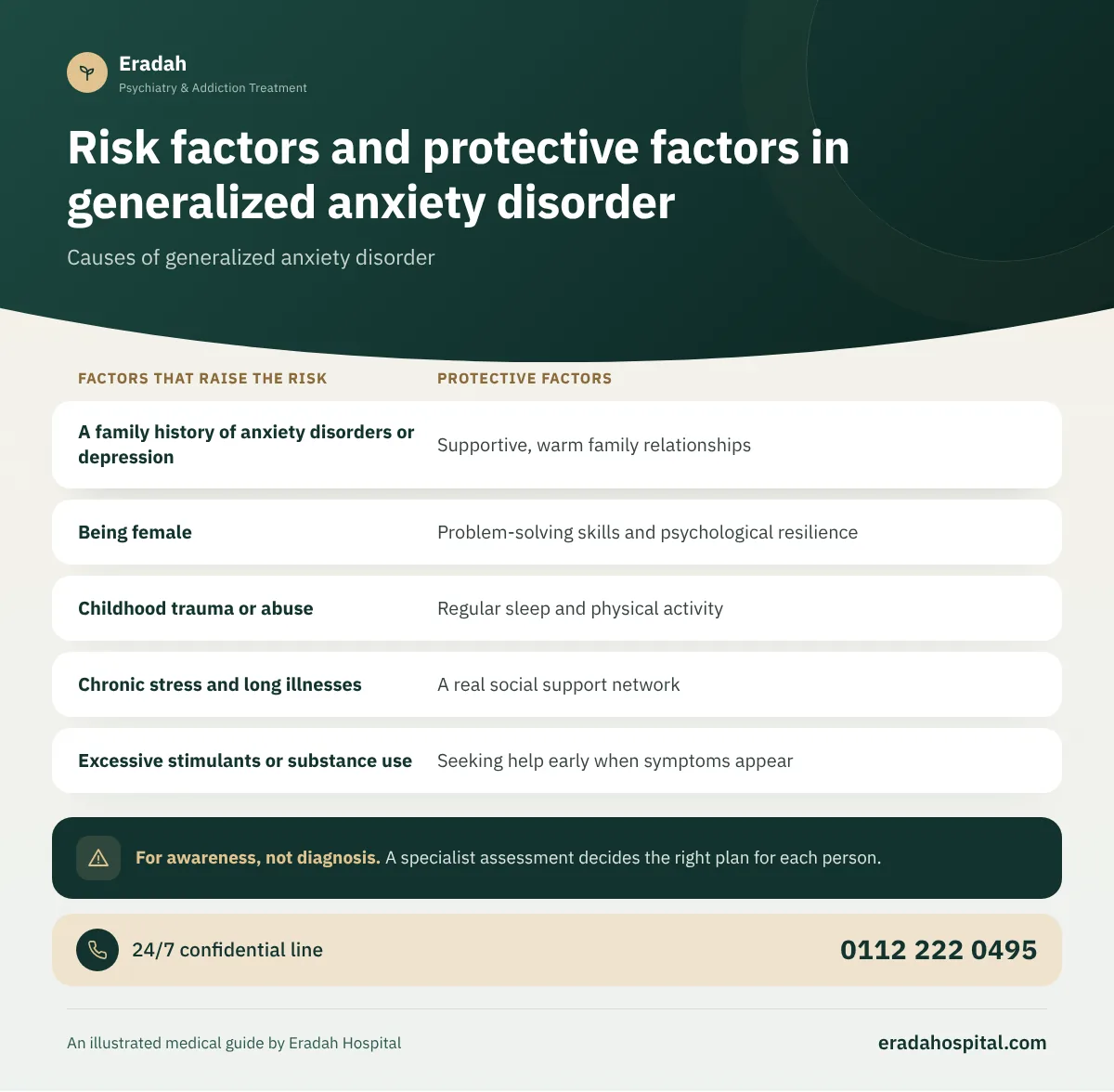
Risk factors and protective factors
| Factors that raise the risk | Protective factors |
|---|---|
| A family history of anxiety disorders or depression | Supportive, warm family relationships |
| Being female | Problem-solving skills and psychological resilience |
| Childhood trauma or abuse | Regular sleep and physical activity |
| Chronic stress and long illnesses | A real social support network |
| Excessive stimulants or substance use | Seeking help early when symptoms appear |
Common myths about the causes of anxiety
- “Anxiety is caused by weak faith”: Pathological anxiety affects religious and non-religious people alike, and has biological and psychological causes.
- “The mother is to blame”: Blaming parents is inaccurate and unhelpful; the causes are many and intertwined.
- “Anxiety is just a vitamin deficiency”: Some deficiencies may increase tiredness, but they are not a sufficient cause of chronic anxiety.
- “Someone who hasn't been through trauma can't get it”: Many people develop it without any obvious trauma, because of predisposition and everyday stress.
Understanding the causes eases guilt and points toward a suitable plan. You will find the available options on the treatment page.