Why does anxiety increase at night?
“All day I'm fine, and as soon as I put my head on the pillow my brain switches on: work, money, the kids, anything that could happen tomorrow.” This is one of the most common complaints in anxiety and insomnia clinics. Anxiety at night is not imaginary and not a weakness, but a known pattern with understandable causes and practical solutions.
During the day the mind is busy with work, people and tasks, so worrying thoughts recede into the background. With the quiet and dark the distractions disappear, and all the postponed thoughts come forward at once. Tiredness at the end of the day makes them harder to calm. When this repeats night after night, the brain may learn to link the bed itself with thinking and tension, so the anxiety starts as soon as you enter the room.
The US National Institute of Mental Health (NIMH) states that difficulty falling or staying asleep is a symptom of generalized anxiety disorder, along with worry that is hard to control, muscle tension and fatigue.
Anxiety and insomnia: which causes which?
In a systematic review published in the journal Sleep in 2013, the researchers concluded that the best available evidence indicates that insomnia is linked to anxiety and depression in both directions: anxiety disrupts sleep, and lack of sleep raises anxiety the next day. A closed loop forms:
- Anxiety before bed delays sleep.
- Too little sleep makes you more tense and less able to cope during the day.
- The anxiety begins to be about sleep itself: “If I don't sleep, I'll be wrecked tomorrow.”
- This new anxiety delays sleep even more the following night.
The NHS defines insomnia that lasts three months or more as long-term insomnia. If you have reached this stage, read the guide to chronic insomnia.
How does anxiety show up at night?
- Racing thoughts about tomorrow or the day's events, and endless “what if” scenarios.
- Palpitations or a sense of the heartbeat when lying down, and tightness in the neck and shoulders.
- Tossing and turning in bed for an hour or more before sleep.
- Waking in the middle of the night with the thoughts returning at once.
- Watching the clock and counting the hours of sleep left.
- Fatigue, irritability and poor concentration in the morning.
If the same thoughts go round in a loop that does not stop night or day, the guide to overthinking may help you.
Waking in terror: is it a night-time panic attack?
The anxiety that keeps you from falling asleep is different from waking suddenly from sleep in terror, with palpitations, shortness of breath, sweating and a sense of danger. A review published in Sleep Medicine Reviews in 2005 notes that night-time panic is common in people with panic disorder, with 44% to 71% of them reporting at least one episode, that it occurs in non-dreaming stages of sleep, and that it differs from nightmares, sleep terrors and sleep apnea.
In this case cognitive behavioral therapy targets the frightening interpretation of body sensations and the pattern of rapid breathing. Telling them apart needs a doctor, because waking up choking can also be a sign of sleep apnea, a medical problem that needs examination.
What can you do tonight to calm anxiety at night?
These steps combine NHS sleep advice with techniques used in cognitive behavioral therapy for anxiety:
Half an hour in a fixed place away from the bedroom, writing down your worries and what can be done about them.
If a thought comes at night, write it in one line and postpone it to the next day's worry time.
A quiet activity such as reading or a warm bath, and a dark, quiet room.
News and social media before bed fire up thoughts and delay drowsiness.
The NHS advises avoiding tea, coffee, smoking and alcohol for at least six hours before bed.
Wake up and get out of bed at the same time every day, even after a bad night.
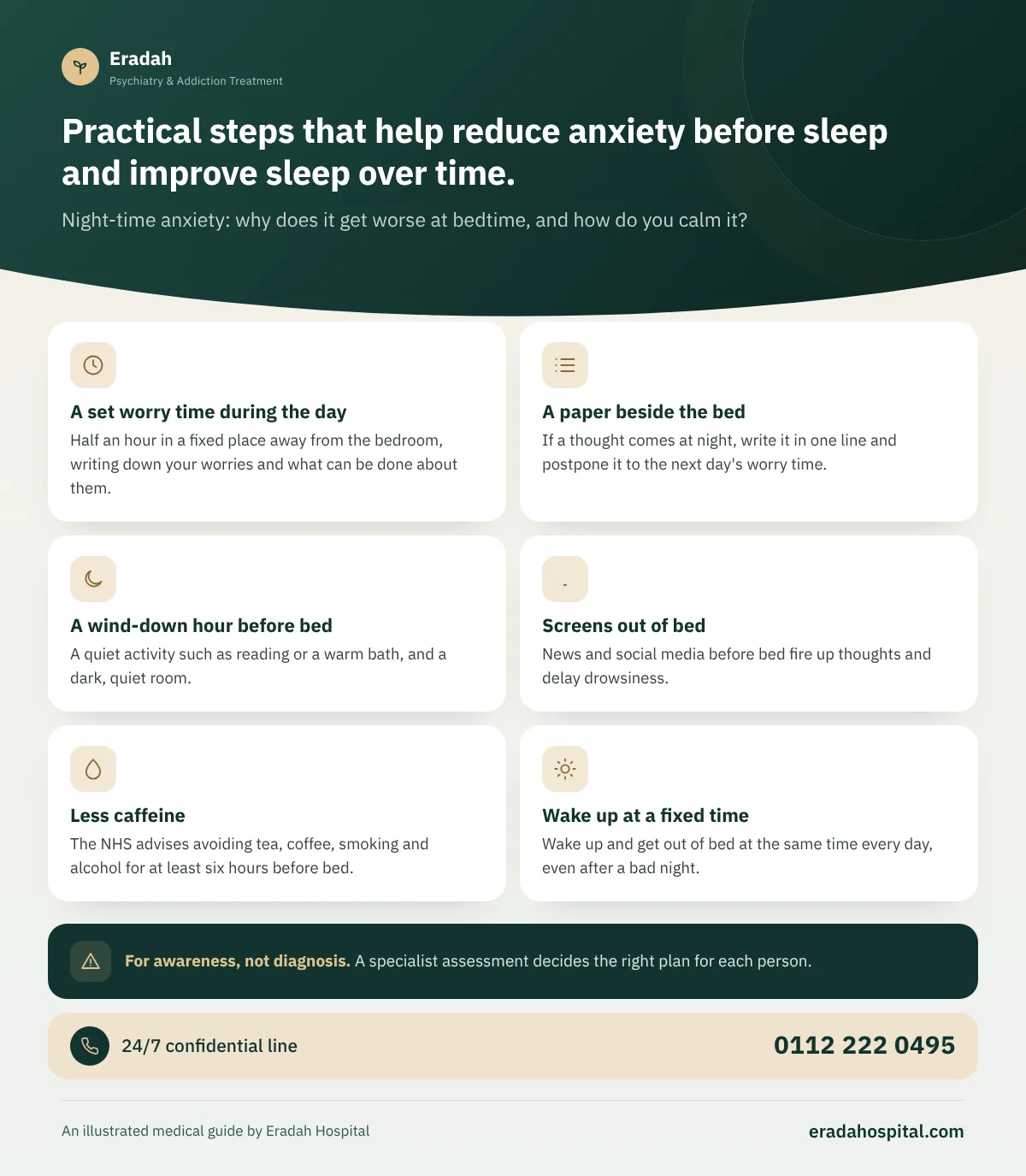
The idea of “worry time” has a research basis: in a small trial published in the journal Behavior Modification in 2013 with 53 participants who worried a lot, setting aside a daily period of 30 minutes at a set time and place for worrying, for two weeks, led to a greater reduction in anxiety and insomnia compared with the other group. Treating generalized anxiety explains how this technique is used within cognitive behavioral therapy.
If you cannot sleep: get out of bed
Staying in bed for hours wrestling with thoughts strengthens the link between the bed and anxiety. It is better to get up and go somewhere else with dim light, do something quiet and a little boring, and return when you feel sleepy. Do not look at the clock often, as counting the lost hours raises tension. And avoid making up for a bad night with long daytime sleep, because it delays sleep the following night.
Are sleeping pills and sedatives a solution for anxiety at night?
The NHS notes that doctors rarely prescribe sleeping pills today to treat insomnia, because they can cause serious side effects and dependence, and they do not treat insomnia but may help with sleep for only a very short time. In Egypt many people turn to benzodiazepines, allergy medications or alcohol to calm anxiety at night, and over time the problem turns into dependence that increases anxiety when they stop.
The guide to insomnia and addiction explains how this cycle begins and how it is broken safely. Do not start or stop any medication without a doctor.
When does anxiety at night need a doctor?
- If the anxiety and insomnia continue for more than a few weeks despite regulating your habits.
- If it comes with persistent daytime worry that is hard to control about many things.
- If you repeatedly wake in terror with palpitations and shortness of breath.
- If you have come to depend on sedatives, alcohol or cannabis to sleep.
- If thoughts about death appear, or life has become unbearable.
Cognitive behavioral therapy is effective for anxiety and insomnia together, and a doctor may add a suitable medication when needed. At Eradah Hospital it starts with an assessment that determines whether what you are experiencing is generalized anxiety, panic, insomnia, depression or dependence on sedatives, followed by a plan through outpatient treatment or residential care for men when needed. The first consultation is free and confidential.
A severe attack, or symptoms that do not feel like anxiety? Get help now
- Pressing chest pain spreading to the arm or jaw, or shortness of breath that will not ease
- Fainting, confusion, or sudden weakness on one side of the body
- Attacks that do not stop as time passes, especially for the first time
- Talk of death or that life has become “unbearable”
- Increasing use of sedatives or alcohol at night to sleep or to calm down
If chest symptoms, fainting or sudden weakness appear for the first time, do not assume it is anxiety: call the ambulance (123) or go to the nearest emergency room to rule out a physical cause. If the person talks about death or hurting themselves, stay with them, listen calmly, keep medications out of their reach, and contact the mental health support line (16328), open around the clock.
Ambulance 123 Mental health support line 16328