“I want the best medication for depression and anxiety, one you don't get hooked on and that won't affect my work.” It is an understandable request, but the more accurate question is: which medication is most suitable for me? There are many medications that treat depression and anxiety, and each suits a particular pattern of symptoms and health circumstances. Here we lay out the options as they are, without recommending any specific drug, so that you understand the doctor's reasoning and share in the decision.
Why is there no best medication for depression and anxiety for everyone?
In a large analysis published in The Lancet in 2018, covering 522 trials and more than 116,000 patients, all 21 antidepressants were more effective than placebo in major depression in adults. But the differences between the drugs themselves were relatively small, and they varied in tolerability and in how many people left treatment because of side effects. So the practical question is not “what is the strongest drug?” but “which drug will work for you and which can you stay on?”
Matters are complicated further by the fact that depression and anxiety often occur together in the same person, and the dominant symptoms differ: some people complain of insomnia and loss of appetite, others of physical tension and panic attacks, and others of recurring thoughts. Each pattern has a more suitable drug. You will find an explanation of the groups and how they work in the guide to antidepressants.
Medication options for depression and anxiety
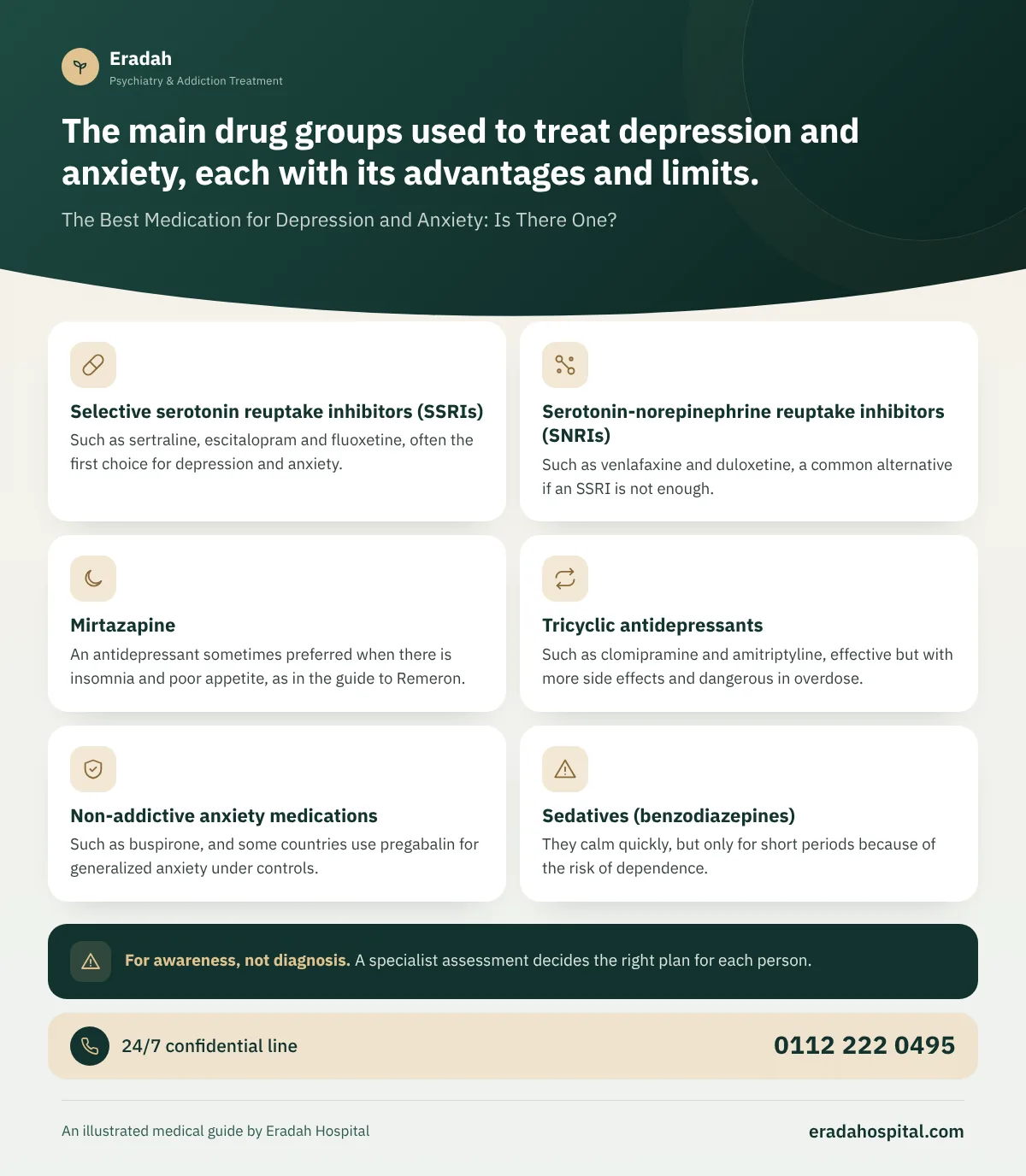
Such as sertraline, escitalopram and fluoxetine, often the first choice for depression and anxiety.
Such as venlafaxine and duloxetine, a common alternative if an SSRI is not enough.
An antidepressant sometimes preferred when there is insomnia and poor appetite, as in the guide to Remeron.
Such as clomipramine and amitriptyline, effective but with more side effects and dangerous in overdose.
Such as buspirone, and some countries use pregabalin for generalized anxiety under controls.
They calm quickly, but only for short periods because of the risk of dependence.
What do medical guidelines say about the best medication for anxiety and depression?
For generalized anxiety, the guidelines of the UK's National Institute for Health and Care Excellence (NICE) leave the choice to the patient between intensive psychological therapy (cognitive behavioral therapy or applied relaxation) and medication, because there is no evidence that one is better than the other. If the patient chooses medication, the start is an SSRI, and the guidelines suggest sertraline first because it is the least costly. If it does not work, another SSRI or an SNRI is tried, and if the patient cannot tolerate them, pregabalin can be considered.
For depression, NICE guidelines describe SSRIs as well tolerated and safe, and say they should be the first choice for most people. But they do not recommend medication as routine first-line treatment for less severe depression unless the patient prefers it after learning the options, while combining cognitive behavioral therapy with an antidepressant is among the first options for more severe depression.
How does the doctor choose the right medication for you?
| Factor | Why does it matter? |
|---|---|
| The dominant symptoms | Insomnia and poor appetite favor one drug, while panic or obsessions favor another. |
| The side effects you can accept | Some drugs add weight, and some affect sexual function or sleep. |
| Other illnesses and medications | Heart and liver disease, blood thinners and painkillers such as tramadol change the calculation. |
| Pregnancy and breastfeeding | Some drugs have clearer safety data than others at this stage. |
| Personal and family history | Previous manic episodes, or a first-degree relative's response to a particular drug. |
| Substance use | Alcohol and drugs interact with the medication and may be the cause of the symptoms in the first place. |
Why aren't sedatives the best medication for anxiety and depression?
Many people look for a medication that “relieves you from the first pill”, and this is what benzodiazepines such as Xanax do. But quick relief has a price: the body gets used to them, so their effect weakens and withdrawal symptoms appear on stopping, and they can turn into dependence. They also do not treat depression. That is why the doctor sometimes uses them for a few days or weeks at the start, until the antidepressant begins to work, and then stops them gradually.
The same applies to pregabalin: although the UK guidelines mention it as an alternative in generalized anxiety, the United Kingdom has classified it since 2019 as a controlled substance because of its misuse, and the guidelines call for assessing any history of substance use before prescribing it.
When does the medication take effect? And why is it abandoned early?
The side effects of antidepressants usually appear before the benefit, and the UK's National Health Service (NHS) notes that many of them ease after about two weeks, while improvement may take several weeks. This is where a common mistake occurs: the patient judges the medication in the first week and drops it, or moves from one drug to another before any of them has had a chance. It is better to agree with your doctor on a clear date for review.
Psychological therapy: an alternative or a partner to medication
Medication is part of the plan, not the whole plan. Cognitive behavioral therapy teaches skills for dealing with worrying thoughts and with the behaviors that feed depression, and its effect continues after the sessions end. You can learn how it works in the guide to cognitive behavioral therapy. In many cases, combining medication and psychological therapy is better than either alone.
When do you need a specialist assessment?
If you have tried two or more medications without enough improvement, or if anxiety and depression come with the use of sedatives or other substances, a comprehensive assessment that reviews the diagnosis and all medications is best. At Eradah this begins with a free, confidential first consultation, followed by follow-up through outpatient treatment or the psychiatry department as needed, with a dual diagnosis program for people who have both a mental illness and substance use.