How are the types of depression classified medically?
Psychiatrists rely on two main classification systems: the American Diagnostic and Statistical Manual in its revised edition, DSM-5-TR, and the World Health Organization's International Classification of Diseases, ICD-11. They agree in substance even where some names differ.
It is important to distinguish between two things: the disorders themselves (such as major depression and persistent depression), and the specifiers, which are descriptors added to the diagnosis to clarify its picture, such as "peripartum onset," "seasonal pattern" or "with psychotic features." Postpartum depression, for example, is not classified as a separate illness in DSM-5-TR; it is major depression that began during pregnancy or after childbirth.
| Type | Key feature |
|---|---|
| Major depressive disorder | One or more episodes of depressed mood or loss of pleasure lasting at least two weeks, with other symptoms |
| Persistent depressive disorder (dysthymia) | Depressed mood on most days for at least two years in adults, and one year in children and adolescents |
| Premenstrual dysphoric disorder | Severe mood symptoms that recur in the week before the period and improve after it starts |
| Disruptive mood dysregulation disorder | In children: chronic irritability and frequent severe temper outbursts |
| Substance- or medication-induced depression | Depressive symptoms linked to substance use, withdrawal or a particular medication |
| Depression due to another medical condition | Depressive symptoms caused directly by a physical illness such as an underactive thyroid |
| Other specified or unspecified depressive disorders | Presentations that do not meet all the criteria of the types above but cause distress |
What is major depressive disorder?
This is the best-known form, and what is usually meant when people say "depression." It is diagnosed when depressed mood or loss of pleasure is present along with a number of other symptoms for at least two weeks, to a degree that causes clear distress or impairment. It may happen once in a lifetime, or recur as episodes separated by periods of improvement, and ICD-11 calls it single-episode or recurrent depressive disorder.
The doctor specifies the severity of the episode (mild, moderate or severe), whether it is in partial or full remission, and adds the appropriate specifiers. The details of the symptoms themselves are on the page symptoms of depression.
What is chronic depression or dysthymia?
Persistent depressive disorder, or "dysthymia," is long-term depression: depressed mood for most of the day on most days for at least two years in adults (one year in children and adolescents, in whom the mood may be irritable), with symptoms such as low energy, low self-esteem, hopelessness, poor concentration and disturbed sleep or appetite.
Its symptoms may be milder than a major episode, but its long duration leads the person to think "this is just how I am" or "my personality," so they do not seek help for years. Episodes of major depression may occur on top of it, which is sometimes called "double depression." DSM-5 merged chronic major depression and dysthymia under this single name.
What is postpartum depression?
In DSM-5-TR it is called depression with peripartum onset, used when a depressive episode begins during pregnancy or in the four weeks after childbirth, although in practice doctors pay attention to any depression that appears during the first year after birth. The World Health Organization estimates that more than 10% of pregnant women and new mothers experience depression.
| The situation | Duration and severity | What is needed? |
|---|---|---|
| Postpartum blues (baby blues) | Mood swings, crying and mild anxiety in the first days, usually going away within two weeks | Support, rest and sleep, and see a doctor if it continues |
| Postpartum depression | Stronger depressive symptoms lasting more than two weeks, with difficulty caring for oneself or the baby or bonding with the baby | Specialist assessment and treatment; it is common and treatable |
| Postpartum psychosis | Rare, usually starting early after birth, with hallucinations, unrealistic beliefs or severe agitation | A psychiatric emergency that needs immediate care |
An affected mother does not deserve labels like "bad mother" or "lacking faith"; she is going through a common illness with hormonal, psychological and social causes. Support from the husband and family with sleep and caring for the baby is an important part of recovery.
What is seasonal depression?
Scientifically known as major depressive disorder with seasonal pattern, in which depressive episodes begin and end at specific times of the year. The best known is the winter pattern, which starts in late autumn and improves in spring, and this pattern must recur for at least two consecutive years. It is dominated by oversleeping, craving food, especially carbohydrates, weight gain, sluggishness and withdrawal.
It is thought that reduced exposure to sunlight affects the body clock and hormones such as melatonin. It is less common in sunny countries like Egypt, but it does appear in some people, and there is also a less common summer pattern.
What is psychotic depression?
This is severe depression with psychotic features, meaning fixed unrealistic beliefs (delusions) or hallucinations appear with it. These beliefs are usually consistent with the depressed mood, such as believing one has committed a great sin that deserves punishment, is completely bankrupt, has a serious illness that does not exist, or hearing voices that blame the person.
This type needs urgent assessment and a special treatment plan, because its risk is higher and the patient may not realize they are ill. It differs from schizophrenia in that the psychotic symptoms appear only during the depressive episode.
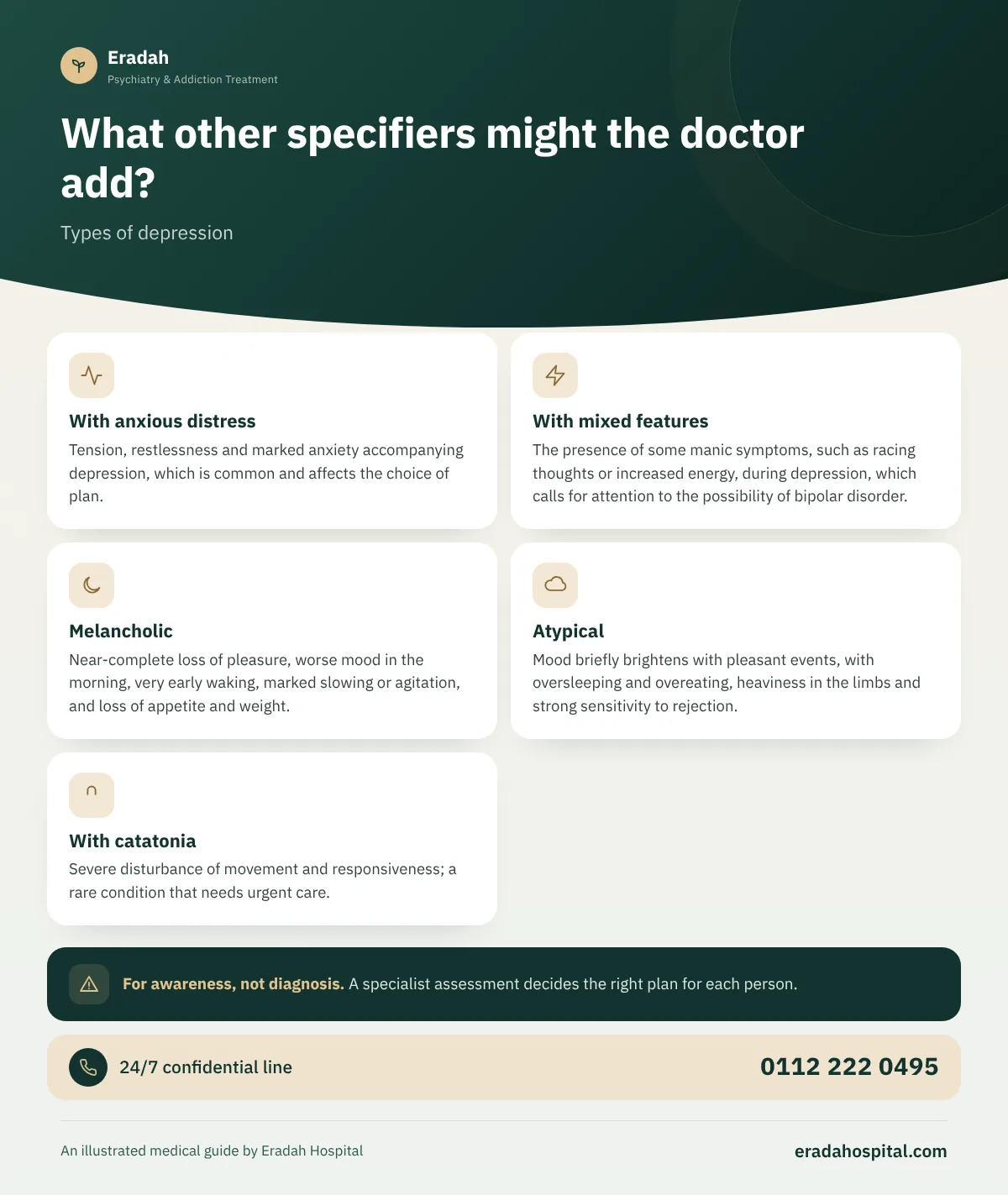
What other specifiers might the doctor add?
Tension, restlessness and marked anxiety accompanying depression, which is common and affects the choice of plan.
The presence of some manic symptoms, such as racing thoughts or increased energy, during depression, which calls for attention to the possibility of bipolar disorder.
Near-complete loss of pleasure, worse mood in the morning, very early waking, marked slowing or agitation, and loss of appetite and weight.
Mood briefly brightens with pleasant events, with oversleeping and overeating, heaviness in the limbs and strong sensitivity to rejection.
Severe disturbance of movement and responsiveness; a rare condition that needs urgent care.
What is the difference between depression and bipolar depression?
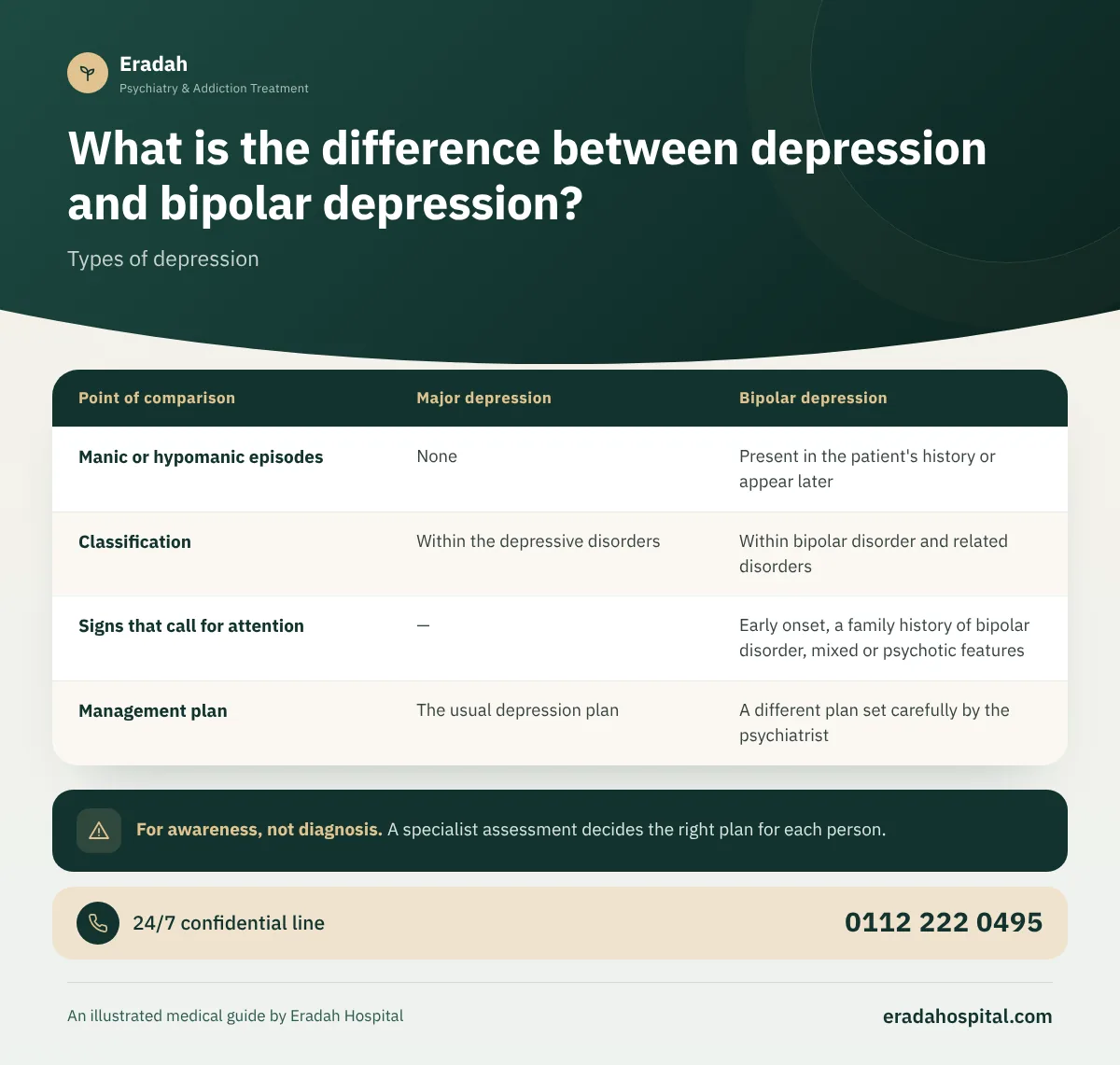
A depressive episode in bipolar disorder can be identical to a major depressive episode, but what distinguishes them is a past or future manic or hypomanic episode: periods of excess energy, reduced need for sleep, racing speech and thoughts, impulsivity, and excessive spending or risk-taking.
That is why DSM-5-TR does not classify bipolar depression among the depressive disorders but in a separate chapter. The doctor takes care to ask about these periods and about family history before making the plan, because treatment of bipolar depression differs from the usual depression treatment, and some options may be unsuitable for it if used alone.
| Point of comparison | Major depression | Bipolar depression |
|---|---|---|
| Manic or hypomanic episodes | None | Present in the patient's history or appear later |
| Classification | Within the depressive disorders | Within bipolar disorder and related disorders |
| Signs that call for attention | — | Early onset, a family history of bipolar disorder, mixed or psychotic features |
| Management plan | The usual depression plan | A different plan set carefully by the psychiatrist |
What other, less well-known types of depression are there?
- Premenstrual dysphoric disorder: severe mood symptoms such as irritability, sadness and tension that recur before the period and cause clear impairment; it is much more severe than ordinary premenstrual syndrome.
- Disruptive mood dysregulation disorder: diagnosed in children between ages 6 and 18, with symptoms starting before age 10, featuring chronic irritability and frequent severe temper outbursts.
- Substance- or medication-induced depression: linked to substance use or withdrawal, and covered in detail on the page depression and addiction.
- Depression due to a medical condition: such as depression linked to an underactive thyroid, stroke or Parkinson's disease.
- Mixed anxiety and depressive disorder: recognized by ICD-11 to describe anxiety and depressive symptoms together when neither reaches the threshold for a separate diagnosis.
What is treatment-resistant depression?
"Resistant depression" is a clinical term, not an official type in the classifications, and it is usually applied when depression does not improve enough despite properly trying at least two different medications for an adequate time. Before judging it resistant, the doctor reviews the diagnosis itself, adherence to treatment, and the presence of accompanying anxiety, substance use or physical illness. There are several options for these cases, explained on the page depression treatment.