Feelings that swing sharply within hours, a constant fear that people you love will leave you, and close relationships that swing between attachment and conflict: these are some features of borderline personality disorder, a real disorder that responds to specialist treatment more than many people think.
Start the borderline personality test
How is the score calculated?
Each “yes” answer equals one point and each “no” equals zero, so the result ranges from 0 to 10. The scale's developers chose a score of 7 as the cutoff for a positive screen, because it gave the best balance between picking up cases and ruling out others.
| Level | Explanation | Suggested step |
|---|---|---|
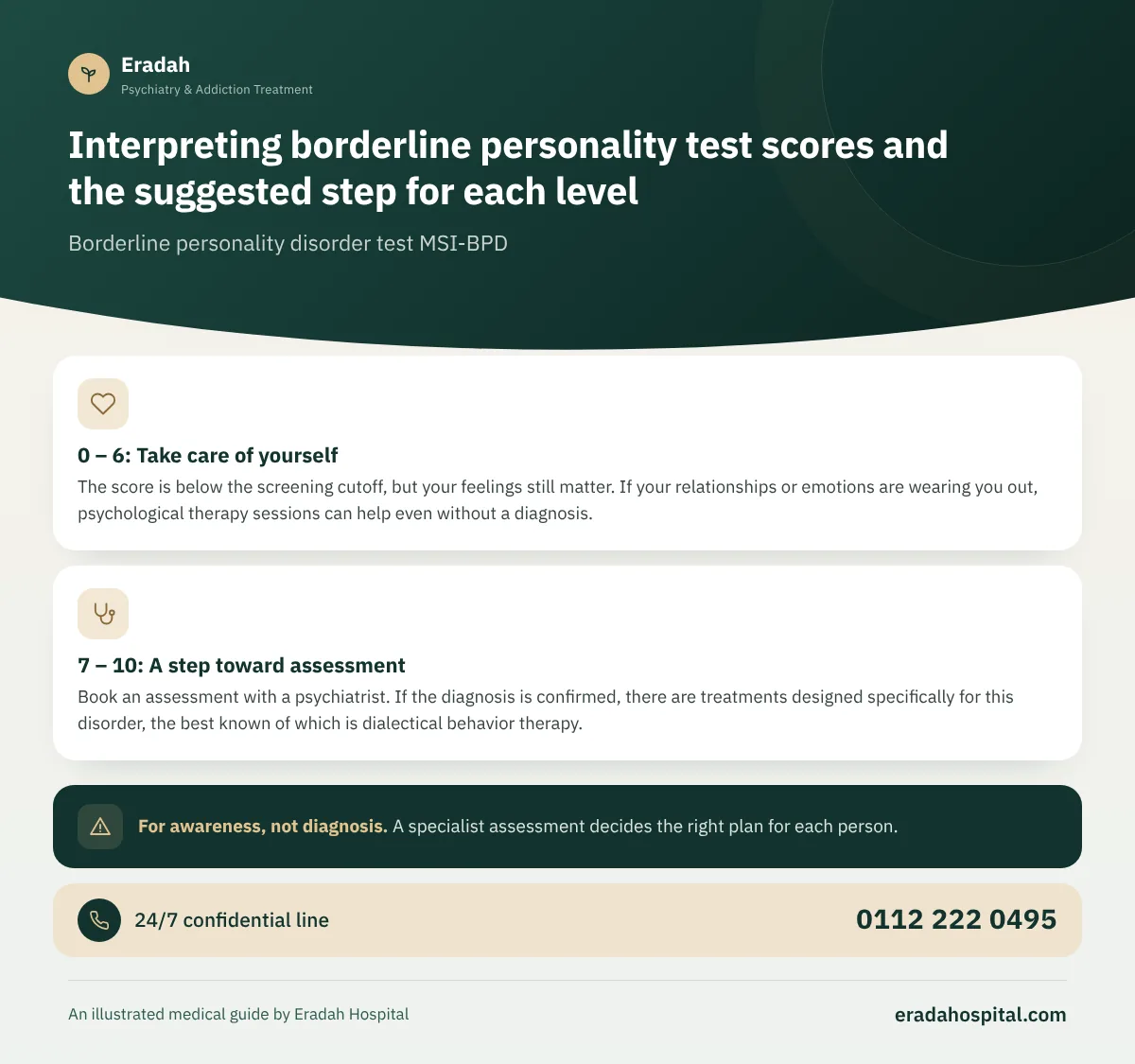
| 0 – 6 | Below the screening cutoff | Take care of yourself, and ask for help if your feelings or relationships are exhausting |
| 7 – 10 | Above the screening cutoff | Assessment by a psychiatrist |
The urge to harm yourself is often an attempt to relieve emotional pain that feels beyond what you can bear, and it is not a request for attention. There are safer ways to get through those moments that can be learned, and some of them are explained in our guide on self-harm.
What to do after your result
The score is below the screening cutoff, but your feelings still matter. If your relationships or emotions are wearing you out, psychological therapy sessions can help even without a diagnosis.
Book an assessment with a psychiatrist. If the diagnosis is confirmed, there are treatments designed specifically for this disorder, the best known of which is dialectical behavior therapy.
And remember that the difficulties the test describes are not a flaw in who you are or a weakness of your willpower, but a pattern formed over years, and skills for dealing with it can be learned. Some of its symptoms also resemble other disorders, so it helps to read about the difference between bipolar disorder and borderline personality disorder.
What is the MSI-BPD scale?
Researcher Mary Zanarini and her team at McLean Hospital, affiliated with Harvard University, developed this scale, and its validation study was published in 2003. Its ten questions are taken from a detailed diagnostic interview that corresponds to the criteria for the disorder in the diagnostic manual, with the paranoia and dissociation criterion split into two questions. In the original study, a score of 7 or more picked up about 81% of people with the disorder and ruled out about 85% of those without it, and the participants were young adults. The scale is valued for its brevity and the clarity of its questions, so it is used in clinics and research as a first step before the full diagnostic interview, not as a substitute for it.
How does the disorder show up in daily life?
A person with borderline personality disorder does not experience feelings foreign to human beings; they experience the same feelings more intensely, and the feelings settle down more slowly. That is what makes ordinary situations seem like major crises. Common examples include:
- A friend's late reply to a message is read as rejection or abandonment, and feelings of fear and anger flare up.
- Views of other people swing between complete idealization and complete disappointment.
- Impulsive decisions in moments of distress, followed by regret and guilt.
- A recurring sense of emptiness or of not knowing what you want from life.
These difficulties usually begin in adolescence or early adulthood, and are often linked to an innate emotional sensitivity that met an environment that did not help soothe it. With age and regular treatment, the severity of symptoms eases in many people and relationships become more stable.
Limits of the test
- It does not diagnose the disorder; a diagnosis needs a detailed interview with a psychiatrist.
- Some of its symptoms resemble bipolar disorder, post-traumatic stress disorder and depression.
- Acute crises and major stresses can raise the score temporarily.
- Substance use and withdrawal increase impulsiveness and mood swings.
- The scale was developed on young adults, and its accuracy at other ages has been studied less.
- An answer given on a difficult day may differ from one given on a calm day, so be careful to describe your usual pattern.
Borderline personality disorder and addiction
Many people with borderline personality disorder turn to alcohol, sedatives or drugs to calm overwhelming feelings or to fill the sense of emptiness, and the temporary fix becomes a second problem that increases impulsiveness and complicates relationships. Treating both problems together works better than treating each alone, as the article on borderline personality disorder and addiction explains. Residential treatment at Eradah is available for men, while women and teenagers are received for assessment and follow-up.
Free confidential consultation
If your score is above the screening cutoff, or you feel your emotions and relationships are draining you, you are not alone in this. Contact the Eradah team for a free, confidential first consultation on 01122220495, so we can listen to you and help you decide on the next step.