"Do I need dopamine or serotonin?" This question comes up often after videos that talk about "happiness hormones" as if they were buttons we press. The truth is that the two are different neurotransmitters in source and function, but they work together, and understanding the difference protects against misleading advice and from trying supplements or medications without a doctor.
What is the difference between dopamine and serotonin in brief?
Both are neurotransmitters, that is, chemical messengers through which nerve cells pass signals. But dopamine pushes you toward what you want and teaches you what is worth repeating, while serotonin sets the general rhythm of mood, sleep and appetite and helps restrain impulses. Imagine the first as the gas pedal and the second as part of the car's balance system.
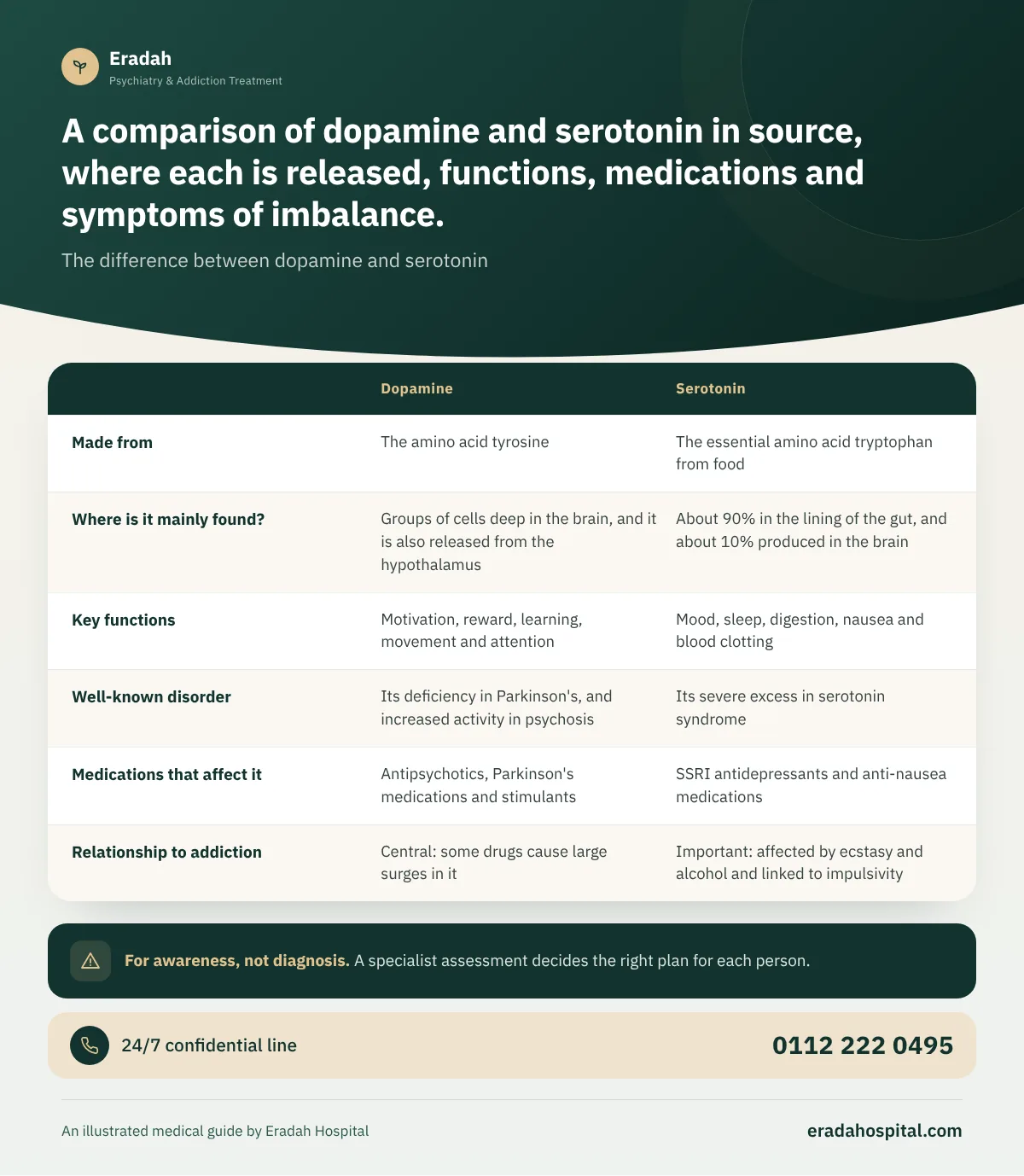
Table of differences between dopamine and serotonin
| Dopamine | Serotonin | |
|---|---|---|
| Made from | The amino acid tyrosine | The essential amino acid tryptophan from food |
| Where is it mainly found? | Groups of cells deep in the brain, and it is also released from the hypothalamus | About 90% in the lining of the gut, and about 10% produced in the brain |
| Key functions | Motivation, reward, learning, movement and attention | Mood, sleep, digestion, nausea and blood clotting |
| Well-known disorder | Its deficiency in Parkinson's, and increased activity in psychosis | Its severe excess in serotonin syndrome |
| Medications that affect it | Antipsychotics, Parkinson's medications and stimulants | SSRI antidepressants and anti-nausea medications |
| Relationship to addiction | Central: some drugs cause large surges in it | Important: affected by ecstasy and alcohol and linked to impulsivity |
The Cleveland Clinic notes that serotonin is made from tryptophan, which the body cannot make and gets from food, and that about 90% of it is found in the cells lining the digestive tract, and platelets pick it up from the blood. Dopamine, by contrast, is made from tyrosine and works as a neurotransmitter in the brain, and it is also released from the hypothalamus to act as a neurohormone.
Which one is responsible for happiness?
Neither one on its own. Dopamine is tied to desire and "eagerness to get the thing" more than to pleasure itself, and serotonin helps with stability, contentment and regulating anxiety. That is why the happiness hormones guide describes this nickname as an oversimplification. Feeling good is the product of a network that also includes oxytocin, endorphins and others, and it is affected by sleep, relationships and movement.
The difference between dopamine deficiency and serotonin deficiency
- Dopamine deficiency: its best-known forms are slow movement, tremor and stiffness in Parkinson's, and it is also linked to reduced motivation and difficulty concentrating. The details are in dopamine deficiency.
- Serotonin deficiency: popularly linked to depression, anxiety and insomnia, but the relationship is more complex than is said, as the serotonin deficiency guide explains.
And what about excess?
Increased dopamine activity in certain pathways is linked to hallucinations and delusions in psychosis, and appears with stimulants such as crystal meth (shabu) and cocaine; we explain this in high dopamine. Severe excess of serotonin causes serotonin syndrome, an emergency that usually occurs when medications or substances that raise it are combined, and appears as fever, sweating, tremor, stiffness and confusion; the details are in high serotonin.
Dopamine and serotonin in addiction
The US National Institute on Drug Abuse (NIDA) explains that some drugs cause surges of neurotransmitters in the reward circuit, including dopamine, far larger than those produced by natural pleasures like eating and music, so the brain learns to seek them urgently, as the dopamine and addiction guide explains. Serotonin, meanwhile, is strongly affected by some substances such as ecstasy, and its disruption is linked to impulsivity and mood swings after stopping; the details are in serotonin and addiction. That is why a person in recovery needs time to regain their natural mood and motivation.
Can one be raised without the other?
Safe natural methods such as regular sleep, exercise, daylight exposure and social relationships support the whole network, not a single neurotransmitter. Supplements marketed to raise serotonin or dopamine, however, may interact dangerously with antidepressants and some painkillers. You can find what science proves in increasing dopamine naturally and increasing serotonin naturally.
When should you see a doctor instead of looking for the "missing neurotransmitter"?
There is no blood test that measures the level of dopamine or serotonin in the brain for use in diagnosing mental conditions. If you have persistent sadness, loss of passion, anxiety or insomnia for weeks, or tremor and slow movement, the right step is a medical assessment, not guessing. At Eradah we offer a free, confidential first consultation at the psychiatric hospital, and we treat cases where a mental disorder and substance use occur together under dual diagnosis.