What does low dopamine mean?
When doctors talk about “dopamine deficiency,” they usually mean a weakened dopamine signal in a particular pathway of the brain: either because the cells that make it are dying, or because its receptors are blocked by a medication, or because the brain has lowered its sensitivity after long exposure to a substance that raises it strongly.
That is why there is no single “dopamine deficiency” that one treatment fits. A patient with Parkinson’s has a real and clear deficiency in the movement pathway, while a child with ADHD has a difference in how dopamine is regulated in attention pathways, and someone who recently stopped shabu goes through a temporary drop in reward circuit activity. Understanding it correctly starts with identifying the context.
What are the symptoms of low dopamine?
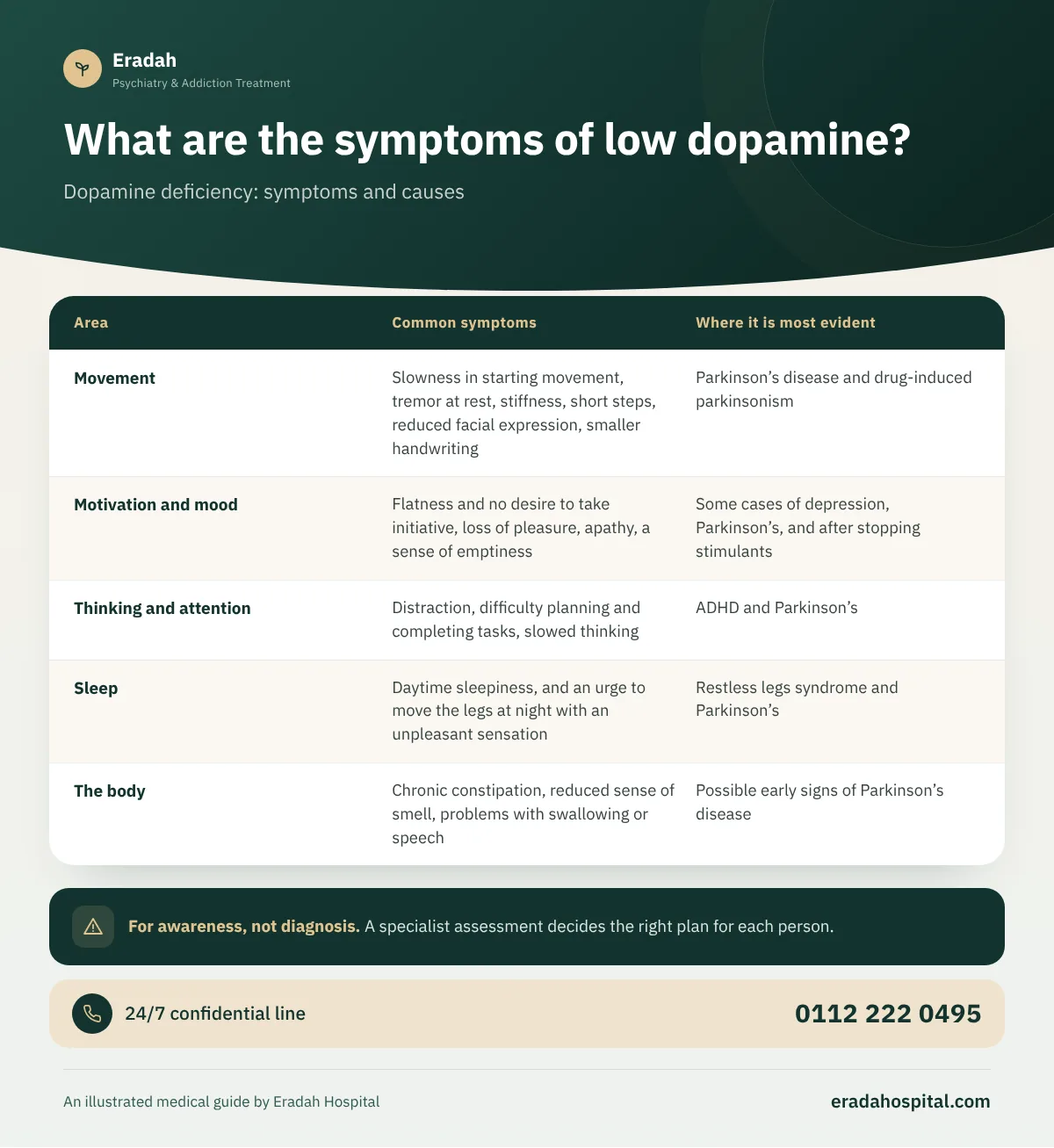
We present the symptoms grouped by the system affected, with a reminder that having some of them does not necessarily mean dopamine is the cause:
| Area | Common symptoms | Where it is most evident |
|---|---|---|
| Movement | Slowness in starting movement, tremor at rest, stiffness, short steps, reduced facial expression, smaller handwriting | Parkinson’s disease and drug-induced parkinsonism |
| Motivation and mood | Flatness and no desire to take initiative, loss of pleasure, apathy, a sense of emptiness | Some cases of depression, Parkinson’s, and after stopping stimulants |
| Thinking and attention | Distraction, difficulty planning and completing tasks, slowed thinking | ADHD and Parkinson’s |
| Sleep | Daytime sleepiness, and an urge to move the legs at night with an unpleasant sensation | Restless legs syndrome and Parkinson’s |
| The body | Chronic constipation, reduced sense of smell, problems with swallowing or speech | Possible early signs of Parkinson’s disease |
One sign neurologists pay attention to is a disorder called “REM sleep behavior disorder”, in which a person “acts out” their dreams, hitting out or shouting during sleep. In some patients it can appear years before the motor symptoms of Parkinson’s, so it deserves evaluation.
What causes low dopamine?
Dopamine cells in the substantia nigra die gradually, and motor symptoms usually appear only after 60 to 80% or more of them are lost.
Such as some antipsychotics and some anti-nausea drugs like metoclopramide. They can cause “drug-induced parkinsonism,” which often improves after the medication is adjusted.
After long-term use of cocaine or shabu, the brain lowers its dopamine receptors, so the person goes through a period of flatness and loss of pleasure.
An imaging study showed that a single night without sleep reduced the availability of dopamine receptors in the reward area.
Iron is a cofactor for the enzyme that makes dopamine, and its deficiency is linked to restless legs syndrome.
Genetics plays a major role in ADHD, and there are rare inherited disorders of dopamine synthesis that appear in childhood.
Scientists also discuss the role of chronic stress and inflammation in weakening the reward system, but this research is still developing and is not enough to consider either a proven cause in any particular person.
Which conditions are linked to low dopamine?
- Parkinson’s disease: the clearest example of dopamine deficiency. It mostly affects older adults and progresses slowly. Treatment greatly eases symptoms but so far does not restore the lost cells.
- ADHD: linked to a difference in the regulation of dopamine and norepinephrine in attention and control pathways, not a simple “deficiency,” which is why its medications work by improving the availability of these two chemicals.
- Restless legs syndrome: an urgent need to move the legs when resting at night; part of it is linked to dopamine dysfunction and iron deficiency in the brain.
- Depression with loss of pleasure: dopamine takes part in the loss of motivation and pleasure in some patients, but depression cannot be reduced to a single chemical.
- Rare inherited disorders: such as L-DOPA-responsive dystonia, which appears in childhood and improves remarkably with the right treatment.
Who is most at risk of low dopamine?
- Older adults, especially with a family history of Parkinson’s disease.
- People who take medications that block dopamine receptors for long periods, especially older adults.
- People who recently stopped stimulants after long or heavy use.
- People with iron deficiency, including pregnant women and people with kidney disease, in the case of restless legs.
- Children who have relatives with ADHD.
- People with chronic sleep deprivation or long-term stress, to a lesser degree and with less consistent evidence.
How is low dopamine diagnosed? Is there a test for it?
There is no blood test that detects dopamine deficiency in the brain. The doctor relies on the history of symptoms and a neurological and psychological examination, then orders what is needed to rule out other causes:
- Medical history and medications: when the symptoms began, and whether a new medication or stopping a substance came before them.
- Neurological examination: assessing tremor, stiffness, slowness, gait and facial expression.
- Tests to rule out other causes: such as thyroid function, iron stores, vitamin B12 and a blood count.
- Psychological scales: to assess depression and ADHD when the symptoms are psychological or cognitive.
- Dopamine transporter imaging: in selected cases, requested by a neurologist to distinguish Parkinson’s from other causes of tremor.
How is low dopamine treated medically?
Treatment targets the underlying condition and is prescribed and followed by a doctor. We mention the drug classes for awareness only; they are not to be used without a prescription:
| The situation | Common treatment categories | Important notes |
|---|---|---|
| Parkinson’s disease | Levodopa with carbidopa, dopamine agonists, inhibitors of the enzymes that break down dopamine, and physical therapy | Dopamine agonists can cause compulsive behaviors; tell your doctor about any change |
| ADHD (attention-deficit/hyperactivity disorder) | Stimulant medications such as methylphenidates, non-stimulant medications, and behavioral therapy | Dispensed by prescription with follow-up, and misuse is dangerous |
| Restless legs | Iron replacement when deficient, and medications chosen by the doctor | Some medications may worsen symptoms in the long term |
| Drug-induced parkinsonism | Reviewing or adjusting the causative medication | Do not stop an antipsychotic on your own |
| Depression with loss of pleasure | Psychotherapy, and antidepressants chosen by the doctor | Improvement takes weeks |
As for supportive lifestyle measures such as regular sleep and exercise, we explain them in detail, with an assessment of the evidence, on the page Natural Ways to Boost Dopamine. They support treatment and are not a substitute for it in neurological diseases.
When should you see a doctor about possible low dopamine?
- A hand tremor at rest, clearly slowed movement, or a change in the way you walk.
- Loss of the sense of smell with chronic constipation and “acting out” dreams during sleep.
- Stiffness or unusual movements after starting a psychiatric medication or an anti-nausea medication.
- Flatness and loss of pleasure that last more than two weeks and affect work and relationships.
- A nighttime urge to move the legs that disrupts sleep.
- Severe, prolonged flatness after stopping drugs; this is part of recovery and needs specialized support.
The right doctor depends on the symptoms: a neurologist for movement symptoms and restless legs, a psychiatrist for flatness, depression and ADHD, and an addiction treatment team for the period after stopping substances. If the drop is linked to drugs, you will find the full picture in Dopamine and Addiction.