What does high dopamine mean?
There is no illness called “excess dopamine” that is diagnosed by a number on a test. Medically, what is meant is overactive dopamine signaling in a particular pathway of the brain, because of a substance that raises its release, a medication that mimics it, or a dysfunction in its regulation as in psychosis.
The affected pathway shapes the picture: overactivity in the reward pathway is linked to impulsiveness, suspiciousness and hallucinations, in the movement pathway to involuntary movements, while raised catecholamines in the blood are linked to rare tumors that raise blood pressure. That is why we present the causes and signs by context.
What are the symptoms of high dopamine?
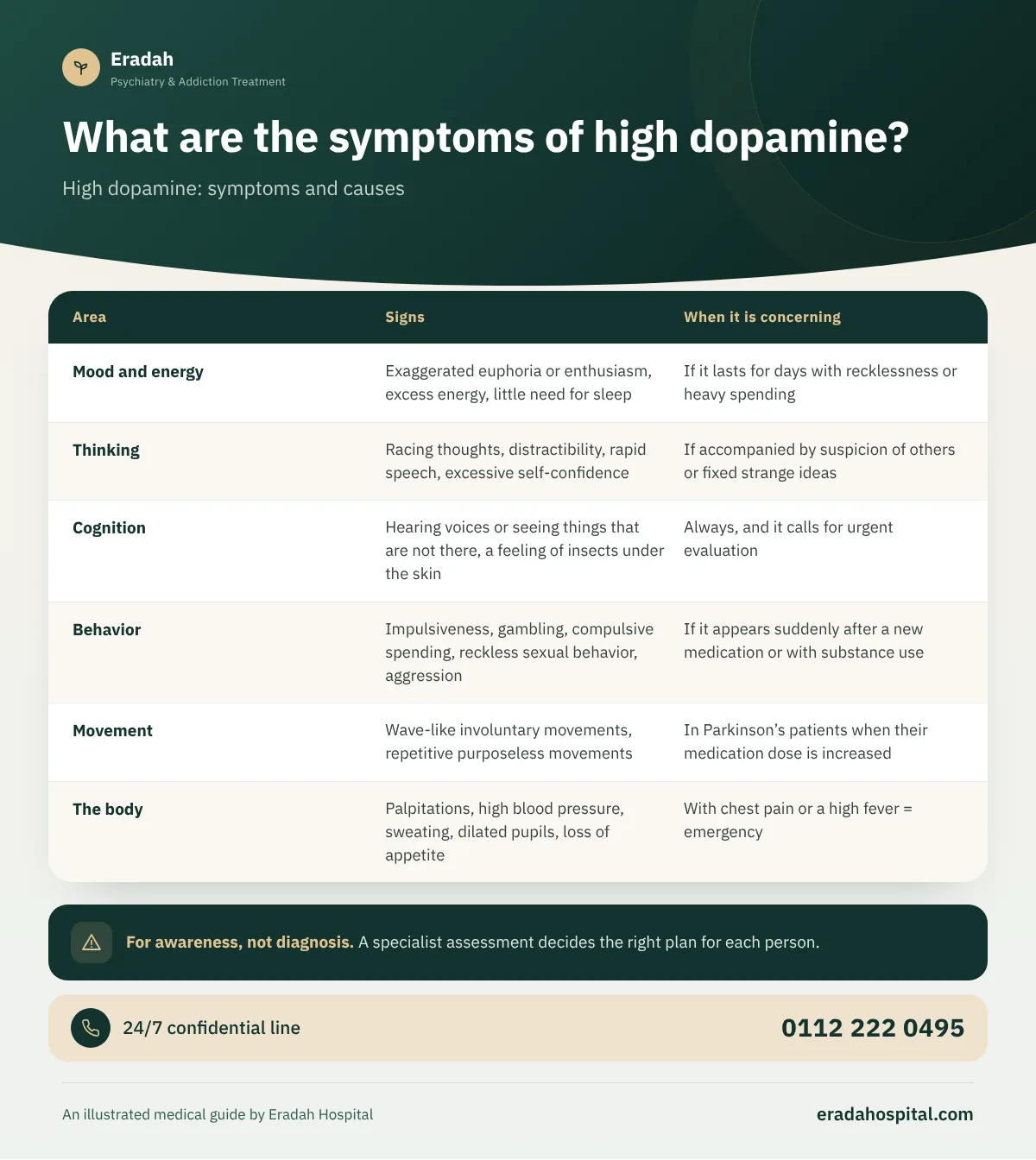
| Area | Signs | When it is concerning |
|---|---|---|
| Mood and energy | Exaggerated euphoria or enthusiasm, excess energy, little need for sleep | If it lasts for days with recklessness or heavy spending |
| Thinking | Racing thoughts, distractibility, rapid speech, excessive self-confidence | If accompanied by suspicion of others or fixed strange ideas |
| Cognition | Hearing voices or seeing things that are not there, a feeling of insects under the skin | Always, and it calls for urgent evaluation |
| Behavior | Impulsiveness, gambling, compulsive spending, reckless sexual behavior, aggression | If it appears suddenly after a new medication or with substance use |
| Movement | Wave-like involuntary movements, repetitive purposeless movements | In Parkinson’s patients when their medication dose is increased |
| The body | Palpitations, high blood pressure, sweating, dilated pupils, loss of appetite | With chest pain or a high fever = emergency |
What causes high dopamine?
Cocaine blocks dopamine reuptake, while shabu, amphetamine and Captagon push the cell to release it in huge amounts.
Research points to increased synthesis and release of dopamine in the striatum in many people with psychosis.
Mania in bipolar disorder is linked to overactivity of dopamine systems, among other factors.
Levodopa and dopamine agonists used for Parkinson’s and restless legs may cause involuntary movements and compulsive behaviors.
Pheochromocytoma and tumors of the nerve ganglia secrete catecholamines, sometimes including dopamine, which raises blood pressure.
Methylphenidates are relatively safe when prescribed, but using them without supervision or in non-medical ways raises dopamine dangerously.
For each substance in detail, see the pages on cocaine, shabu, Captagon and Ritalin.
What is the link between high dopamine and psychosis and schizophrenia?
The “dopamine hypothesis” is one of the oldest theories in psychiatry. It holds that overactive dopamine in the reward pathway makes the brain assign exaggerated “significance” to ordinary things: a passing glance becomes a message, and an inner voice is heard as if it came from outside. It is supported by two facts: that stimulants that raise dopamine can cause psychosis in healthy people, and that antipsychotic medications work mainly by blocking D2 receptors.
But the full picture is more complex: schizophrenia also includes negative symptoms and cognitive impairment that are more linked to low dopamine in the frontal cortex, and to dysfunction of glutamate. We explain the illness in detail in the schizophrenia guide, and substance-induced psychosis in drug-induced psychosis.
Can Parkinson’s medications raise dopamine too much?
Yes, and this is some of the clearest evidence of dopamine’s role in behavior. In a large study of more than three thousand Parkinson’s patients, impulse control disorders (such as gambling, compulsive shopping, binge eating and compulsive sexual behavior) appeared in about 14% of patients, and were clearly more common in those taking dopamine agonists.
A small number of patients may develop what is called “dopamine dysregulation syndrome”, in which the patient takes more of the medication than prescribed in pursuit of the feeling, in a way that resembles addiction. The right response is to tell the neurologist so the plan can be adjusted rather than stopping the medication suddenly, with the family helping to notice any change in behavior or spending.
What are the risks and complications of high dopamine?
- Heart and blood vessels: stimulants raise blood pressure and speed up the heart, and can cause angina, arrhythmia or stroke even in young people.
- Very high body temperature: with agitation and exertion in hot places, it can progress to muscle breakdown and kidney failure.
- Psychosis: suspiciousness and hallucinations may lead to violence or self-harm, and psychosis may persist after stopping in some people.
- Destructive decisions: gambling debts, compulsive spending and reckless sexual behavior can leave long-lasting effects on the family.
- Exhaustion and the crash after the high: after a stimulant binge, the high is followed by a drop in mood and energy that may come with severe depression.
- Hypertensive crises: with tumors that secrete catecholamines, and they can be dangerous.
When is high dopamine an emergency?
At the other extreme, be aware of a rare but dangerous condition, neuroleptic malignant syndrome: high fever, severe stiffness, confusion and unstable blood pressure after starting a medication that blocks dopamine or raising its dose. It is also an emergency that calls for going to the hospital immediately.
How is high dopamine diagnosed?
- Clinical assessment: a psychiatrist or emergency physician evaluates the symptoms, behavior, consciousness and vital signs.
- Urine drug test: to determine whether stimulants or other substances are behind the symptoms.
- Medication review: especially medications for Parkinson’s, restless legs and ADHD.
- Physical tests: an ECG, kidney function and muscle enzymes when stimulant poisoning is suspected.
- Blood or urine tests for catecholamines and their metabolites: when a secreting tumor is suspected, together with appropriate imaging.
How is high dopamine treated?
| Cause | Lines of treatment (categories only) | Who follows up |
|---|---|---|
| Stimulant toxicity | Supportive emergency care, lowering body temperature, sedatives in hospital for agitation, and heart monitoring | The emergency physician, then the addiction treatment team |
| Psychosis and schizophrenia | Antipsychotics that block D2 receptors, with psychotherapy and rehabilitation | The psychiatrist |
| Mania | Mood stabilizers and antipsychotics, and regulating sleep | The psychiatrist |
| Parkinson’s medication effects | Gradual adjustment of the medication plan, and psychotherapy for compulsive behaviors | The neurologist together with the psychiatrist |
| Secreting tumor | Medication before surgery, then usually removal of the tumor | The endocrinologist and the surgeon |
If the rise is the result of repeated use, real treatment goes beyond the emergency to treating the addiction itself; we explain how stimulants change the reward circuit in the long term in Dopamine and Addiction.
Stimulant overdose or acute psychosis? Call an ambulance (123) immediately
- Chest pain or pressure, a fast irregular heartbeat, or shortness of breath after using cocaine, crystal meth (shabu) or Captagon
- A very high body temperature with heavy sweating or dehydration, and agitation that does not settle
- Seizures, loss of consciousness, or signs of a stroke: a drooping face, a weak arm, sudden slurred speech
- Severe suspiciousness, hallucinations and aggressive behavior that may put the person or others in danger
- Severe muscle stiffness with a high temperature and confusion after starting an antipsychotic or suddenly stopping Parkinson’s medicines
Call an ambulance (123) immediately and do not wait for it to “calm down on its own.” Stay with the person in a quiet, cool, dimly lit place, speak calmly without arguing or restraining them by force, and if they lose consciousness, place them on their side. Tell the paramedics honestly what the person took; this speeds up treatment and is not meant to blame anyone. If there are thoughts of self-harm, call the mental health support line 16328.
Ambulance 123 Mental health support line 16328