What does “serotonin deficiency” actually mean?
The phrase “serotonin deficiency” is widespread online, but it is not a medical diagnosis. There is no disease called “serotonin deficiency” in medical classifications, and no test measures its level in the brain. What does exist is evidence that the serotonin system takes part in regulating mood, sleep and appetite, and that drugs acting on it help treat some conditions.
It is more accurate to speak of “a disturbance in how the serotonin system works,” which could lie in the amount produced, in receptor sensitivity, in the speed of reuptake, or in communication between serotonin and other neurotransmitters. All of this is hard to measure in an individual outside of research.
That is why this page lists the symptoms usually attributed to low serotonin activity, while stressing that they are general symptoms caused by many conditions, and that the right path is to assess the symptoms, not to guess at a “substance level.”
What are the common symptoms of serotonin deficiency?
| Area | Symptoms | Note |
|---|---|---|
| Mood | Persistent sadness, loss of pleasure, mood swings, quick irritability | May be signs of depression that needs assessment |
| Anxiety | Constant tension, excessive anxiety, repeated distressing thoughts, panic attacks | Linked to several anxiety disorders |
| Sleep | Difficulty falling asleep, early waking or unrefreshing sleep | Sleep is also affected by melatonin, which is derived from serotonin |
| Appetite | Cravings for starches and sugars, or loss of appetite | Appetite is affected by many other factors |
| Thinking | Poor concentration, slowed thinking, difficulty making decisions | A common symptom in depression and lack of sleep |
| Behavior | Impulsivity, irritability, difficulty controlling anger | Serotonin research links it to restraining impulses |
| The body | Digestive disturbances, headache, unexplained pain, fatigue | Physical causes must be ruled out first |
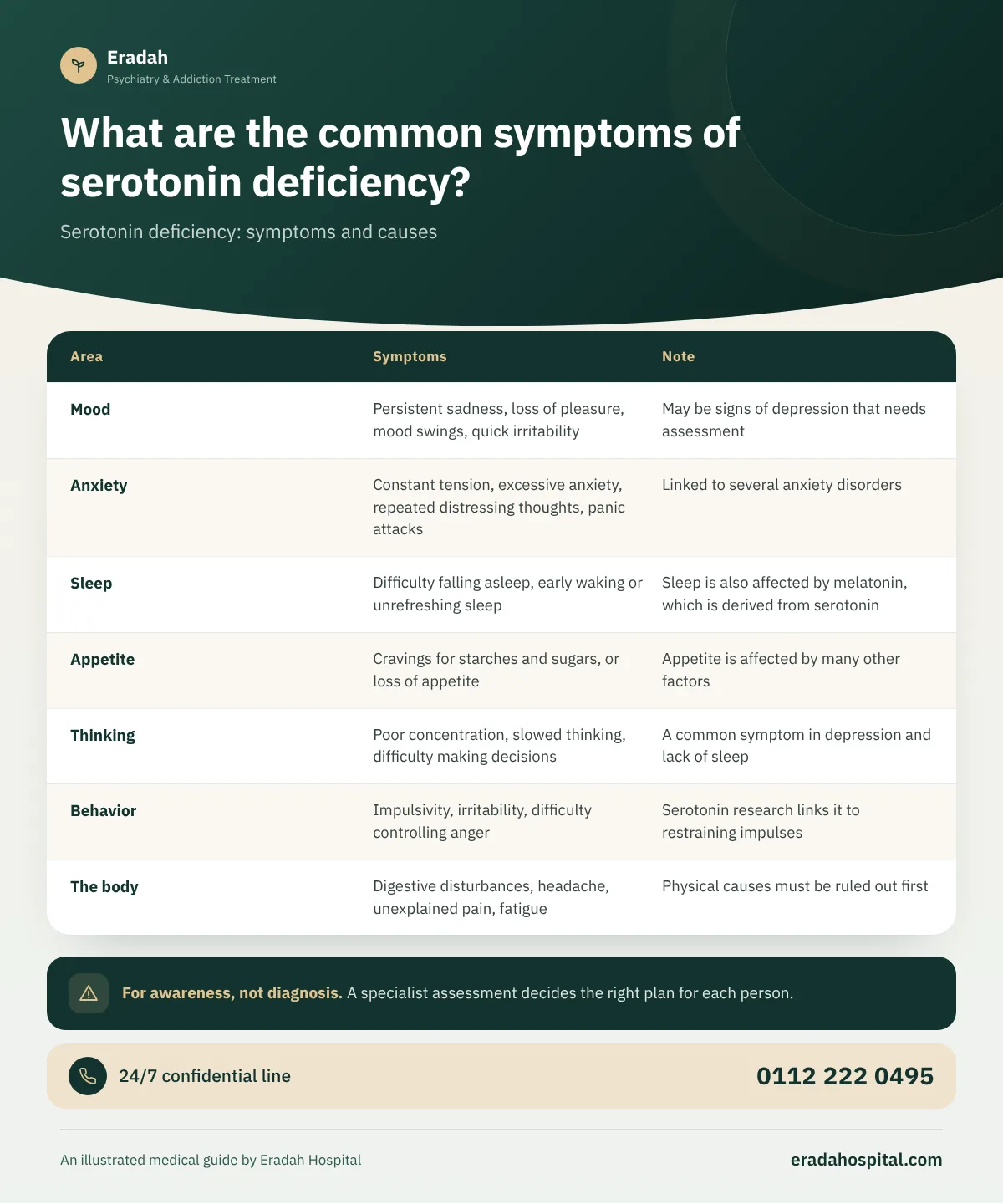
Note that most of these symptoms also appear in depression, generalized anxiety disorder, chronic lack of sleep, underactive thyroid, anemia and some vitamin deficiencies. So a person should not conclude from a list of symptoms that he is “low in serotonin” and start treating himself.
Is serotonin deficiency the cause of depression?
This is the most famous idea in popular psychiatry, known as the “chemical imbalance theory.” It emerged in the middle of the last century after it was observed that drugs acting on serotonin improve mood, and then spread with drug advertising until it came to be presented as established fact.
But a comprehensive review of the research published by Moncrieff and colleagues in 2022 found no consistent evidence that depression results from low serotonin: levels of its breakdown product did not clearly differ, findings on receptors and the transporter were weak or conflicting, and tryptophan-depletion experiments did not cause depression in most healthy people. Other researchers have criticized some aspects of this review, and the scientific debate is still ongoing.
The picture closest to the science today is that depression has multiple causes: genetic predisposition, stress and trauma, physical illness, thinking patterns, social factors, and changes in brain circuits involving the serotonin, norepinephrine, glutamate, stress and inflammation systems. Serotonin is part of the story, not the whole story.
What are the possible causes of low serotonin activity?
The genes responsible for enzymes, receptors and the transporter differ from person to person, and the effect of any single gene is small.
Prolonged stress alters the systems of the hormone cortisol and affects the whole neurotransmitter network.
Reduced daylight in winter is linked to changes in serotonin and melatonin in people with seasonal depression.
Sleep and serotonin influence each other in both directions.
Tryptophan comes from protein, and true deficiency is rare except with severe malnutrition or extreme diets.
Such as ecstasy, which temporarily depletes the serotonin store after use.
In laboratory “tryptophan depletion” experiments, which temporarily lower serotonin, a passing drop in mood occurred in some people with a personal or family history of depression, while most healthy people were unaffected. This supports the idea that serotonin plays a role in vulnerability in some people, not that it is a general direct cause.
Which medical conditions are linked to the serotonin system?
| The situation | Nature of the relationship |
|---|---|
| Depression | Antidepressants that act on serotonin are among the core treatment options, together with psychotherapy |
| Generalized anxiety and panic attacks | SSRI medications are among the common drug options |
| Obsessive-compulsive disorder | Often needs serotonin-acting medications together with behavioral therapy |
| Post-traumatic stress disorder | Some serotonin medications are options alongside specialized psychotherapy |
| Irritable bowel syndrome | Serotonin regulates bowel movement, and drugs acting on it are used in some cases |
| Migraine | Some medications for migraine attacks act on serotonin receptors |
The benefit of a serotonin-acting drug in a condition does not mean its cause is “serotonin deficiency”; a painkiller relieves a headache without the headache being a “painkiller deficiency.” This is an important rule for understanding psychiatry without oversimplifying.
Who is more prone to disruption of the serotonin system?
- People with a family history of depression, anxiety or obsessive-compulsive disorder.
- People living with chronic stress, trauma or long social isolation.
- People with chronic insomnia, or who work night shifts that upset the body clock.
- People exposed to little daylight for long periods, especially those with a seasonal depression pattern.
- People who use ecstasy or stimulants, since their serotonin and mood systems are disturbed after use.
- Women during periods of hormonal change such as before menstruation and after childbirth, among multiple factors.
Is there a test for serotonin deficiency?
No. There is no approved blood or urine test to diagnose “serotonin deficiency” in the brain. Serotonin in the blood reflects what the gut releases and what platelets store, and has no clear relationship to what happens at the synapses. Medical guidelines do not rely on any such test to diagnose depression or anxiety.
What the doctor actually does is a clinical assessment: questions about symptoms, their duration and their impact, validated psychological scales, and tests to rule out physical causes such as thyroid problems, anemia and vitamin B12 or D deficiency. If you are offered a commercial test that reveals your “serotonin level” and sells you supplements based on it, treat it with caution.
How is low serotonin treated medically?
The doctor does not treat a “number” but a diagnosed condition. If the symptoms result from depression, anxiety or OCD, the options include:
Such as cognitive behavioral therapy, which is effective in depression and anxiety and reduces relapse after improvement.
The SSRI class, among the most commonly prescribed antidepressants, whose effect usually begins after weeks.
Such as serotonin-norepinephrine reuptake inhibitors, and older drugs chosen by the doctor according to the case.
Regular sleep, movement, light and relationships support treatment but do not replace it in moderate and severe cases.
Medications are started, adjusted and tapered off by the doctor, so do not take a medication prescribed for someone else, and do not combine two drugs that affect serotonin or add an herbal supplement without consultation, because that may cause serotonin syndrome. Supportive daily habits, with an honest assessment of their evidence, are covered on the ways to increase serotonin naturally page.
When should you see a doctor about symptoms of serotonin deficiency?
- Sadness or loss of pleasure lasting more than two weeks and affecting your work, studies or relationships.
- Anxiety, panic attacks or repeated distressing thoughts that disrupt your day.
- Insomnia lasting weeks despite organizing your habits.
- A clear change in appetite or weight with no known cause.
- Turning to alcohol, drugs or sedatives to improve mood or sleep.
- Any thoughts of death or self-harm; here, do not wait: ambulance (123) or the mental health support line 16328.
A person who asks for help is taking the right step, since depression and anxiety are treatable conditions. Start with a psychiatrist or a general practitioner you trust, and bring a list of your symptoms and medications.