What is a dopamine detox?
“I did a 48-hour dopamine detox: no phone, no sweets, no talking to anyone, and afterward I was worse off than before.” This is a story told by many who tried the trend as they saw it on TikTok and YouTube. The problem is not their wish to change, but a distorted idea of how the brain works.
Cleveland Clinic reports that the American psychologist Cameron Sepah coined the term “dopamine fasting” in 2019 in a LinkedIn article, aiming to reduce problematic, impulsive behaviors such as emotional eating and excessive internet and social media use. The idea then spread on social media and turned into abstaining from almost everything enjoyable, which its originator never intended. We explain what dopamine is and what it does in the Dopamine guide.
Why is the name “dopamine detox” misleading?
Harvard Health quotes Sepah himself as saying that dopamine is merely a mechanism that explains how addictive habits become entrenched, and that the title is catchy and not meant literally. Dopamine is a neurotransmitter the brain needs for movement, motivation, learning and attention, and it does not build up like a toxin that needs “cleaning.” There is no evidence that staying away from your phone for a day or two lowers its level or resets its receptors.
And Cleveland Clinic describes the original idea as a modern version of cognitive behavioral therapy: learning, often with a therapist’s help, to tolerate uncomfortable feelings without immediately escaping into something pleasant that distracts you.
The popular dopamine detox compared with the scientific idea
| The popular detox online | The original, science-based idea | |
|---|---|---|
| Goal | “Cleaning” the brain of dopamine | Reducing one specific impulsive behavior that harms you |
| What do you abstain from? | Every pleasure: food, music, talking and people | One or two habits only, such as late-night scrolling |
| Duration | A day or days of extreme deprivation | Short, regular periods that fit your life |
| The alternative | Emptiness and boredom | Healthy activities such as exercise, nature and company |
| Expected outcome | Distress, then often a quick relapse | Gradually better control of the habit |
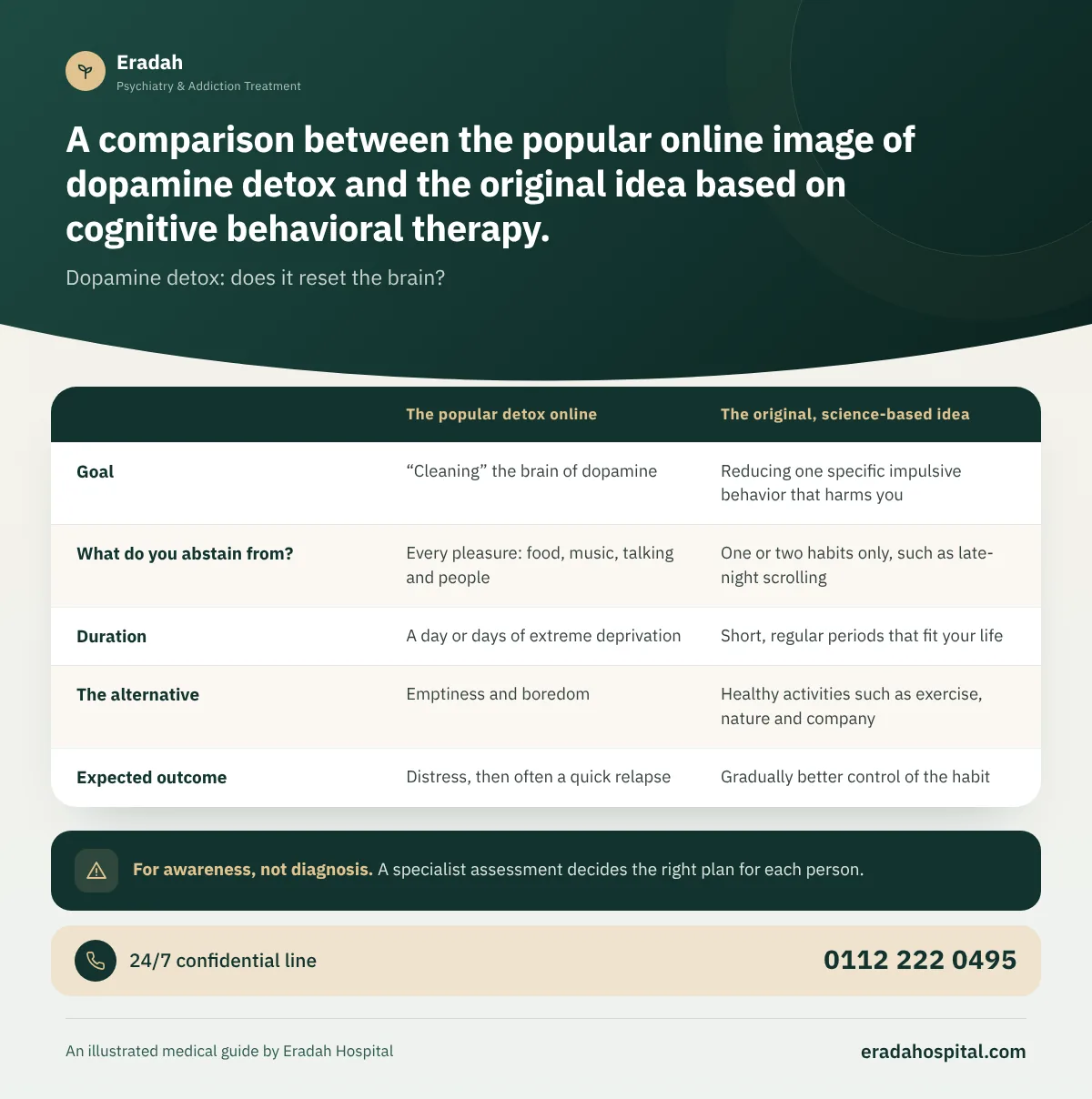
Harvard Health criticizes the extreme version of fasting because avoiding interaction with people was not part of the original idea; human relationships are among the healthy activities that are meant to replace harmful habits, and depriving yourself of them for no reason rests on a mistaken understanding of the science.
What actually helps in dopamine fasting?
The useful part is controlling triggers. Among the recent evidence is a randomized trial published in PNAS Nexus in 2025, in which researchers blocked mobile internet for two weeks while keeping calls, messages and computer internet. Mental health, life satisfaction and measured sustained attention improved, and 91% of participants improved on at least one of these measures. A 2020 systematic review also concluded that short-term abstinence looks promising for problematic use of phones, social media and games, though its adverse effects still need to be studied.
How do you do a smart digital detox?
- Choose one habit that really bothers you, such as scrolling in bed or opening apps at every moment of boredom.
- Set a clear rule: no phone after 11 p.m., or no social apps before noon.
- Change the environment: turn off unnecessary notifications and keep the phone out of the bedroom.
- Have a ready alternative: a walk, a book, a call with a friend, or exercise.
- Start with short, regular periods, as Sepah suggested: one to four hours at the end of the day, then one day on the weekend.
- Notice the effect on your sleep and mood after two weeks, and adjust the rule according to the result.
When can a dopamine detox be harmful?
- When it turns into complete isolation from people, which increases loneliness and sadness.
- When it is used instead of treatment for real depression, anxiety or ADHD.
- When it involves food restriction in people with a history of eating disorders.
- When it is followed by an excessive “reward” that brings the habit back even stronger.
Is a dopamine detox suitable for treating addiction?
No. Addiction to drugs or alcohol changes the reward and self-control circuits profoundly, as we explain in Dopamine and Addiction, and it needs structured medical and psychological treatment; withdrawal from some substances can also be dangerous without supervision. Behavioral addictions such as phone addiction and social media addiction have clearer treatment plans that go beyond temporary abstinence.
When do you need a doctor instead of a detox?
If your reason for the detox is losing interest in everything, persistent sadness, or an inability to concentrate that disrupts your life, the cause may be depression, ADHD or a condition linked to low dopamine that needs assessment. At Eradah we offer a free, confidential first consultation, with treatment through outpatient treatment or the psychiatric hospital depending on the case.
Losing interest and feeling sad for weeks? It may not be “dopamine” but depression
- Persistent sadness or emptiness most of the day for two weeks or more
- Loss of enjoyment in almost everything, not just in your phone
- Thoughts of death or that life has no meaning
- Complete isolation, or neglecting eating, sleep and hygiene
- Relying on substances or pills to “adjust your mood”
Don’t try to treat these symptoms with deprivation or with supplements bought without a doctor. Talk to someone you trust and ask for a psychological assessment. If thoughts of self-harm appear, stay with the person and do not leave them alone, and call the ambulance (123) or the mental health support line 16328, available around the clock.
Ambulance 123 Mental health support line 16328