Short-term harms of benzodiazepines
The harms of benzodiazepines do not begin with addiction; they can appear from the first dose: drowsiness at work, forgetting an entire conversation, or an unsteady step on the stairs. Most pass, but some can cost a life.
The most common effects, and they can last into the next morning with types that the body clears slowly.
Difficulty remembering what happens after taking the drug, a well-known effect that is put to use before procedures.
Poor balance and coordination that raise the risk of falls and driving accidents.
Usually mild with the drug alone, and dangerous with opioids and alcohol.
Irritability, insomnia or aggression instead of calm in some people, especially children and older adults.
Heavy speech and confusion with higher doses or mixing.
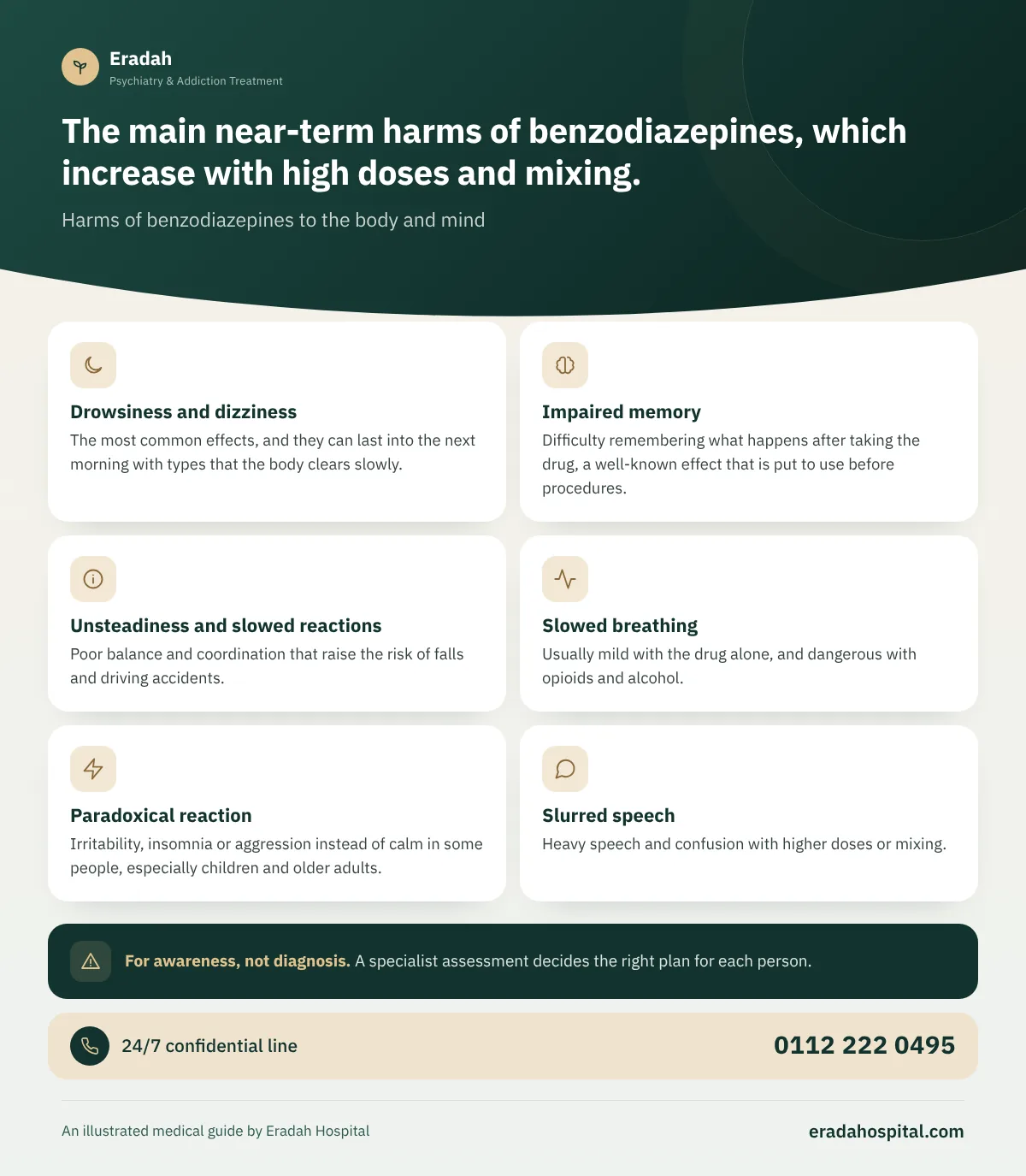
These symptoms are listed in the US Food and Drug Administration warning, which counts drowsiness, dizziness, weakness and slowed breathing among the common effects, and in the Ashton Manual, which describes the “paradoxical reaction” as increased anxiety, insomnia, irritability and aggressive behavior, and says it is more common in anxious people, children and older adults.
Long-term harms of benzodiazepines
The 2025 American Society of Addiction Medicine guidelines state that benzodiazepine use is associated with an increased risk of falls, car crashes, cognitive decline, delirium, overdose and death, especially with alcohol or opioids. They add that the benefit fades over time while the risks remain, so after months a user finds themselves taking a pill that no longer gives what it used to, and cannot stop.
- Tolerance and dependence: Needing a larger dose for the same effect, and withdrawal symptoms appearing with a delay or when stopping.
- Impaired memory and concentration: Slowed thinking that those around the person notice before they do.
- Depression and emotional blunting: Ashton says that people who use benzodiazepines for long periods often experience depression, and it may appear for the first time during extended use. If thoughts of self-harm appear, seek help immediately through the mental health support line (16328) or the ambulance (123).
Why is mixing benzodiazepines with opioids or alcohol deadly?
The StatPearls review of benzodiazepine toxicity explains that an overdose of them alone usually shows up as drowsiness and central nervous system depression with normal or near-normal vital signs, and that serious consequences are uncommon, whereas taking them with alcohol, opioids or other sedatives carries a risk of complications and death.
The numbers confirm it: according to the US Food and Drug Administration, overdose deaths involving benzodiazepines rose from 1,298 in 2010 to 11,537 in 2017, and the share of deaths involving benzodiazepines alone was no more than 2.7% in 2017. For this reason the agency has warned since 2016 against combining them with opioid painkillers. In Egypt they are often mixed with tramadol, an opioid painkiller.
The danger of counterfeit pills and illicit benzodiazepines
A pill bought outside a pharmacy as “Xanax” or “Rivotril” may not be what it claims. In a US Centers for Disease Control and Prevention report, deaths involving illicit benzodiazepines rose by 519.6% between the second quarter of 2019 and the same quarter of 2020, and illicitly manufactured fentanyl was present in 66.7% of benzodiazepine deaths in the first half of 2020. The 2025 guidelines warn that counterfeit pills may contain potent opioids such as fentanyl without the knowledge of the person taking them.
Harms of benzodiazepines in older adults: falls and confusion
Older adults are more sensitive to these drugs and slower to clear them. The 2025 guidelines cite an analysis of randomized trials in people over 60 who took them for insomnia, which found 3.8 times as much daytime drowsiness, 4.8 times as much cognitive impairment, and 2.6 times as many motor accidents such as falls, and another analysis that found an increased risk of hip fractures with a relative risk of 1.34. For this reason the American Beers Criteria recommend avoiding both short- and long-acting benzodiazepines after age 65 where possible, and Ashton describes what she calls “pseudo-dementia,” which may be wrongly attributed to Alzheimer's disease.
Do benzodiazepines cause dementia?
This question has not yet been settled. In a Canadian case-control study published in the British Medical Journal in 2014, benzodiazepine use was associated with an increased risk of Alzheimer's disease with an odds ratio of 1.51, and the association grew with longer use. But the researchers themselves pointed out that the drug may be an early sign of the disease rather than a cause, because anxiety and insomnia can precede dementia by years.
On the other hand, the Rotterdam Study published in 2024 followed about 5,443 people with normal cognition for an average of 11.2 years and found no overall association between their use and dementia, although it noted a higher association with large cumulative doses of the anti-anxiety ones among them, and faster shrinkage of the hippocampus in current users. The honest summary: temporary cognitive harm is certain, while permanent dementia is unproven, and both are reasons to avoid long-term use without need.
Benzodiazepines in pregnancy and breastfeeding
The 2025 guidelines summarize the evidence as showing that use in pregnancy was associated with more miscarriage, preterm birth and lower birth weight, though a causal relationship is unclear, and that it is not associated with major birth defects. They note that about 20% to 40% of newborns exposed to them in late pregnancy show withdrawal symptoms, and that some are born limp and drowsy with weak feeding in what is known as “floppy infant” syndrome, with symptoms that begin in the first hours and may last up to 14 days.
But untreated anxiety and insomnia also harm the mother and the fetus. So if you are pregnant or planning a pregnancy and take one of these drugs, do not stop it on your own; see your doctor so they can weigh the options.
Do the harms of benzodiazepines go away after stopping?
Many of them improve. Ashton suggests that impaired memory and concentration are linked to the drug's continued effect in the body, and recounts that depression went away after withdrawal in patients at her clinic who had taken excessive doses during long-term use. The condition is that stopping be gradual and supervised, as the benzodiazepine addiction treatment guide explains, because stopping suddenly has its own harms.
Danger signs after using benzodiazepines: call ambulance (123) immediately
- Deep sleep from which the person cannot be woken by calling or shaking.
- Slow, shallow or irregular breathing, or bluish lips.
- Severe slurred speech, unsteadiness and confusion after taking a sedative with alcohol, tramadol or any opioid painkiller.
- Seizures, hallucinations or severe confusion within days of suddenly stopping a sedative that was used for a long time.
- Taking tablets of unknown origin that are said to be “Xanax” or “Rivotril.”
Call ambulance (123) immediately and do not wait for them to “sleep it off.” If the person is unconscious but breathing, place them on their side in the recovery position, stay with them and watch their breathing until the paramedics arrive, and do not give them any sedative, stimulant or food. Tell the paramedics what they took, the approximate amount and the time, bring the medicine box if you find it, and tell them if the person also drank alcohol or took an opioid painkiller.
Call the ambulance 123