When do benzodiazepines become a problem?
“Mom has been taking half a pill for years to sleep, and now she takes two and still doesn't sleep.” That is how one family describes the start of their worry. The symptoms of benzodiazepine addiction differ from the common picture of an “addict,” because they often start from a medical prescription in an ordinary home and creep in slowly until it is hard to tell treatment from addiction.
Benzodiazepines are a family of sedatives such as alprazolam, clonazepam and diazepam, and the benzodiazepines guide explains their names and how they work. The US Food and Drug Administration explains that these drugs can lead to misuse and addiction even when taken at the recommended doses, and estimated that about 5.4 million people in the United States aged 12 and over misused them in 2018 alone.
This page is about the signs: what the person sees in themselves, what the family notices, and when it becomes an addiction that needs treatment. The harms have their own page, harms of benzodiazepines.
Physical symptoms of benzodiazepine use
Benzodiazepines slow brain activity, so symptoms sometimes resemble intoxication, and they become more obvious with large amounts or mixing with other substances:
Drowsiness at unusual times, difficulty waking in the morning, and a feeling of “heaviness” all day.
Stammering and a heavy tongue that people who know the person well will notice.
Staggering when walking, stumbling and falling, which is more dangerous in older adults.
Delayed reactions, which make driving under their influence dangerous.
Dizziness when standing and sometimes blurred vision.
Tremor, sweating and anxiety that appear before the next pill is due and disappear after it.
The last symptom is important. According to Professor Heather Ashton's manual, tolerance to the sleep-inducing effect develops within days to a few weeks, and there is no strong evidence that the anti-anxiety effect lasts after a few months. So a regular user may find that their anxiety increases between doses and think they need a larger amount, when what is happening is a mini-withdrawal repeating every day.
Behavioral signs the family notices
Behavioral signs are often clearer than physical ones, because they relate to the relationship with the medication itself:
- Running out of the prescription before it is due, with repeated excuses such as losing the strip or dropping it.
- Visiting more than one doctor to get prescriptions, or buying the pills without a prescription.
- Increasing the amount on their own, or taking an extra “backup” pill before any situation.
- Hiding strips in unusual places, or getting angry when asked about them.
- Severe anxiety when the medication is close to running out, and planning to get more before anything else.
- Giving up activities they used to love, withdrawing, and declining performance at work or school.
The British guidance (NICE) advises doctors to review any prescription for a drug that causes dependence regularly, and to watch for early requests for renewal or requests for a higher dose, because these are among the clearest signals of a problem.
Psychological and mental symptoms
The Ashton Manual lists these among the effects associated with long-term use:
- Impaired memory: Forgetting recent events or entire conversations, especially after large doses.
- Emotional blunting: A feeling of emotional numbness, with no real joy and no sadness, which may develop into depression.
- Paradoxical effects: In some people, irritability, impulsiveness or aggression appear instead of the expected calm.
- Anxiety that grows over time: Anxiety and panic attacks may increase despite continuing the medication, because of tolerance.
If thoughts about death or self-harm appear, this is a situation that needs immediate help: call the mental health support line (16328) or the ambulance (123), and do not leave the person alone.
Physical dependence or benzodiazepine addiction?
This is the most important distinction on the subject. Many patients who take benzodiazepines by prescription for a long time become physically dependent, meaning they get withdrawal symptoms if they stop, without being addicted. The US Food and Drug Administration stresses that physical dependence can occur with regular use for several days to weeks even as prescribed.
| Expected physical dependence | Addiction | |
|---|---|---|
| Who decides the amount | The doctor, and the patient follows it | The person themselves, and it gradually rises |
| Purpose of the medication | Treating anxiety, insomnia or seizures | Escape, a feeling of euphoria, or avoiding withdrawal |
| Control | Able to stick to the schedule | Fails to cut down despite trying |
| Source | One prescription from a doctor who follows them | More than one doctor or the black market |
| Effect on life | Lives normally | Problems at work, in the family and with driving |
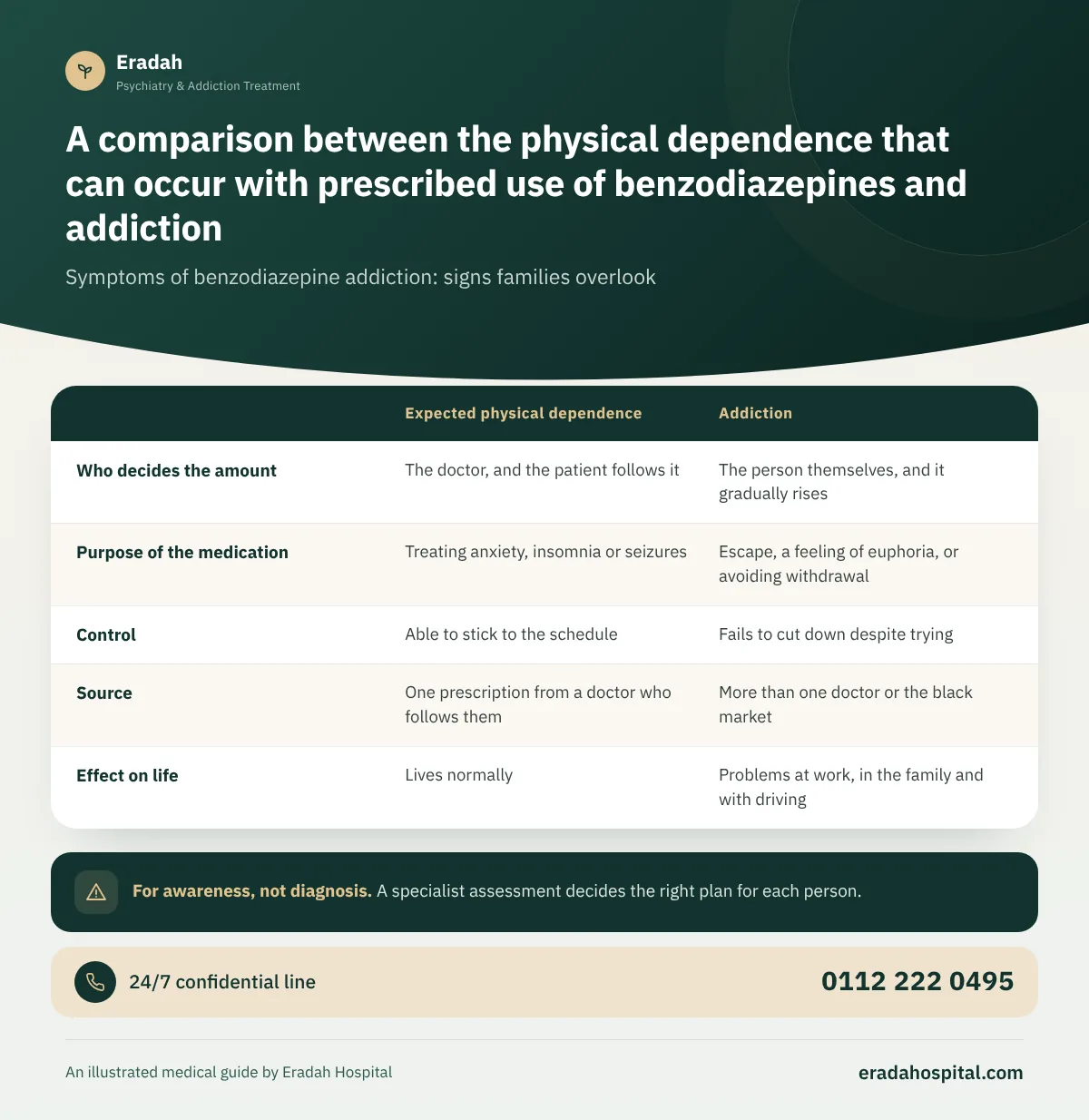
In both cases, stopping suddenly is dangerous. The US agency warns that stopping suddenly or reducing quickly can cause withdrawal reactions, including seizures that can be life-threatening. The page on benzodiazepine withdrawal symptoms explains what happens in detail.
Signs of mixing benzodiazepines with other substances
The most dangerous forms of misuse are combining benzodiazepines with tramadol, heroin, alcohol or pregabalin. The US Food and Drug Administration notes that 63% of US poison center reports of benzodiazepine misuse in 2017 involved more than one substance, and their consequences were more severe. Signs that point to mixing include:
- Deep drowsiness out of proportion to what the person says they took.
- A smell of alcohol with very heavy speech and severe unsteadiness.
- Strips of different medications in the same place, such as tramadol and sedatives.
- Episodes of complete memory loss for what happened on a particular night.
Different signs in older adults
Symptoms of benzodiazepine addiction in older adults can hide behind other explanations, so forgetfulness is put down to “old age” and falls to “ordinary frailty.” The Ashton Manual notes that excessive sedation lasts longer in older adults and may contribute to falls and fractures, and that acute confusion has occurred in them even at small doses. If you notice new confusion or repeated falls in an older relative who takes a sedative, show their list of medications to the doctor before drawing any conclusion.
What should you do if you notice symptoms of benzodiazepine addiction?
Do not confiscate or hide the pills suddenly, because stopping abruptly can lead to dangerous withdrawal. Start with a calm conversation, then ask for a medical assessment that sets a gradual reduction plan suited to the case. Joint American guidelines issued in 2025 recommend that tapering be individualized and monitored, not on one schedule for everyone.
The page on benzodiazepine addiction treatment sets out the stages of treatment and their length, and treatment can be outpatient or through medically supervised detox depending on the severity of the case and any accompanying substances. At Eradah the first consultation is free and confidential. Do not start or stop any medication without a doctor.
Danger signs after using benzodiazepines: call ambulance (123) immediately
- Deep drowsiness, difficulty waking, or not responding when called.
- Slow or weak breathing or unusual snoring, especially with tramadol or alcohol.
- Bluish lips or extremities.
- Seizures after suddenly stopping regular use.
- Severe confusion or hallucinations during withdrawal.
Call ambulance (123) immediately. If the person is unconscious but breathing, place them on their side so they do not choke on vomit. Stay with them and do not leave them alone. Do not give them food or drink, and tell the paramedics everything they took or used, and the amount and time if you know them.
Call the ambulance 123