What is oxycodone?
When the “opioid epidemic” in the United States is mentioned, oxycodone is among the first names to come up. Many stories began with a legitimate prescription for pain after surgery or an injury, then turned into dependence, then into a search for substitutes on the street. Understanding this story protects anyone who takes an opioid painkiller.
Oxycodone belongs to the opioid family, and the DEA describes it as a semi-synthetic opioid receptor agonist derived from thebaine. It is marketed on its own in immediate-release or extended-release tablets, or combined with non-opioid painkillers such as acetaminophen in Percocet and aspirin in Percodan. It is listed in Schedule I of the Single Convention on Narcotic Drugs of 1961.
And what is hydrocodone?
Hydrocodone is a semi-synthetic opioid closer in structure to codeine. According to the DEA, it is close to morphine in relieving pain, and it is also used to suppress cough. Most of its products are combinations, the best known being hydrocodone with acetaminophen in Vicodin and Lortab. In the United States, its prescriptions peaked at about 144.5 million in 2011, then fell to 47.4 million in 2024 as guidelines tightened.
How does oxycodone affect the brain?
The US National Institute on Drug Abuse (NIDA) explains that opioids bind to opioid receptors in the brain, spinal cord and other organs, especially those responsible for pain and pleasure, which blocks pain signals and releases large amounts of dopamine, and this is what strengthens the urge to repeat the experience. The DEA describes oxycodone’s effects as pain relief, calm, euphoria and relaxation, along with respiratory depression, constipation, pinpoint pupils and cough suppression.
According to the DEA, its behavioral effects last up to 5 hours, while extended-release OxyContin works for 8 to 12 hours. With repeated use the brain adapts, so the effect weakens, the person needs more, and uncomfortable symptoms appear when it is stopped.
Medical use of oxycodone
The DEA notes that its combination products are used for moderate to severe pain, and that extended-release tablets are prescribed for severe, ongoing pain that needs round-the-clock treatment for a long time. NIDA reminds us that prescription opioid painkillers are generally safe when used for a short time and as the doctor prescribes.
- Take it only by prescription and for the period set.
- Swallow extended-release tablets whole; breaking, chewing or dissolving them can release the whole amount at once and cause an overdose, as MedlinePlus warns.
- Do not share it with anyone, and keep it out of the reach of children.
- Tell your doctor about all your medicines, especially sedatives and antidepressants.
- Do not start or stop without a doctor.
Why is oxycodone misused?
The DEA notes that the launch of OxyContin in 1996 led to a marked rise in its misuse, and that the large amount of the drug in extended-release tablets made them attractive to people who misuse it. Its street names in the United States include “oxy” and “OC.” In 2023, 2.6 million people in the United States misused oxycodone products out of 21 million who used them, or 12.6%, according to the national survey reported by the DEA.
Counterfeit pills and fentanyl
Oxycodone compared with hydrocodone and morphine
| Oxycodone | Hydrocodone | Morphine | |
|---|---|---|---|
| Origin | Semi-synthetic, from thebaine | Semi-synthetic, close to codeine | Natural, from opium |
| Best-known names | OxyContin, Percocet | Vicodin, Lortab | Various names |
| Use | Moderate to severe pain | Pain, and sometimes cough | Severe pain |
| Addiction risk | High, similar to morphine | High | High |
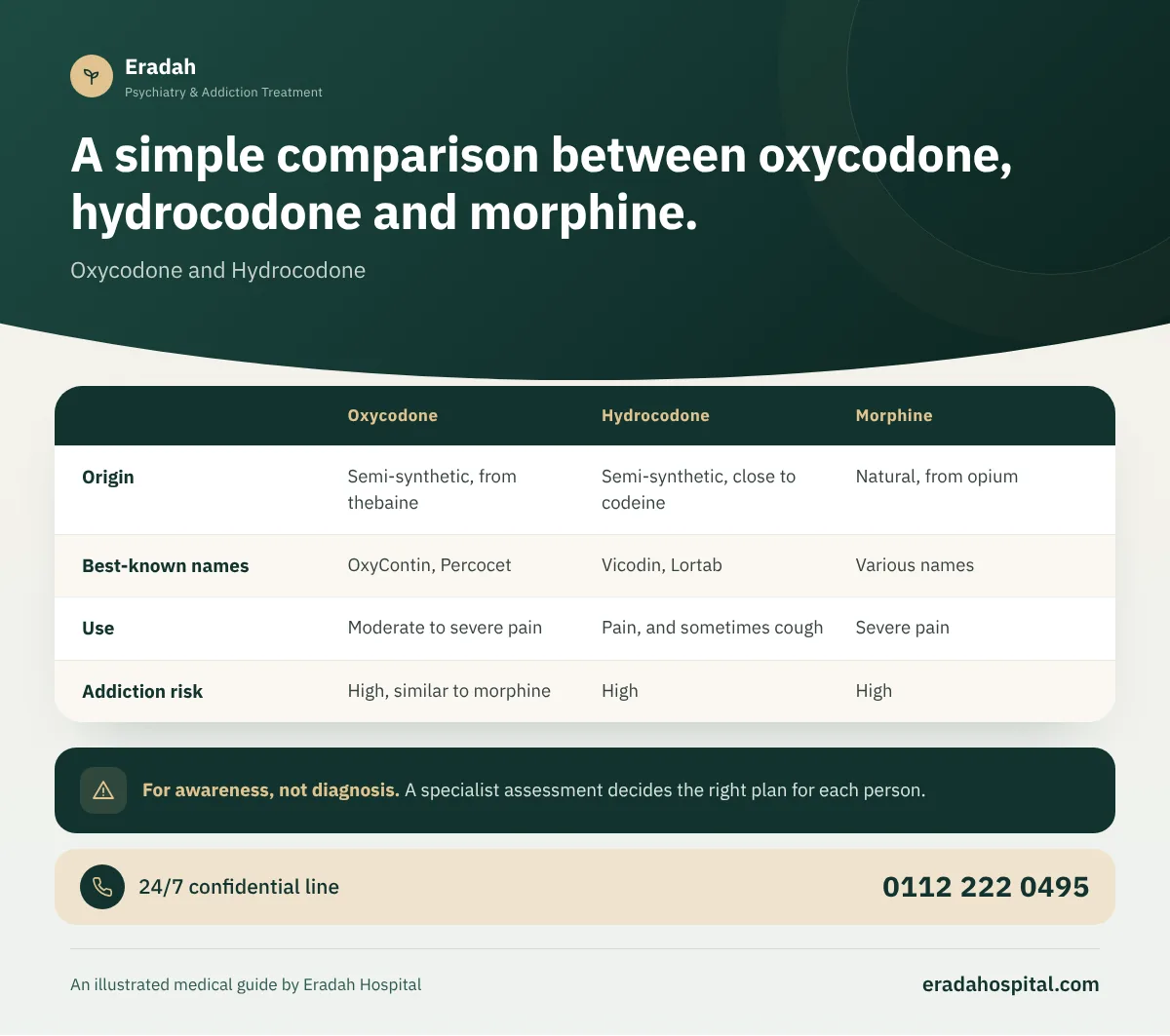
These painkillers differ from tramadol and pethidine in that they do not inhibit serotonin reuptake, as a review published in 2005 explains, but they all share the risks of respiratory depression and addiction.
The legal status of oxycodone
Oxycodone and hydrocodone are listed in Schedule I of the Single Convention on Narcotic Drugs of 1961, and both are in Schedule II of controlled substances in the United States according to the DEA. In Egypt, any opioid painkiller of this kind is treated as a medicine that is dispensed only by prescription and under controls, and possessing or circulating it without a medical basis is an offense. The Fund for Drug Control and Treatment of Addiction offers free, confidential treatment through hotline 16023.
This is general educational information and not legal advice.
Oxycodone in numbers
Source: the oxycodone assessment by the US Drug Enforcement Administration (DEA), 2025.
Harms, symptoms, withdrawal and treatment in brief
Harms: respiratory depression, liver damage from the acetaminophen in combination tablets, counterfeit pills, and effects on hormones and pregnancy. Details are in harms of oxycodone.
Symptoms: drowsiness and pinpoint pupils, early refill requests and higher doses, and changes in behavior. Read symptoms of oxycodone addiction.
Withdrawal and treatment: NIDA notes that withdrawal can begin a few hours after the last dose and follows a course similar to morphine withdrawal. It is treated with medications such as buprenorphine and methadone along with behavioral therapy, as in treatment of morphine addiction.
Oxycodone guide: everything you need to know
We have gathered everything about oxycodone into 4 pages, each answering one question in detail. Choose what you are looking for:
Harms of oxycodone to the body and mind
Harms of oxycodone: respiratory depression, the danger of crushing extended-release tablets, liver poisoning from the acetaminophen in Percocet, fentanyl-laced counterfeit pills, and effects on hormones, pregnancy and the brain.
Oxycodone addiction symptoms and signs of use
How do you know if someone is misusing oxycodone? The physical, behavioral and psychological signs of oxycodone addiction, the difference between medical use and misuse, and why a test may come back negative.
Morphine withdrawal symptoms and how long they last
When do morphine withdrawal symptoms start and how long do they last? The timeline of morphine withdrawal, the difference between immediate-release and extended-release forms, and why stopping must be gradual.
Morphine addiction treatment: stages and duration
How is morphine addiction treated? The stages of treating morphine addiction from assessment and safe withdrawal to approved medications, psychological treatment, an alternative pain plan and relapse prevention.
Is someone in your family taking oxycodone?
- Make sure the medicine is prescribed and that a doctor is following the case.
- Keep the tablets locked away, and count them if you have a concern.
- Dispose of leftover tablets after treatment ends, as your pharmacist advises.
- Beware of any “oxy” pills from outside a pharmacy.
- Learn the overdose signs below and save the ambulance number, 123.
Danger signs after using oxycodone: call an ambulance (123) immediately
- Slow, shallow or stopped breathing, or long pauses and strange snoring during sleep
- Severe drowsiness and being unable to wake the person or get a response
- Pinpoint pupils, blue lips and nails, and cold, clammy skin
- A slow pulse and limp muscles
- Any deep drowsiness after a pill of unknown source, since it may contain fentanyl
Call an ambulance on 123 immediately. If the person is unconscious but breathing, place them on their side (recovery position) so they do not choke on vomit, stay with them and do not leave them alone, and do not give them anything by mouth. Tell the paramedics what they took and any sedatives or alcohol taken with it, and keep the packaging or the remaining pills.
Call the ambulance 123