Physical signs of oxycodone use
“The doctor prescribed the painkiller after the surgery, and the box ran out a week early.” This is one of the sentences clinics hear most at the start of the story. The physical signs may be quiet, but they repeat in a clear pattern.
- Unusually small pupils.
- Difficulty staying awake, or falling asleep at inappropriate times, which some people call “nodding off.”
- Flushed skin that causes itching.
- Chronic constipation, nausea and headache.
- Confusion and poor concentration, as NIDA notes.
MedlinePlus lists these signs among the signs of opioid use that may lead a doctor to order a test.
Behavioral signs
- Asking for early refills or demanding higher doses.
- Complaining of pain that increases although the condition is not getting worse.
- Moving between more than one doctor or pharmacy.
- Taking tablets from the prescriptions of family members or friends.
- Having tablets without a box or from an unknown source.
- Neglecting responsibilities and withdrawing from family and friends.
MedlinePlus notes that taking tablets from other people’s prescriptions, even to treat real pain, counts as misuse, as does taking larger or more frequent doses than prescribed or mixing it with alcohol or other substances.
Names the family may hear
The DEA notes that OxyContin is known on the American street by names such as “oxy,” “OC” and “oxycotton.” It may also be referred to by brand names such as Percocet and Roxicodone. Hearing these names in your children’s conversations, especially with mention of pills from the internet or from a “friend,” deserves attention.
Psychological signs
- Personality changes: irritability or indifference that was not typical for them.
- Constant preoccupation with the time of the next dose and how many tablets are left.
- Anxiety and tension between doses, then sudden calm afterward.
- Denying the problem or downplaying it on the grounds that “the doctor is the one who prescribed it.”
Signs that appear if a dose is late
NIDA notes that withdrawal symptoms can begin a few hours after the last dose, and include muscle and bone aches, sleep problems, diarrhea and vomiting, cold flashes with goosebumps, involuntary leg movements, and intense cravings. MedlinePlus adds frequent yawning, dilated pupils and a rapid pulse. The course of these symptoms is similar to morphine withdrawal.
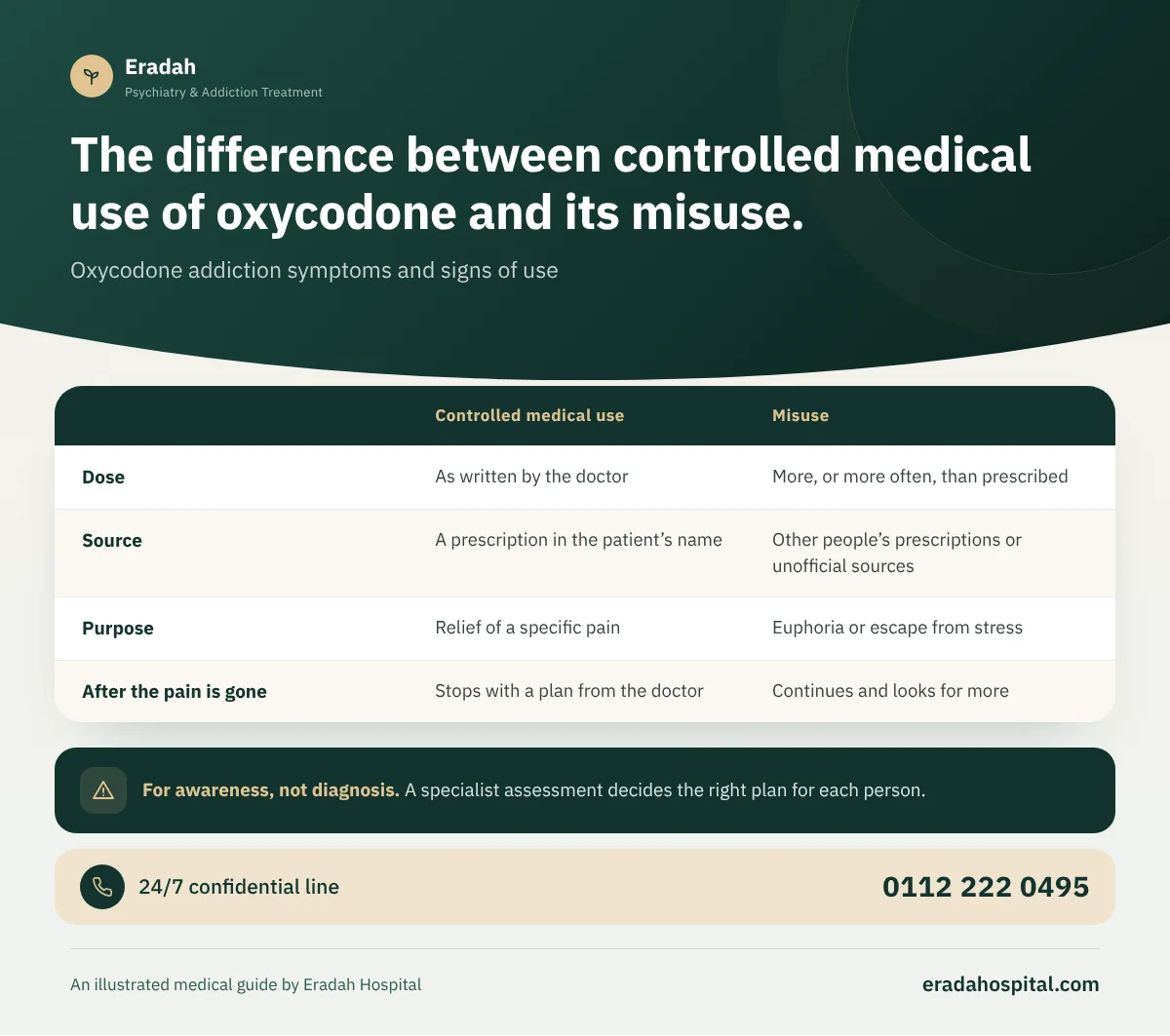
Medical use or misuse?
| Controlled medical use | Misuse | |
|---|---|---|
| Dose | As written by the doctor | More, or more often, than prescribed |
| Source | A prescription in the patient’s name | Other people’s prescriptions or unofficial sources |
| Purpose | Relief of a specific pain | Euphoria or escape from stress |
| After the pain is gone | Stops with a plan from the doctor | Continues and looks for more |
NIDA reminds us that long-term use, even as prescribed by the doctor, can cause tolerance and physical dependence, and that dependence alone is not addiction. Addiction is a chronic disease marked by compulsive drug-seeking and use despite consequences.
Why might a drug test be negative?
American Family Physician explains that the rapid immunoassay for opiates reliably detects morphine, codeine and heroin, but often misses other opioids such as oxycodone and hydrocodone, so the doctor needs an expanded panel. That is why families should not rely on a negative home test for reassurance. Read the guide to drug testing.
Signs that call for emergency care immediately
Shallow or stopped breathing, or long pauses and snoring during sleep.
Does not wake to calling or touch.
Blue lips and fingernails and cold, clammy skin.
Deep drowsiness after a pill from outside a pharmacy may mean fentanyl.
How do you talk to someone who is misusing oxycodone?
- Do not start with accusations. Acknowledge that the pain may have been real at the beginning.
- Talk about facts: the number of tablets, the early refills, and the changes you have noticed.
- Suggest visiting the treating doctor together to review the plan.
- Do not ask him to stop suddenly; stopping needs a medical plan.
- Ask for a confidential consultation, and read how to convince a person with addiction to get treatment.
Treatment is available and effective, and includes medications such as buprenorphine along with behavioral therapy and follow-up.
Danger signs after using oxycodone: call an ambulance (123) immediately
- Slow, shallow or stopped breathing, or long pauses and strange snoring during sleep
- Severe drowsiness and being unable to wake the person or get a response
- Pinpoint pupils, blue lips and nails, and cold, clammy skin
- A slow pulse and limp muscles
- Any deep drowsiness after a pill of unknown source, since it may contain fentanyl
Call an ambulance on 123 immediately. If the person is unconscious but breathing, place them on their side (recovery position) so they do not choke on vomit, stay with them and do not leave them alone, and do not give them anything by mouth. Tell the paramedics what they took and any sedatives or alcohol taken with it, and keep the packaging or the remaining pills.
Call the ambulance 123