What is Lyrolin?
“Take Lyrolin, it's not Lyrica, it's something else, something mild.” A young person may hear this sentence from a friend or a seller, and it is completely wrong. Lyrolin is not a “milder” drug. It is pregabalin itself under another brand name.
Lyrolin is a brand name sold in Egyptian pharmacies for capsules containing pregabalin, the same active ingredient as in the original drug Lyrica. Medications containing the same substance share the same uses, side effects and warnings, even if the manufacturer, price and some inactive ingredients differ.
The pregabalin guide explains in detail how the substance works. This page answers the questions about the name itself: what Lyrolin is, why its name is linked to misuse in Egypt, and what people taking it on prescription should know.
Medical uses of Lyrolin
Because the substance is pregabalin, its uses follow what drug regulators have approved for pregabalin, which differs slightly from country to country. The US Lyrica label and the European Medicines Agency list the following:
- Nerve pain, such as diabetic nerve pain and the pain that follows shingles.
- Add-on treatment for partial seizures, added to other medications by a neurologist.
- Generalized anxiety disorder, approved for this purpose in Europe but not in the United States.
- Fibromyalgia and nerve pain after spinal cord injury in the United States.
Pregabalin works by binding to part of the calcium channels in nerves, which reduces the release of excitatory neurotransmitters. This calms irritated nerves in pain and epilepsy, but it is also why large doses cause a feeling of relaxation and euphoria in some people.
Common side effects of Lyrolin
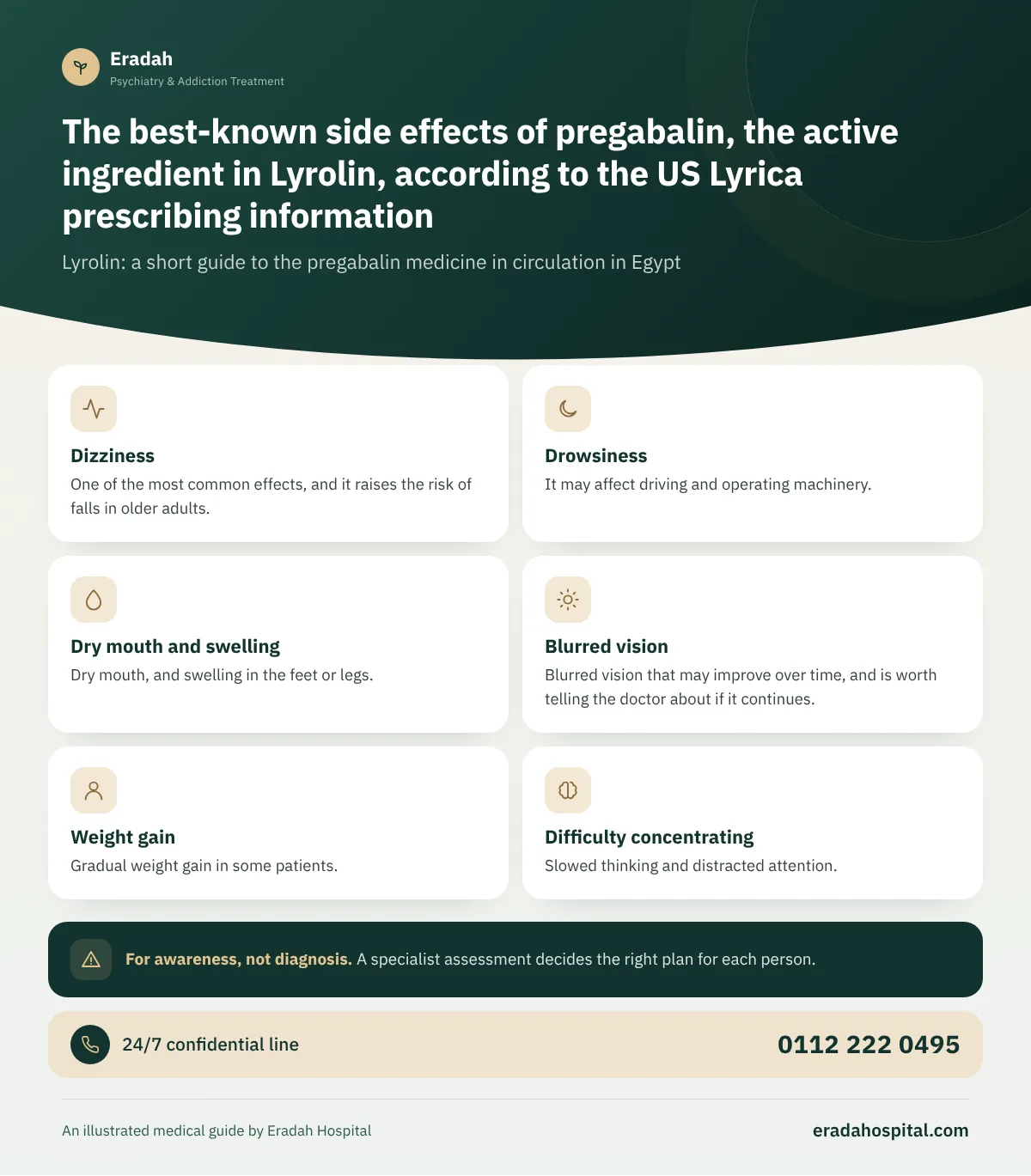
The official Lyrica leaflet lists the most common side effects in adults, meaning those seen in 5% or more of patients and at twice the rate seen with placebo:
One of the most common effects, and it raises the risk of falls in older adults.
It may affect driving and operating machinery.
Dry mouth, and swelling in the feet or legs.
Blurred vision that may improve over time, and is worth telling the doctor about if it continues.
Gradual weight gain in some patients.
Slowed thinking and distracted attention.
The leaflet also warns of rare but serious allergic reactions, such as swelling of the face, tongue or throat, and of suicidal thoughts in a small number of people taking epilepsy medications. The section on Lyrolin and sex discusses the sexual effects mentioned in the leaflet.
The difference between Lyrolin and Lyrica
The difference is commercial, not pharmacological. Lyrica is the original name from the company that developed pregabalin, and Lyrolin is another name for capsules containing the same substance. A licensed generic is expected to give an equivalent effect to the original because it contains the same active ingredient. So Lyrolin should not be treated as milder or stronger, and the two names should not be taken together on the assumption that they are different, since that simply means doubling the amount of the same substance.
Why is Lyrolin misused in Egypt?
The Lyrica leaflet states that pregabalin causes euphoria in some patients: 4% of those who took it in clinical trials reported it, versus 1% with placebo, and in some groups the rate reached 12%. A systematic review published in 2017 found that the prevalence of pregabalin and gabapentin misuse among people who misuse opioids ranged from 3% to 68% across different studies.
In Egypt, the name Lyrolin and other pregabalin brand names became linked to tramadol, as some people combine them to strengthen the effect or to ease tramadol withdrawal symptoms. For this reason the Ministry of Health issued a decision in 2019 placing pregabalin and its preparations on the narcotics schedules, so it is dispensed by prescription under controls, and dealing in it outside medical care is a legal violation. The page on the causes of pregabalin addiction explains how dependence develops.
When does Lyrolin use become a problem?
- Increasing the dose on your own, or getting it without a prescription.
- Using it for euphoria or relaxation rather than for pain.
- Combining it with tramadol, sedatives, cannabis or alcohol.
- Anxiety, insomnia and sweating if you are late with a dose.
- Hiding it from family or the doctor.
If some of these signs apply to you, the page on pregabalin addiction symptoms sets out the diagnostic criteria in detail.
Stopping Lyrolin safely
The official leaflet states that stopping suddenly or quickly may cause insomnia, nausea, headache, anxiety, sweating and diarrhea, and may increase seizures in people with epilepsy, which is why it recommends tapering gradually. The doctor sets the pace of reduction according to how long it has been used, the amount and other substances. The page on pregabalin withdrawal symptoms explains what you may go through, and the page on pregabalin addiction treatment sets out the stages of treatment.
At Eradah the first consultation is free and confidential, and after assessment the doctor decides whether outpatient treatment is enough or whether medically supervised detox is needed. Do not start or stop any medication without a doctor.
Danger signs after taking pregabalin: call an ambulance (123) immediately
- Deep drowsiness or difficulty waking.
- Slow or weak breathing, especially with tramadol, sedatives or alcohol.
- Severe confusion, unsteadiness or slurred speech.
- Swelling of the face, lips or tongue, or difficulty breathing.
- Seizures.
Call ambulance (123) immediately. If the person is unconscious but breathing, place them on their side so they do not choke on vomit. Stay with them and do not leave them alone. Do not give them food or drink, and tell the paramedics everything they took or used, and the amount and time if you know them.
Call the ambulance 123