Why are you looking for an alternative to pregabalin?
“The doctor wrote me Lyrica, but the dizziness and the weight are wearing me out, and I can't find it at the pharmacy without a new prescription.” This is how the question begins for many people. The reasons for looking for an alternative to pregabalin vary: side effects, worry about dependence, difficulty getting it after it was placed among controlled drugs, or a wish to stop after misusing it.
In Egypt, a 2019 decision placed pregabalin on the narcotics schedules, and a study published in 2025 found that its sales fell by 99% after the decision, while gabapentin sales jumped by 198%. In other words, many people moved to the alternative closest in form, which is not necessarily what they need.
The rule that governs this page: the right alternative is chosen not because it “resembles” pregabalin, but because it treats the reason it was prescribed, with the lowest possible risk.
Alternatives to pregabalin by reason for the prescription
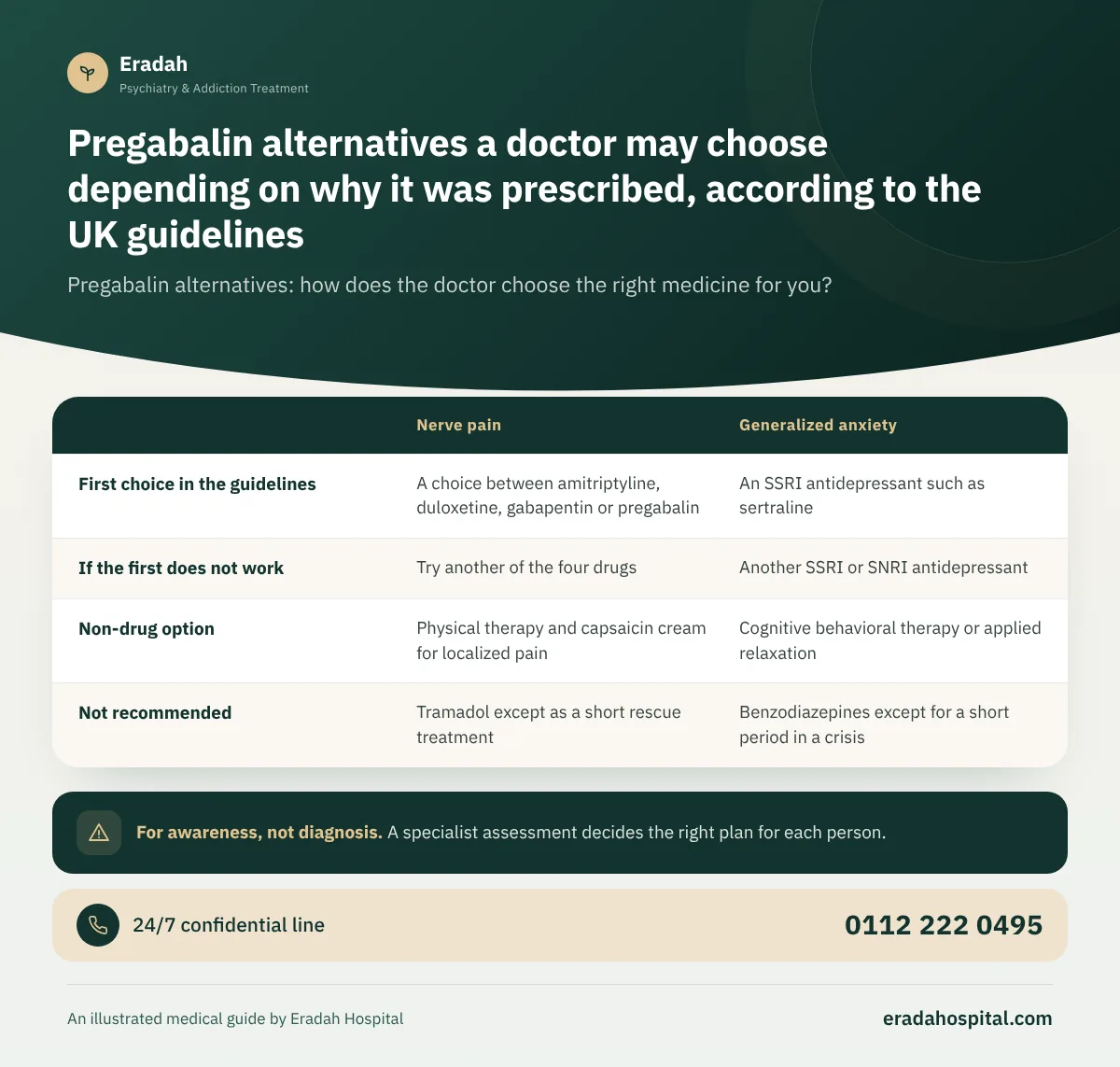
Pregabalin is prescribed for more than one condition, and each has different alternatives in the UK guidelines:
| Nerve pain | Generalized anxiety | |
|---|---|---|
| First choice in the guidelines | A choice between amitriptyline, duloxetine, gabapentin or pregabalin | An SSRI antidepressant such as sertraline |
| If the first does not work | Try another of the four drugs | Another SSRI or SNRI antidepressant |
| Non-drug option | Physical therapy and capsaicin cream for localized pain | Cognitive behavioral therapy or applied relaxation |
| Not recommended | Tramadol except as a short rescue treatment | Benzodiazepines except for a short period in a crisis |
In epilepsy, pregabalin is an add-on treatment that a neurologist adds to other drugs, and changing it is a decision for the neurologist alone, because sudden discontinuation may increase seizures.
Pregabalin alternatives for nerve pain
The UK guidelines (NICE CG173) recommend that a person with nerve pain, other than trigeminal neuralgia, be offered a choice among four drugs at the start: amitriptyline, duloxetine, gabapentin and pregabalin. If the first drug does not work or the patient cannot tolerate it, one of the other three is tried.
An older antidepressant used for nerve pain, known to some as Tryptizol.
Duloxetine is an antidepressant that eases nerve pain and helps if anxiety or depression accompanies it.
For localized pain, for people who want to avoid tablets or cannot tolerate them.
The first choice specifically for trigeminal neuralgia, such as Tegretol.
Each drug has its own side effects and interactions. Amitriptyline, for example, may cause drowsiness and dry mouth and may not suit some heart patients, and the doctor chooses after reviewing the whole picture.
If the pain is chronic with no clear cause
Some patients take pregabalin for widespread chronic pain not linked to specific nerve damage, such as fibromyalgia. Here the recommendations are quite different: the NICE guideline on chronic primary pain (NG193) advises supervised group exercise programs and cognitive behavioral therapy or acceptance and commitment therapy, and certain antidepressants may be offered after discussing benefits and harms, while it advises against starting anti-seizure drugs, including pregabalin and gabapentin, for this type of pain.
Pregabalin alternatives for anxiety
The UK guidelines for generalized anxiety (NICE CG113) place pregabalin at a later step: treatment starts with an SSRI antidepressant, then an alternative from the same class or from the SNRI class, and pregabalin is considered if the patient cannot tolerate these drugs. They advise caution about a history of addiction before prescribing it. The page on pregabalin for anxiety explains its place in detail, and the page on generalized anxiety treatment covers the psychological therapies that are as effective as medication for many people.
Why shouldn't you swap pregabalin for gabapentin or tramadol on your own?
Gabapentin is from the same family and works by the same mechanism, so it carries a similar risk of dependence. A systematic review published in 2026 found growing evidence of misuse of both drugs in the Middle East and North Africa, and that combining them with opioids or benzodiazepines raises the risk of overdose. The page on the difference between pregabalin and gabapentin compares them.
As for tramadol, the guidelines do not recommend it for nerve pain except as a short rescue treatment, and it is an opioid that carries a risk of addiction and seizures. Replacing one substance with another without a doctor may transfer the dependence instead of treating it, and the page on the difference between pregabalin and tramadol explains why.
If you are looking for an alternative because you can no longer stop
Some people who look for an alternative to pregabalin do not have pain; they have dependence: they need larger amounts, take it with tramadol, or feel symptoms when they are late with it. Here the solution is not a substitute drug but a treatment plan, which you can find in pregabalin addiction treatment, and the page on pregabalin withdrawal symptoms explains what you may go through.
At Eradah, the first consultation is free and confidential, and treatment can begin through outpatient treatment in suitable cases.
Questions to ask your doctor
- What is the exact reason pregabalin was prescribed for me, and does it still apply?
- What alternatives suit my condition, and what are their side effects?
- How will I move from pregabalin to the alternative without withdrawal symptoms?
- Are there non-drug options that suit my pain or anxiety?
- Does the alternative interact with my other medications or with a heart or kidney condition?
Danger signs after taking pregabalin: call an ambulance (123) immediately
- Deep drowsiness or difficulty waking.
- Slow or weak breathing, especially with tramadol, sedatives or alcohol.
- Severe confusion, unsteadiness or slurred speech.
- Swelling of the face, lips or tongue, or difficulty breathing.
- Seizures.
Call ambulance (123) immediately. If the person is unconscious but breathing, place them on their side so they do not choke on vomit. Stay with them and do not leave them alone. Do not give them food or drink, and tell the paramedics everything they took or used, and the amount and time if you know them.
Call the ambulance 123