Physical signs of pregabalin misuse
These signs appear while the drug is active, especially when more than the prescribed amount is taken or it is mixed with other substances:
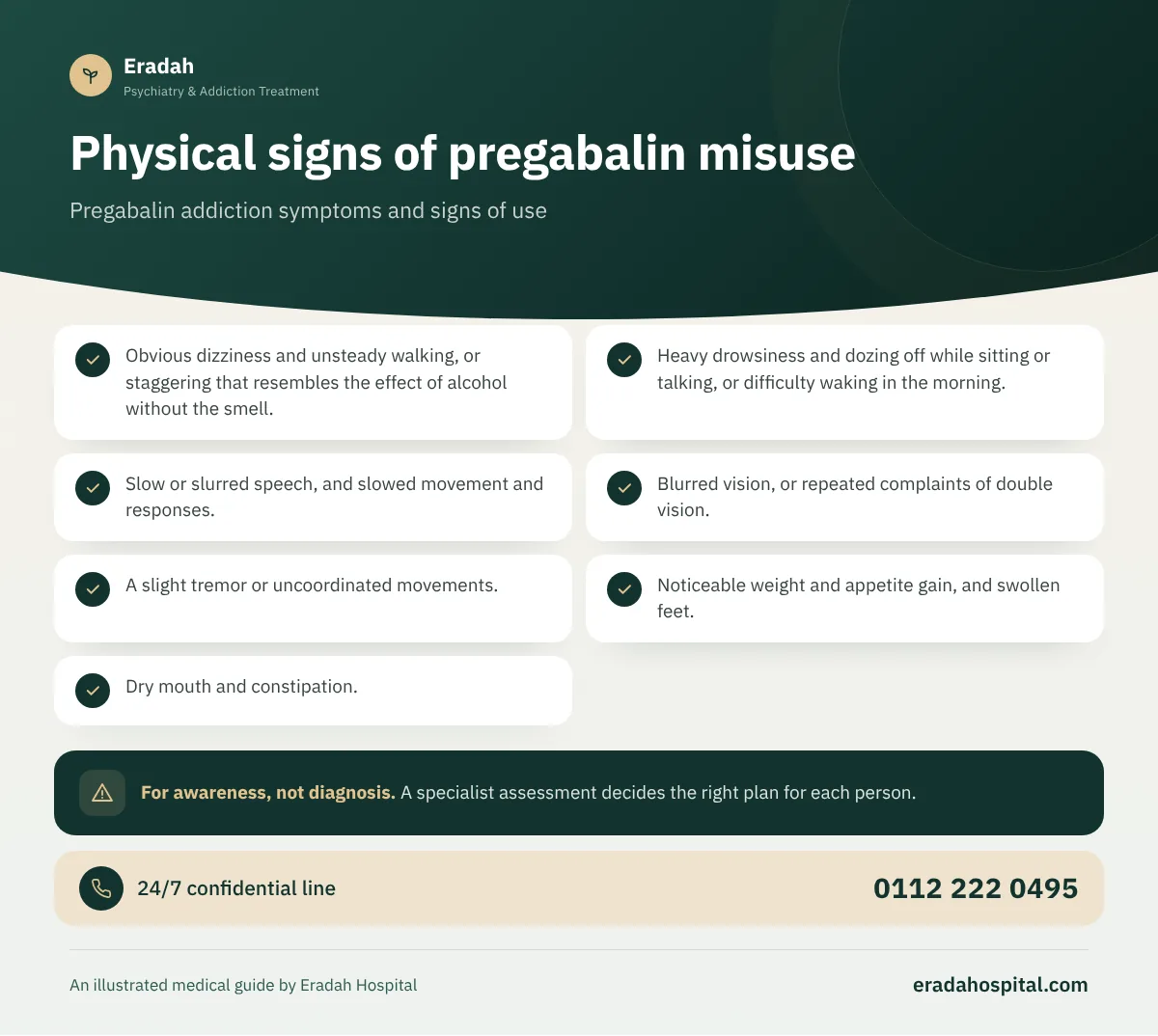
- Obvious dizziness and unsteady walking, or staggering that resembles the effect of alcohol without the smell.
- Heavy drowsiness and dozing off while sitting or talking, or difficulty waking in the morning.
- Slow or slurred speech, and slowed movement and responses.
- Blurred vision, or repeated complaints of double vision.
- A slight tremor or uncoordinated movements.
- Noticeable weight and appetite gain, and swollen feet.
- Dry mouth and constipation.
Behavioral signs the family notices
Behavioral changes often come before the physical ones, and they are clearer to the family:
- Finding strips or boxes of Lyrica or medications containing pregabalin without a medical prescription.
- Visiting more than one doctor or pharmacy to get the drug, or claiming to have lost the prescription.
- Running out of the prescribed medication long before the due date.
- Asking for money often with changing excuses, or money disappearing from the home.
- Withdrawing, changing usual friends and being unusually secretive.
- Neglecting school or work and being absent repeatedly.
- Having tramadol or other sedative medications at the same time.
Psychological and mood signs
- A cheerful mood or unexplained laughter, or excessive calm that is not like their usual nature.
- Irritability and intense tension when the drug is delayed.
- Poor concentration, forgetfulness, slowed thinking and declining school performance.
- Loss of interest in hobbies and activities they used to enjoy.
- Anxiety or depression that increases between doses.
What is the difference between medical use and misuse?
Some dizziness and drowsiness can appear in people taking pregabalin on prescription, especially in the first weeks. So physical symptoms alone are not enough to judge. You need to look at the pattern of use:
| Medical use | Misuse |
|---|---|
| On a doctor's prescription with regular follow-up | Without a prescription, or from more than one source |
| In the amount and at the times set by the doctor | Larger amounts or more often without the doctor's knowledge |
| The aim is to relieve pain, seizures or anxiety | The aim is relaxation, euphoria or strengthening the effect of another substance |
| Not mixed with opioids or alcohol without the doctor's knowledge | Often mixed with tramadol, alcohol or sedatives |
| The person talks openly about their medication | Secrecy and hiding the amount and where it comes from |
How do you tell pregabalin misuse from other substances?
The symptoms of some depressant substances are similar, but there are differences that may help the family, bearing in mind that a test and medical assessment are what settle it:
| Substance | Distinctive signs |
|---|---|
| Pregabalin | Obvious dizziness and unsteadiness, blurred vision, sometimes a cheerful mood, and weight gain over time |
| Tramadol | Pinpoint pupils, itching, constipation, either energy or drowsiness, and a risk of seizures |
| Benzodiazepines | Drowsiness and excess calm, slurred speech, and forgetting recent events |
| Alcohol | A distinctive smell, staggering, and a flushed face |
More than one substance is often present in the same person, especially pregabalin with tramadol, which blurs the signs. To learn more, see the tramadol addiction symptoms page.
When is pregabalin use an addiction? Diagnostic criteria
Doctors rely on the DSM-5 diagnostic criteria for sedative, hypnotic or anxiolytic use disorder, which has eleven criteria over a year, including:
- Using larger amounts or for longer than intended.
- A persistent desire, or failed attempts, to cut down.
- Spending a long time getting the drug or recovering from its effects.
- A strong craving to take it.
- Neglecting responsibilities at work, school or home.
- Continuing despite clear health or social problems.
- Giving up important activities because of use.
- Use in dangerous situations such as driving.
| Number of criteria | Level |
|---|---|
| 2 to 3 | Mild |
| 4 to 5 | Moderate |
| 6 or more | Severe |
If a person stops suddenly after regular use, quite different symptoms may appear, such as insomnia, anxiety and sweating, which are the subject of the pregabalin withdrawal symptoms page.
How do you talk to someone who is misusing pregabalin?
- Gather your observations calmly, without aggressive searching or accusation.
- Talk to a specialist first so you know how to start the conversation.
- Choose a calm time when they are not under the influence of the drug.
- Express your worry and love, and focus on the behavior, not on the person: “I've noticed you sleep a lot and stagger.”
- Ask about the reason: pain, anxiety, insomnia or pressure from friends, because suffering that needs treatment may lie behind it.
- Offer help in clear steps, such as a confidential consultation or an assessment appointment, and do not ask them to stop suddenly at home.
Signs to watch for in a patient taking pregabalin on prescription
Many patients take pregabalin for years for nerve pain or epilepsy without any problem, feeling mild dizziness or drowsiness at first and then adapting. This is normal medical use, and the person should not be treated as someone who misuses drugs.
Not everyone who takes pregabalin on prescription is at risk of addiction, but there are signals the patient or family should discuss honestly with the doctor:
- Running out of the medication before the set date and asking for a new prescription early.
- Feeling that the medication has become necessary to improve mood or sleep, not only to relieve pain.
- Increasing the amount without consulting the doctor on the grounds that “the effect has weakened.”
- Severe anxiety at the idea of reducing or stopping the medication.
- Taking it with alcohol or opioid painkillers without the doctor's knowledge.
Being honest with the doctor early, before it turns into a bigger problem, may end with an adjusted plan or added treatment for anxiety or insomnia, and does not necessarily mean stopping the medication.
Special signs in teenagers and students
The picture may differ in teenagers, because they are better at hiding changes, and because the family may put them down to “adolescence” or “study fatigue.” Pay particular attention to:
- A sudden drop in grades and repeated complaints from school or university.
- Sleeping at unusual times, or waking with great difficulty.
- Finding medication strips in a bag or clothing without a convincing explanation.
- Talk of “pills” with friends, or a sudden change in the circle of friends.
- Asking for a larger allowance for no clear reason.
Mistakes parents make when they notice symptoms
| Avoid | Better |
|---|---|
| Confronting with shouting or insults | A calm conversation that expresses worry and love |
| Forcing them to stop suddenly at home | Seeking a medical assessment for a safe taper plan |
| Giving them sedatives at home to calm them down | Offering specialist help and avoiding any medication without a doctor |
| Complete cover-up or denial | Acknowledging the problem and seeking a consultation for the family itself |
When is it an emergency?
If the person is in a deep sleep they cannot be woken from by calling, or their breathing is slow or irregular, or they have seizures or severe confusion, especially if they have mixed pregabalin with tramadol or alcohol, this is an emergency that cannot wait. Call an ambulance (123) immediately and follow the guidance below.
Signs of pregabalin poisoning or overdose: call an ambulance on 123 immediately
- Extreme drowsiness, or difficulty waking the person, with no response to calling
- Slow, shallow, or irregular breathing, especially if the medicine was mixed with tramadol, opioids, or alcohol
- Blue or pale lips and fingernails
- Severe confusion, agitation, hallucinations, or unintelligible speech
- Seizures, or sudden swelling of the face, lips, and throat with difficulty swallowing or breathing
Call an ambulance on 123 immediately, place the person on their side so they do not choke, do not give them anything by mouth, stay with them until help arrives, and keep the medicine packs they took to show the doctor. If opioids or tramadol were part of the mixture, the emergency team may use the drug naloxone to reverse their effect.
Call the ambulance 123