What makes pregabalin addictive?
Pregabalin was not designed to produce euphoria, but it has properties that make misuse possible and appealing to some people:
It is absorbed quickly from the stomach and reaches the brain efficiently, so its effect appears within a short time.
At higher than therapeutic doses it causes a feeling of calm, euphoria and detachment from stress, which some people describe as similar to the effect of alcohol or sedatives.
With repeated use the same dose has less effect, so the person tends to take more, or take it more often, without the doctor's knowledge.
Stopping suddenly causes anxiety, insomnia and sweating, so the person goes back to the drug to escape these symptoms, not to chase euphoria.
These properties are weaker than those of opioids and benzodiazepines, which is why the risk of pregabalin addiction in the general population is lower than with those drugs. But the risk rises markedly in certain groups, which we cover on this page.
Why is pregabalin addiction linked to tramadol and opioids?
This is the most important point in understanding pregabalin addiction. Studies and medical reports agree that misuse is far more common in people with a history of opioid use, including tramadol and heroin, and medical references note that the risk of misuse is higher in people who take opioid medications or have a history of substance use. There are several reasons for this:
- Boosting the effect: Some people who use opioids turn to pregabalin to intensify the high, and this is exactly what makes the combination deadly.
- Easing withdrawal: Others use it on their own to ease tramadol or heroin withdrawal symptoms, which starts a new dependence on top of the old one.
- Easier access than other drugs: Because it is a medication, some people assume it is less dangerous and easier to obtain.
- Shared vulnerability: A person who is predisposed to addiction to one substance is more likely to become addicted to others.
Can addiction start with a prescription?
Yes, in some cases. A person may start the medication for real nerve pain or anxiety, then notice that it gives a sense of relief beyond pain control. They gradually increase the dose without the doctor's knowledge, get it from more than one source, or keep taking it after the medical need has ended.
This does not mean everyone who takes pregabalin on prescription is at risk. Most patients who follow their doctor's instructions and attend follow-up do not run into this problem. What matters is that patients tell their doctor honestly if they notice they want the medication for reasons other than pain, or if they have a past history with any substance.
Anxiety, insomnia and mental health conditions
Many people turn to pregabalin because it calms anxiety and temporarily helps with sleep. Over time it becomes a way to escape difficult feelings instead of treating them. The conditions most often linked to its misuse include:
- Untreated anxiety disorders and panic attacks.
- Depression.
- Chronic insomnia.
- Post-traumatic stress disorder (PTSD).
- Chronic pain accompanied by psychological stress.
- Personality disorders, especially those associated with impulsivity.
Why has pregabalin misuse spread in Egypt and the region?
Medical and official reports in recent years have noted a rise in pregabalin misuse in Egypt and several Arab countries. This led the Egyptian Ministry of Health in 2019 to tighten control over it and place it on the narcotics schedules. Several factors together help explain its spread:
- Link to tramadol: The spread of tramadol misuse made pregabalin a “companion” drug for some people who use it.
- A misleading image: It is seen as a “nerve” medication that is less dangerous than street drugs.
- Circulation among friends: Wrong information about its effect and safety spreads through youth groups and social media.
- Anxiety and economic and social pressures: People look for a quick way to calm down or sleep without real treatment.
Does genetics play a role in pregabalin addiction?
Addiction research in general indicates that genetic factors explain a large part of a person's vulnerability to addiction, which is why the risk is higher in people with a parent or sibling who has an addiction to any substance. There is no “gene” specific to pregabalin addiction. Rather, there is a general predisposition that affects how the brain responds to sedative substances and the ability to control impulses.
Environment and social factors
- Friends and surroundings: The drug circulates among friends as “mood pills,” “staying-up pills” or “fun pills.”
- Belief that it is safe: Because it is a medication, some people think it is less dangerous than street drugs and so take it lightly.
- Starting at an early age: The adolescent brain is more sensitive to addiction because the areas responsible for self-control have not finished developing.
- Work and study pressure: Using it to escape stress or to get through long working hours.
- Lack of family support: Weak communication in the family, constant conflict, or lack of supervision.
How does pregabalin addiction develop?
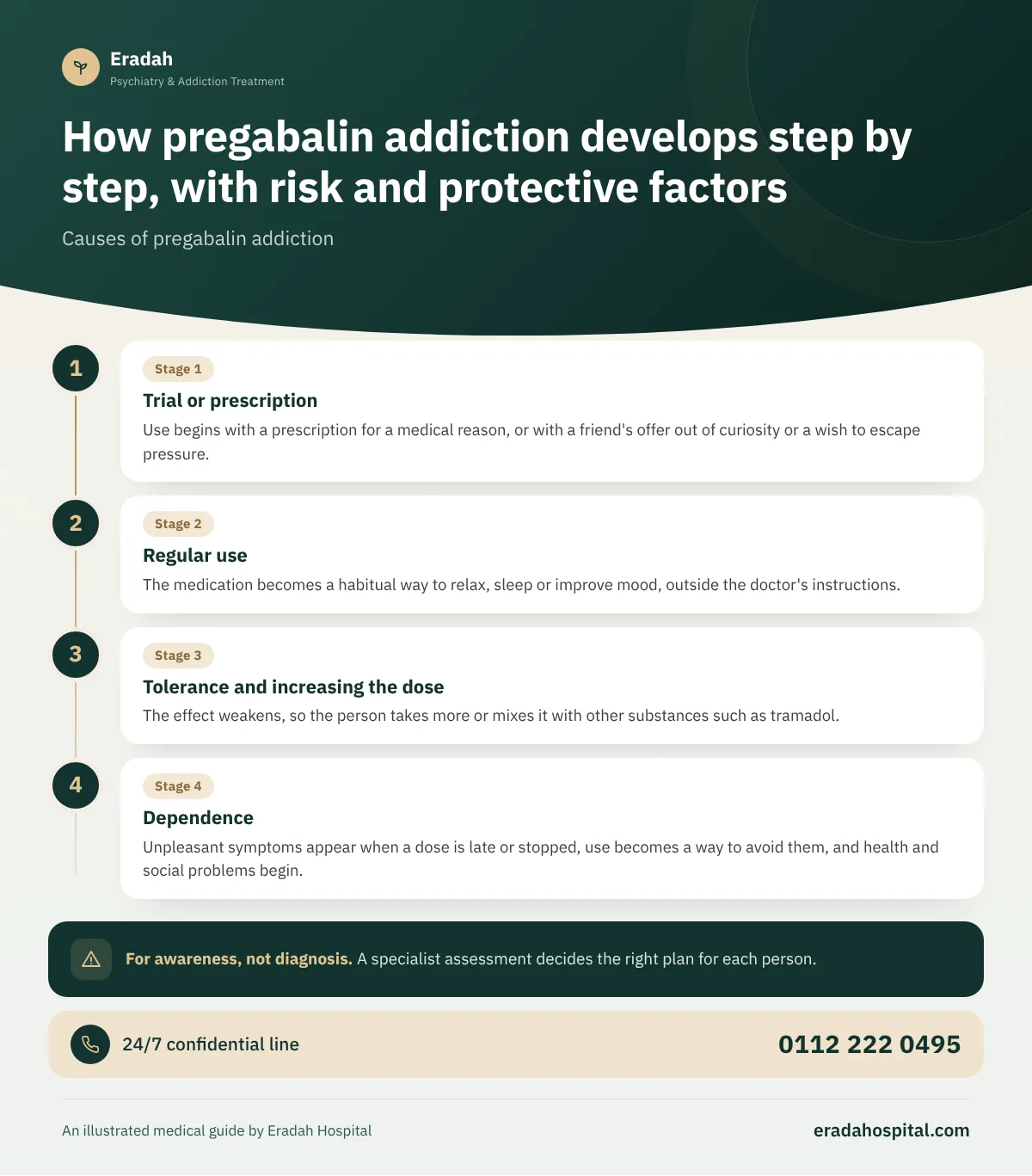
Addiction does not happen suddenly. It usually passes through overlapping stages:
- Stage 1Trial or prescription
Use begins with a prescription for a medical reason, or with a friend's offer out of curiosity or a wish to escape pressure.
- Stage 2Regular use
The medication becomes a habitual way to relax, sleep or improve mood, outside the doctor's instructions.
- Stage 3Tolerance and increasing the dose
The effect weakens, so the person takes more or mixes it with other substances such as tramadol.
- Stage 4Dependence
Unpleasant symptoms appear when a dose is late or stopped, use becomes a way to avoid them, and health and social problems begin.
Risk factors versus protective factors
| Factors that raise the risk | Factors that protect against it |
|---|---|
| A history of opioid, tramadol or other substance use | Telling the doctor about any past history before starting the medication |
| Untreated anxiety, depression or insomnia | Treating the mental health condition safely, with regular follow-up |
| Getting the drug without a prescription or from more than one source | Receiving the drug on a prescription from one doctor with regular follow-up |
| Friends who share sedative medications | Supportive relationships, healthy activities and a regular daily routine |
| Family history of addiction | A family that is open to talking and seeks help early |
Is pregabalin addiction a weakness of willpower?
This is one of the most widespread ideas and one of the most harmful. Addiction is a change in the brain's reward and self-control circuits, shaped by biological, psychological and social factors, and no one chooses to become addicted. Blaming a person or using demeaning labels does not help them stop. It more often pushes them toward hiding and isolation.
Seeing addiction as an illness does not remove a person's responsibility. It means that the right path is treatment and support, just as we handle any other chronic illness that needs a plan and follow-up.
How can you protect yourself or your children from pregabalin addiction?
- If pregabalin is prescribed to you, take it exactly as your doctor directs, and never increase the dose on your own.
- Tell your doctor about any history with opioids, alcohol or sedatives before the medication is prescribed.
- Do not share your medication with anyone, and store it somewhere safe, out of children's reach.
- Talk to your children clearly about how a “medication” can be dangerous if used outside medical care.
- Seek real treatment for anxiety and insomnia, and do not rely on a sedative medication without follow-up.
- Ask for specialist advice at the first sign of misuse, not after the problem has worsened.