Stages of pregabalin addiction treatment
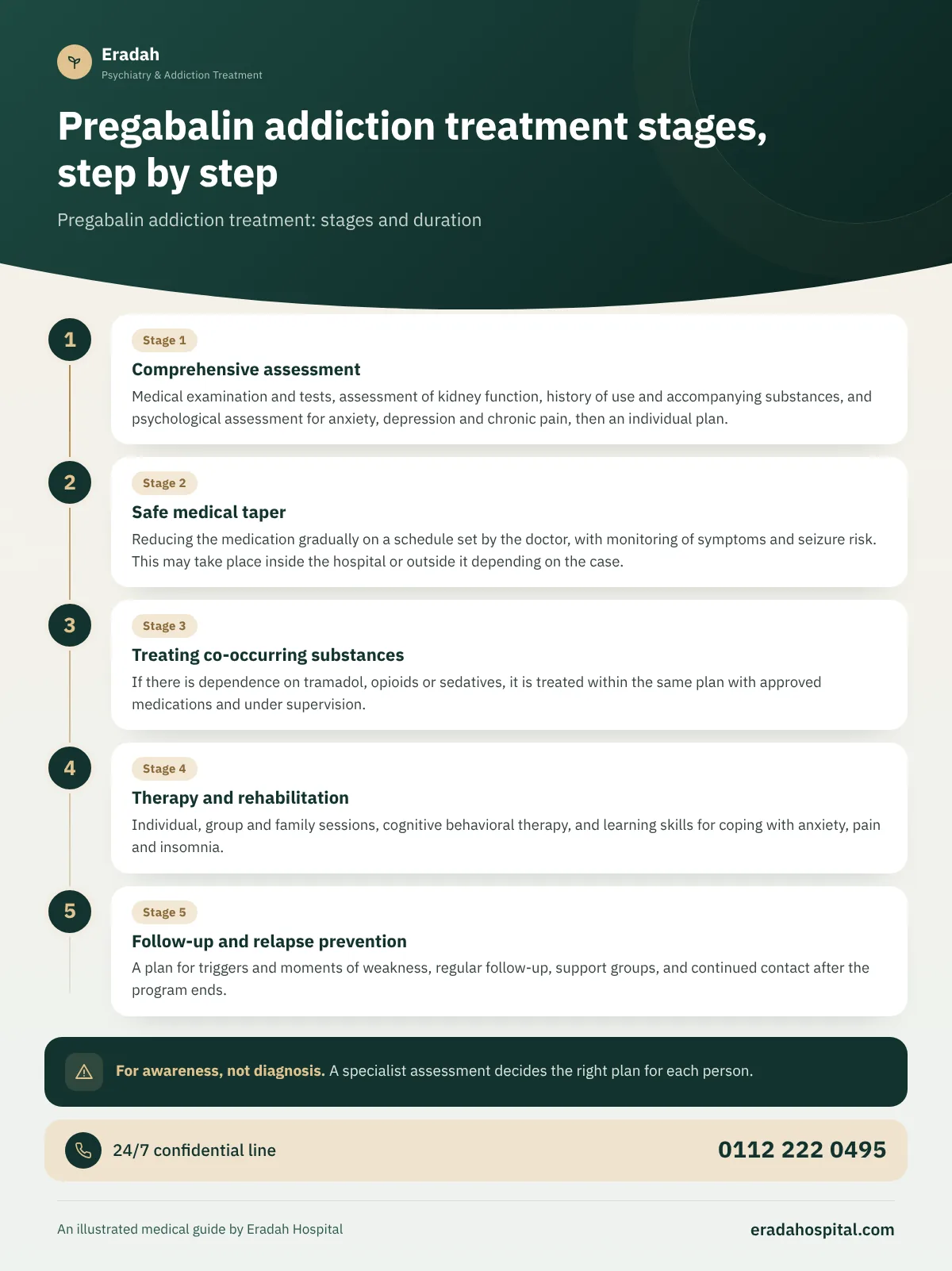
- Stage 1Comprehensive assessment
Medical examination and tests, assessment of kidney function, history of use and accompanying substances, and psychological assessment for anxiety, depression and chronic pain, then an individual plan.
- Stage 2Safe medical taper
Reducing the medication gradually on a schedule set by the doctor, with monitoring of symptoms and seizure risk. This may take place inside the hospital or outside it depending on the case.
- Stage 3Treating co-occurring substances
If there is dependence on tramadol, opioids or sedatives, it is treated within the same plan with approved medications and under supervision.
- Stage 4Therapy and rehabilitation
Individual, group and family sessions, cognitive behavioral therapy, and learning skills for coping with anxiety, pain and insomnia.
- Stage 5Follow-up and relapse prevention
A plan for triggers and moments of weakness, regular follow-up, support groups, and continued contact after the program ends.
Why does treatment begin with a comprehensive assessment?
Pregabalin alone is rarely the whole story. Many cases involve tramadol, opioids or other sedatives, real nerve pain, an anxiety disorder, or chronic insomnia. A careful assessment identifies:
- All the substances the person uses, because a mixture changes the plan for stopping and its risks.
- Epilepsy or a history of seizures, because it raises the risk of stopping quickly.
- Kidney function, because it affects how the body handles the drug.
- Mental state and suicide risk, because they determine the level of care needed.
- Whether there is a genuine medical reason that needs a safe alternative treatment.
Medical tapering: why not stop suddenly?
Stopping pregabalin suddenly after regular use can cause insomnia, anxiety and sweating, and it can cause seizures. This is why the official leaflet recommends tapering rather than sudden discontinuation. The doctor sets the pace of tapering according to the length of use, the amount, general health and accompanying substances, and the plan may stretch from days to weeks or more.
Are there medications to treat pregabalin addiction?
So far there is no approved medication specifically for treating pregabalin addiction, as there is for opioid addiction. But the doctor may use medications for specific purposes within the plan, chosen case by case:
| Purpose | Examples and their role |
|---|---|
| Treating accompanying opioid dependence | Buprenorphine, methadone or naltrexone, depending on the case and what is available and licensed, to treat tramadol or opioid dependence. |
| Treating anxiety and depression | Antidepressants from groups that do not cause dependence, chosen by the psychiatrist. |
| Treating the underlying nerve pain | Medication and non-medication alternatives set by the doctor if there is real pain. |
| Preventing seizures | In selected cases, especially people with epilepsy, a neurologist chooses the appropriate medication. |
Doctors usually avoid replacing pregabalin with other sedatives that cause dependence, such as benzodiazepines, except for a very short period and under close supervision. No medication should be started or stopped without a doctor.
Psychological and behavioral therapy
Helps you understand the thoughts and situations that drive use of the drug, and build new ways of coping with anxiety, pain and cravings.
A safe space to share the experience with others on the same journey, and to learn relapse prevention skills.
Rebuilds trust and teaches the family how to support without blame and without enabling use.
Treating accompanying anxiety, depression or trauma at the same time, because they are often behind the use.
Behavioral techniques to improve sleep without depending on sleeping pills.
Programs combining physical therapy, psychological treatment and lifestyle changes for people with real pain.
Does pregabalin addiction treatment need a hospital stay?
| Residential treatment is more suitable when | Outpatient treatment may suit when |
|---|---|
| Pregabalin is mixed with tramadol, opioids or sedatives | Pregabalin is used alone, without other substances |
| There is epilepsy or a history of seizures | There is no history of seizures |
| Large amounts over a long period | A shorter period of use and smaller amounts |
| Severe depression or suicidal thoughts | A stable mental state |
| Earlier attempts have failed, or the environment is unsupportive | A supportive family and commitment to follow-up |
The treatment team decides the appropriate level after assessment, and a patient may start with residential care and then move gradually to outpatient treatment.
How long does pregabalin addiction treatment take?
| Stage | Approximate duration |
|---|---|
| Assessment | A few days |
| Medical taper | From days to several weeks depending on the case |
| Residential treatment and rehabilitation when needed | Roughly 4 to 12 weeks |
| Outpatient treatment | Several months |
| Follow-up and relapse prevention | At least a year, and it may extend longer |
The duration varies greatly between someone who uses pregabalin alone and someone who mixes it with tramadol or other substances; the more substances involved, the longer the plan. Staying in treatment for long enough is one of the most important factors in success.
Relapse prevention after pregabalin treatment
- Know your personal triggers: anxiety, insomnia, pain, particular friends and certain places.
- A written plan for moments of weakness: whom to call and what to do.
- Tell any new doctor about your history with pregabalin before they prescribe any sedative or painkiller.
- Treat pain or anxiety in safe ways and keep up follow-up.
- Attend support groups for people in recovery, and build a healthy routine of sleep, exercise and work.
How do you choose a pregabalin addiction treatment center?
- An official license and a team that includes psychiatrists, internists and psychologists.
- Experience treating addiction to medications and mixtures, especially pregabalin with tramadol.
- The ability to provide round-the-clock medical follow-up during tapering.
- Treatment of dual diagnosis and chronic pain, not addiction alone.
- A family program, follow-up after discharge, and complete confidentiality.
What is the family's role in pregabalin addiction treatment?
The family is a core partner in treatment, not just a spectator. It can help with simple, effective steps:
- Attend family therapy sessions to understand the nature of addiction and the right way to support.
- Agree with the treatment team on how to store medications at home, especially if the patient needs other medications.
- Avoid blame and constant reminders of the past, and focus on progress however small.
- Watch for early signs of relapse such as insomnia, irritability and withdrawal, and contact the treatment team.
- Look after family members' mental health too, since the stages of treatment are tiring for everyone.
Does pregabalin addiction treatment work?
Yes, and full recovery is possible, especially when treatment starts early and covers the underlying cause. Outcomes improve greatly when the patient sticks to the taper plan without rushing, treats anxiety, pain or insomnia in safe ways, deals with any accompanying dependence on tramadol or other substances, and keeps up follow-up after the first stage ends. Relapse, if it happens, is a signal to adjust the plan, not proof of failure.
Choosing a hospital for pregabalin addiction treatment
The biggest risk with pregabalin is not the craving alone but unplanned stopping: it can cause acute anxiety, insomnia and sweating, and may lead to seizures, especially after large amounts or with a history of epilepsy. It is made more complicated by the fact that many people combine it with tramadol or sedatives, or started it for nerve pain or anxiety that is still there. So choosing the place means choosing who will manage this whole tangle.
- An assessment that counts all the pills actually used, not only what the patient admits to in the first session.
- A taper decided by a doctor, with someone present to act immediately if a seizure occurs at night.
- A clear order for withdrawing tramadol and pregabalin if both are present in the same patient.
- Treatment of the underlying pain or anxiety by methods that do not cause dependence, coordinated with the relevant specialist.
- Follow-up after discharge, because going back to the nearby pharmacy is easy.
At Eradah a doctor and nursing staff are on site day and night during the medical detox stage, and the patient is taken by ambulance to the nearest general hospital if their condition requires it. The anxiety that pregabalin was covering is treated within the dual diagnosis program, with psychological sessions and a medication plan set by the doctor. For a comparison of the two substances, read the difference between pregabalin and tramadol.
Pregabalin addiction treatment at Eradah
At Eradah we begin with a comprehensive assessment that identifies all substances used and any pain, anxiety or insomnia behind the use. Then we set a safe taper plan under round-the-clock medical supervision when needed, and treat any accompanying dependence on tramadol or other substances within the same plan. This is followed by a psychological and family treatment program and follow-up after discharge, with complete confidentiality from the first call.