"I want to get rid of Tamol for good, and I don't want any other medication." That is an understandable wish, and many people hope for a quick fix that ends after a week in a clinic. But opioid addiction treatment in particular is one of the fields where science has changed most in recent decades, and the most important finding is that the right medication combined with psychological therapy really does save lives.
What is opioid addiction treatment?
Opioids are a family that includes tramadol, heroin, codeine, morphine and others. Treating addiction to them aims at three things: stopping compulsive use safely, preventing relapse, and rebuilding life. The US National Institute on Drug Abuse states that medication should be the first-line treatment for opioid addiction, together with behavioral therapy or counseling.
Stages of opioid addiction treatment
- Stage 1Assessment
A physical and psychological examination, identifying the substances, amounts and accompanying illnesses, and screening for infection if injecting was involved.
- Stage 2Detox or starting medication
Easing withdrawal symptoms safely, or starting a therapeutic medication straight away as decided by the doctor.
- Stage 3Rehabilitation
Cognitive behavioral therapy, individual, group and family sessions, and treatment of accompanying depression or anxiety.
- Stage 4Follow-up
Continuing medication if the patient needs it, a relapse prevention plan, and regular follow-up.
Why isn't detox alone enough?
In the principles of addiction treatment published by the National Institute on Drug Abuse, the tenth principle is explicit: medically supervised detox is only the first stage, and by itself does little to change long-term use. The institute adds elsewhere that detox without follow-up treatment usually leads to a return to use.
The danger is doubled with opioids in particular: after detox the body loses its tolerance, and if the person goes back to their old amount it can be fatal. You will find details of the symptoms in drug withdrawal symptoms.
Medications for opioid addiction
| Methadone | Buprenorphine | Naltrexone | |
|---|---|---|---|
| How they work | Long-acting full agonist | Partial agonist | A blocker that prevents the effect of opioids |
| When does it start? | Within a specialized program, under close supervision | After withdrawal symptoms have begun | After detox is fully complete |
| What it offers | Prevents withdrawal and reduces cravings | Eases withdrawal and cravings, with a higher safety ceiling | Blocks euphoria if the person returns to use |
| Key caution | Risky during the starting period, and must not be mixed with sedatives | May cause sudden withdrawal if started too early | May cause severe withdrawal if opioids remain in the body |
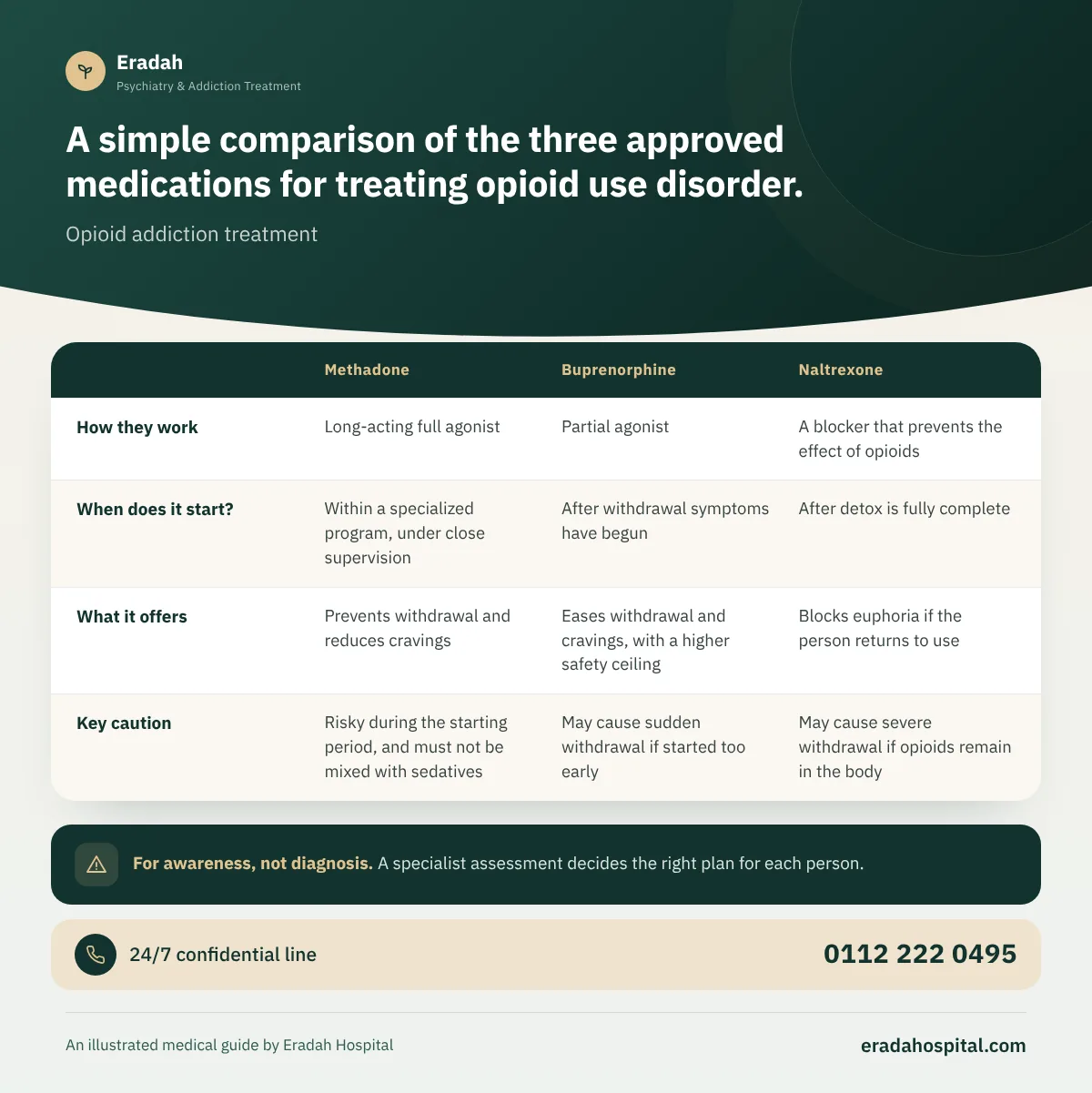
The pages on methadone, buprenorphine and naltrexone cover each medication in detail. The availability of their forms and programs varies from place to place in Egypt, and the addiction doctor determines the option that is available and suitable for each case.
What does the evidence say about the effectiveness of medication treatment?
In a systematic review published by the BMJ in 2017 covering more than 122,000 people treated with methadone, all-cause deaths were 11.3 per 1,000 people per year during treatment versus 36.1 outside it, and overdose deaths fell similarly. With buprenorphine they were 4.3 during treatment versus 9.5 outside it.
The same study points to two dangerous periods: the start of methadone treatment, and the first weeks after leaving either medication. A 2014 Cochrane review also found that buprenorphine is better than placebo at keeping patients in treatment and reducing illicit opioid use.
Psychological and behavioral therapy in opioid addiction treatment
- Cognitive behavioral therapy to learn to handle triggers and cravings.
- Motivational interviewing to strengthen the decision to change.
- Family therapy, and family support through the family program.
- Support groups and programs such as the twelve steps.
- Treatment of accompanying depression, anxiety or chronic pain, as part of dual diagnosis.
How long does opioid addiction treatment take?
There is no single duration that suits everyone. But the National Institute on Drug Abuse principles state that most patients need at least 3 months of treatment to clearly reduce or stop use, that the best results come with longer durations, and that methadone treatment is considered to need 12 months at a minimum, with some patients benefiting from it for years.
Residential or outpatient treatment?
Residential care is often needed by people who mix opioids with sedatives or alcohol, or who have a severe mental illness or suicidal thoughts, or whose attempts at home have failed, or whose environment is full of triggers. Outpatient treatment suits people whose condition is stable and who have family support and the ability to stick with it. At Eradah the decision begins with a free, confidential assessment, then a residential program or outpatient follow-up depending on the case.
The role of the family in opioid addiction treatment
- Treat therapeutic medication as treatment, not as shame, and help with sticking to its schedule.
- Learn the signs of overdose; the family is often the first to see them.
- Do not treat relapse as the end of the road, but as a signal to adjust the plan.
- Look after yourself too, and start with the Family Guide.