What is schizoaffective disorder?
“First they said depression, then they said schizophrenia, and now they say schizoaffective. We don't understand what exactly our son has.” This confusion is very common among patients' families, and it has an understandable cause: schizoaffective disorder sits in a middle zone between two well-known illnesses, and diagnosing it requires following symptoms over time.
Cleveland Clinic defines it as a mental health condition that combines symptoms of schizophrenia with symptoms of a mood disorder, so a person may experience depression, mania and psychosis. A scientific review published in 2019 in the journal Annals of Clinical Psychiatry explains that its distinguishing feature is a major mood episode, depressive or manic, occurring at the same time as symptoms characteristic of schizophrenia, such as delusions, hallucinations and disorganized speech.
It is also called schizoaffective illness or schizoaffective psychosis in Arabic, all of which are translations of the English term schizoaffective disorder. The same review notes that the diagnosis is still a matter of scientific debate: some experts see it as an independent disorder, and others see it as a form of schizophrenia or of mood disorders.
How common is schizoaffective disorder?
Cleveland Clinic bases the prevalence figure on a Finnish study, and notes that the exact number is hard to know because diagnosis is complex and its symptoms overlap with other conditions. The U.S. organization NAMI says that men and women are affected at about the same rate, although men are affected at an earlier age, while the Annals of Clinical Psychiatry review indicates it is more common in women. This disagreement itself reflects how little research there is on this disorder compared with its neighbors.
What are the types of schizoaffective disorder?
The disorder is divided into two types according to the mood symptoms that accompany psychosis, as Cleveland Clinic and NAMI describe:
- Bipolar type: manic episodes occur, which are days of excessive energy, racing thoughts, little need for sleep and recklessness, and depressive episodes may alternate with them.
- Depressive type: only depressive episodes occur, with sadness, emptiness, worthlessness, loss of pleasure and difficulty accomplishing daily tasks.
The type determines the choice of medication: mood stabilizers are essential in the bipolar type, while antidepressants are used in the depressive type when needed.
What are the symptoms of schizoaffective disorder?
Cleveland Clinic divides the symptoms into two groups that occur together or in sequence:
Hearing voices or seeing things that others do not perceive.
Fixed false beliefs such as persecution, being watched, or having special powers.
Disjointed speech or jumping between ideas that is hard to follow.
Sadness, emptiness, fatigue, worthlessness, disturbed sleep and thoughts of death.
Excessive energy, rapid speech, little sleep, recklessness and irritability, in the bipolar type.
Difficulty with work or study, relationships and self-care.
Symptoms vary from person to person and range from mild to severe. Cleveland Clinic warns that mood symptoms can lead to suicidal thoughts, which call for immediate help through the mental health support line 16328 or ambulance (123).
What does schizoaffective disorder feel like from the inside?
“When my mood drops, the voices get louder and harsher. When things calm down a bit, the voices are still there but lighter, and I stay suspicious of everyone.” (A common expression among patients, showing how mood interweaves with psychosis.)
The patient lives through two exhausting experiences at once: a world in which the real and the unreal blend, and a mood that swings between shutting down and impulsiveness. This is why their behavior may seem incomprehensible to their family: at times they withdraw and do not speak, and at other times they don't sleep and plan huge projects. The family's understanding that these are symptoms of an illness, not stubbornness or bad upbringing, is the first step in supporting them.
How is schizoaffective disorder diagnosed?
Cleveland Clinic stresses that no lab tests diagnose it, and that the doctor may order tests to rule out similar physical causes, then relies on the interview, the medical history and the DSM-5 diagnostic criteria, including:
- An uninterrupted period of illness in which a major mood episode (depression or mania) occurs together with symptoms of schizophrenia.
- Hallucinations or delusions for two weeks or more without mood symptoms.
- Mood symptoms present for most of the duration of the illness.
- The symptoms are not caused by a substance, a medication or another medical condition.
The second criterion is what distinguishes it from depression or bipolar disorder with psychosis, where psychotic symptoms appear only during the mood episode. Because this requires following the course over time, NAMI notes that many patients are misdiagnosed at first as having bipolar disorder or schizophrenia. The diagnosis may change over time, as the guide to types of schizophrenia explains.
What is the difference between schizoaffective disorder, schizophrenia and bipolar disorder?
| Schizophrenia | Schizoaffective disorder | Bipolar disorder with psychosis | |
|---|---|---|---|
| Psychotic symptoms | Core and persistent | Core, and also present without a mood episode | Appear only during mood episodes |
| Mood episodes | May be present but are not predominant | Full episodes during most of the illness | Basis of the illness |
| Between episodes | Many symptoms often remain | Psychotic symptoms may remain | Many return to their usual state |
| Course | Often chronic | Between the two illnesses | Episodes with stability in between |
| Focus of treatment | Antipsychotics | An antipsychotic with a mood stabilizer or an antidepressant | Mainly mood stabilizers |
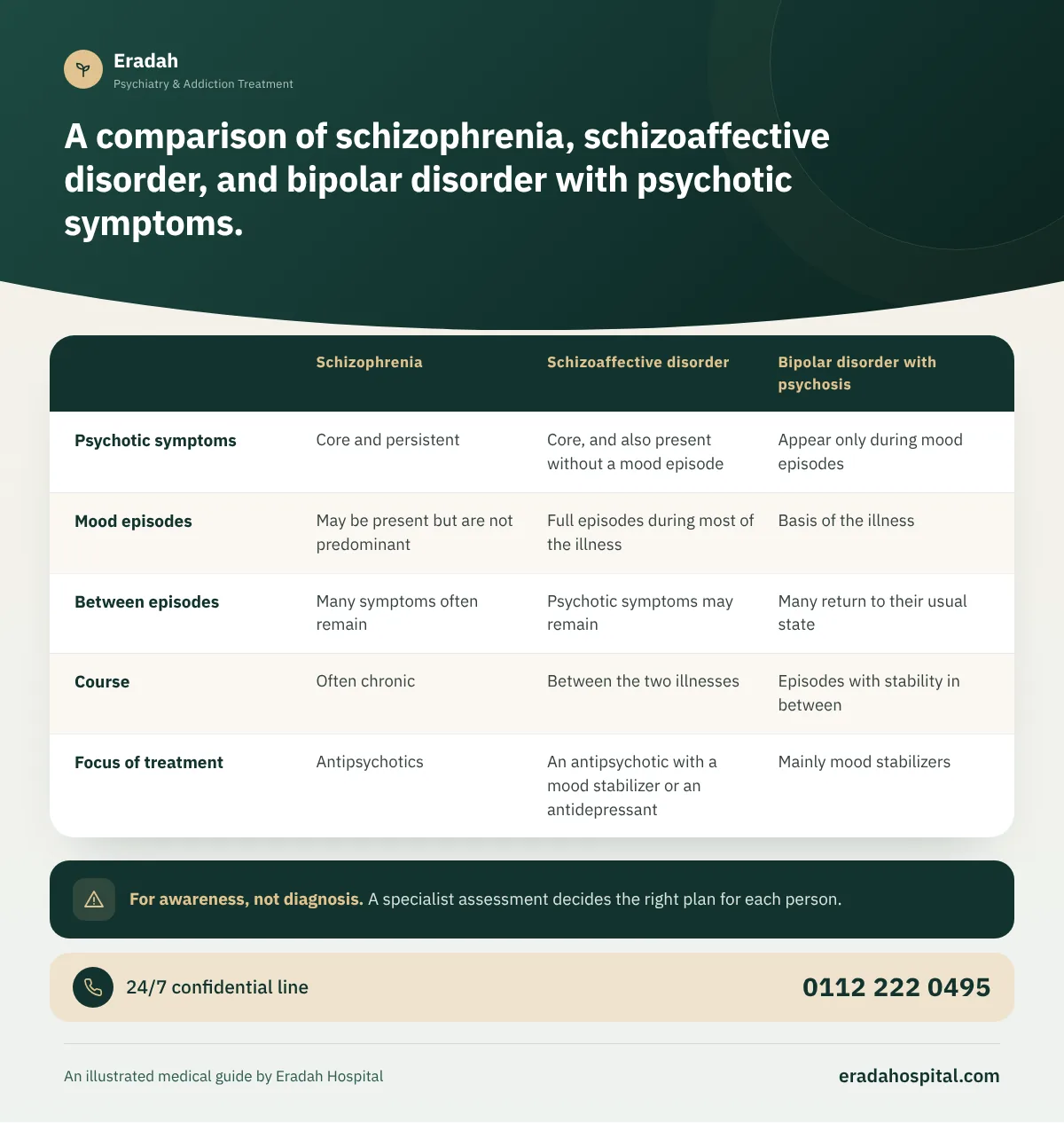
The Annals of Clinical Psychiatry review notes that the course of schizoaffective disorder lies in the middle zone between schizophrenia and bipolar disorder. It also differs from psychotic depression, in which hallucinations and delusions are limited to the period of depression. It is also commonly confused with “split personality,” which is an incorrect description explained in the guide to dissociative identity disorder.
What causes schizoaffective disorder?
The exact cause is unknown, but Cleveland Clinic and NAMI mention overlapping factors:
- Genetics: it tends to run in families, and the likelihood rises with a family history of schizophrenia or mood disorders, and the Annals of Clinical Psychiatry review describes its heritability as high. But most people with this history do not develop it.
- Brain chemistry and structure: imbalances in neurotransmitters such as dopamine, norepinephrine and serotonin, and differences in some brain regions.
- Stress: major events such as the death of a relative, the end of a marriage or the loss of a job may contribute to the appearance of symptoms.
- Drug use: it may increase the risk of symptoms appearing or worsening in those who are predisposed.
Schizoaffective disorder and addiction
NAMI says that substance use disorders are common in people with schizoaffective disorder and need integrated treatment. It notes that regular use of hashish in adolescence is linked to a higher risk of psychotic disorders later, especially in those with a genetic predisposition, and that both depression and mania can make drugs and alcohol tempting “to calm down” or “to energize,” at a heavy cost to recovery.
That is why treating the disorder while use continues, or the reverse, leaves the door open to relapse. The guide to schizophrenia and addiction explains much that applies here, and at Eradah this is treated within a dual diagnosis program.
How is schizoaffective disorder treated?
Cleveland Clinic says the doctor chooses the medication according to the type of the disorder, and the most common classes are:
- Antipsychotics: the foundation of treatment for hallucinations, delusions and disorganized thinking. NAMI notes that paliperidone (brand name Invega, among others) is the only medication approved by the FDA specifically for this disorder, and that clozapine is the FDA-approved medication for treatment-resistant schizophrenia, meaning in people who have not responded to at least two different medications, and it requires follow-up blood tests.
- Mood stabilizers: such as lithium and valproate, to treat and prevent mania in the bipolar type.
- Antidepressants: to treat and prevent depressive episodes in the depressive type.
Psychological therapy is added to medication, including cognitive behavioral therapy adapted for psychosis, which helps in coping with persistent symptoms, family therapy, and training in daily living and work skills. NAMI and the Annals of Clinical Psychiatry review mention that transcranial magnetic stimulation sessions may be an option in cases that have not responded to medication and psychological therapy.
As for hospital admission, Cleveland Clinic says it is not always necessary, but it may be needed if symptoms become severe and there is a danger to self or others. Do not start or stop any medication without a doctor; sudden discontinuation is one of the most common causes of relapse.
Common myths about schizoaffective disorder
| The myth | The truth |
|---|---|
| It is “split personality” | It has nothing to do with multiple personalities; it combines psychotic and mood symptoms |
| The diagnosis changed, so the doctors don't know anything | Change is expected because the diagnosis depends on following symptoms over time |
| If the patient improves, they can stop the medication | Cleveland Clinic says medication is usually continued even during periods of remission |
| The patient is dangerous by nature | Violence is not a feature of the illness, and regular treatment reduces crises and relapses |
| There is no hope of a normal life | Many reach long-term stability, work and live with their families |
Can you recover from schizoaffective disorder?
Cleveland Clinic says there is no cure for the disorder, but staying on medication and psychological therapy may lead to remission, meaning periods when symptoms are absent, although this may take months to years and not everyone reaches it. It stresses that early diagnosis and treatment improve outcomes and reduce relapses and hospital admissions.
According to NAMI, among the most important protections for stability are a steady routine for sleeping and waking, avoiding alcohol and drugs, supportive relationships, and keeping up with follow-up. Many patients live stable lives when the family and the treating team work together.
How can the family support a person with schizoaffective disorder?
- Learn about the illness and your relative's own relapse warning signs, such as lack of sleep, isolation or the return of suspicion.
- Speak calmly in short sentences, and do not argue with delusions or confirm them.
- Help them keep to medication and appointments without suffocating monitoring or threats.
- Reduce stress and criticism at home as far as possible, and celebrate small steps.
- Ask for support for yourselves, because caring for someone with a chronic illness is exhausting.
For more practical steps, read the guide to dealing with a relative with a mental illness and dealing with a person with schizophrenia, since much of what is in them applies here.
When to see a psychiatrist, and Eradah's role
See a psychiatrist if hallucinations, delusions or strange suspicions appear along with depression or periods of excessive energy and little sleep, if relapses recur despite treatment, or if the illness occurs together with substance use. Ask for help immediately at any talk of death, voices commanding harm, or dangerous recklessness during mania.
At Eradah Hospital it starts with a comprehensive assessment that reviews the history and timing of symptoms and rules out physical causes and substances, followed by a plan combining medication, psychological therapy and family training. Residential treatment for men is available when intensive care is needed, and the first consultation is free and confidential for everyone.
An acute psychotic or mood episode, or danger to self? Get help now
- Voices commanding them to harm themselves or others, or acting on them
- Deep depression with talk of death or saying goodbye to family
- Agitation or no sleep for days with dangerous reckless behavior
- Refusing to eat or drink, or neglect that threatens their health
- Stiffness, fever and confusion after starting a new medication or changing it
Speak calmly in short sentences, and do not argue with their ideas or corner them. Quietly remove sharp objects and medication without confrontation. Call ambulance (123) or go to the nearest emergency department if the danger is imminent, and if they talk about death, do not leave them alone and contact the mental health support line 16328, available around the clock.
Ambulance 123 Mental health support line 16328