Why does heroin cause addiction so quickly?
Heroin has properties that make it one of the fastest drugs to cause addiction:
It reaches the brain within seconds to minutes, and the faster a drug arrives, the higher its potential for addiction.
It releases dopamine in amounts that natural rewards cannot match, so the brain learns to seek it out.
The same amount quickly has less effect, so the person increases the amount or how often they use.
Severe symptoms appear within hours of stopping, so the person returns to using to escape them, not to chase euphoria.
The page on heroin withdrawal symptoms covers this stage in detail, because it is the main reason many people go back to using even though they want to stop.
At a certain stage, a person with a substance use disorder no longer uses to feel high, but only to feel normal.
From experimenting to addiction: how does it develop?
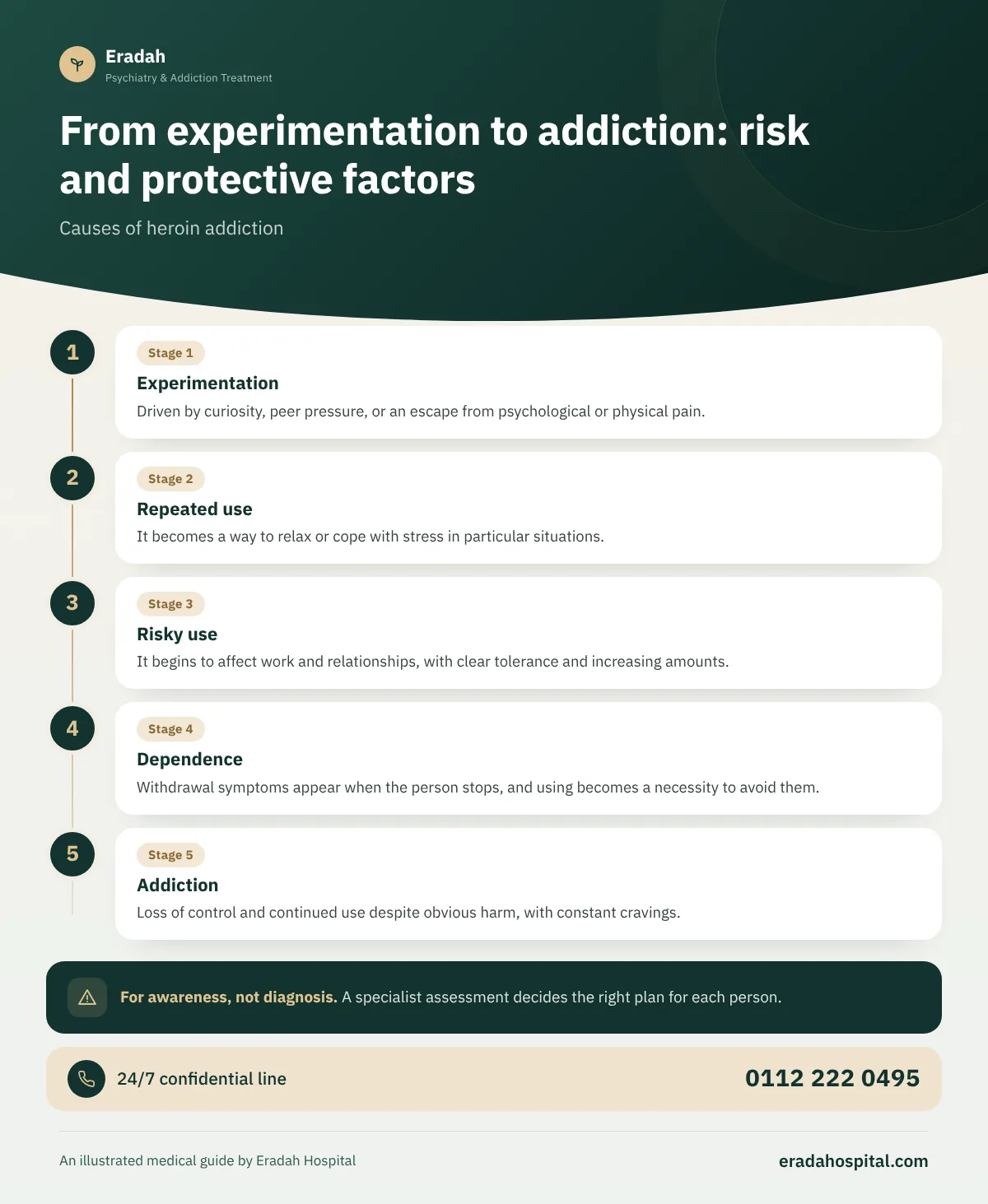
Hardly anyone starts out intending to become addicted. Addiction develops through gradual stages, which can pass very quickly with heroin:
- Stage 1Experimentation
Driven by curiosity, peer pressure, or an escape from psychological or physical pain.
- Stage 2Repeated use
It becomes a way to relax or cope with stress in particular situations.
- Stage 3Risky use
It begins to affect work and relationships, with clear tolerance and increasing amounts.
- Stage 4Dependence
Withdrawal symptoms appear when the person stops, and using becomes a necessity to avoid them.
- Stage 5Addiction
Loss of control and continued use despite obvious harm, with constant cravings.
Why do cravings continue even after stopping? The role of triggers
The brain learns to link heroin with everything around it: places, people, times of day, and even feelings such as boredom, sadness or anger. With repetition, simply encountering one of these triggers is enough to set off a strong craving, even weeks or months after stopping.
This explains why some people in recovery go back to using when they return to the same old environment, and why treatment focuses on identifying personal triggers and building alternative ways to cope with them, not just on physical cessation.
Genetic and biological factors
Studies indicate that genes account for a large part of a person's vulnerability to addiction, which is why the risk is higher for those whose parent or sibling has an addiction. What is meant here is a combination of factors that affect how the brain responds to substances and how well it controls impulses, not a specific "addiction gene."
Mental health conditions and dual diagnosis
Many patients turn to heroin to relieve psychological suffering that was never diagnosed or treated, and the temporary relief turns into addiction. The conditions most often linked with opioid addiction include:
- Depression and anxiety disorders.
- Post-traumatic stress disorder (PTSD).
- Bipolar disorder.
- Untreated attention-deficit/hyperactivity disorder (ADHD).
- Personality disorders, especially borderline personality disorder.
Trauma and difficult experiences
Abuse or neglect in childhood, the loss of a loved one, violence, or severe ongoing stress all raise the likelihood of addiction. Heroin gives a temporary sense of calm and detachment from pain, which makes it especially appealing to people carrying deep emotional pain.
From painkillers to heroin
Some patients start with opioid painkillers such as tramadol or others, with or without a prescription, then develop tolerance and dependence, and when the medication becomes hard to get or too expensive, they move on to heroin. This is why opioid painkillers should always be used under medical supervision and only for the length of time the doctor specifies.
Environment and social factors
- Starting use at an early age: The adolescent brain is more vulnerable to addiction because its self-control regions are not fully developed.
- Friends and surroundings: The presence of the drug in a person's circle and their friends' acceptance of it.
- Lack of family support: Weak communication within the family, lack of supervision, or constant conflict.
- Idleness and unemployment: A lack of purpose and daily routine, along with financial pressure.
Who is most at risk of heroin addiction?
Anyone can develop an addiction, but the risk is clearly higher in certain groups who need attention and early prevention:
The brain is not yet fully developed, and curiosity and peer pressure have a stronger influence at this stage.
Especially those who use opioid painkillers for long periods or without regular medical follow-up.
Such as depression, anxiety and post-traumatic stress disorder (PTSD), when they do not receive appropriate treatment.
Addiction in a parent or sibling raises both the genetic and the environmental vulnerability.
Such as alcohol, sedatives or painkillers, because the brain's reward circuits are already primed.
Risk factors and protective factors
Not every risk factor can be controlled, but every protective factor you add genuinely lowers the likelihood:
| Area | Risk factor | Protective factor |
|---|---|---|
| Family | Ongoing conflict, a parent's addiction, or lack of supervision | Open communication, clear boundaries and emotional support |
| Mental health | Untreated depression, anxiety or trauma | Early diagnosis and treatment, and skills for coping with stress |
| Surroundings | Easy availability of the drug, and friends who use | Supportive friends, and sports or volunteer activities |
| School and work | Academic failure, or unemployment and idleness | Clear goals, and involvement in work or study |
Is addiction a choice?
The first decision to try a drug may be a choice, but addiction itself is not. With repeated use, the brain circuits responsible for reward, self-control and decision-making change, and the person loses the ability to stop despite a sincere wish to. This is why international medical bodies regard addiction as a chronic brain disease that needs treatment, not blame. Understanding this helps families respond with compassion, and helps the patient ask for help without shame.
How can you protect yourself or your children?
- Hold an open, early conversation in the family about drugs, without exaggerating or downplaying the risks.
- Pay attention to changes in mood and behavior, and seek help early for depression and anxiety.
- Use opioid painkillers only when prescribed and under medical supervision.
- Build a healthy routine of sleep, exercise, activities and supportive relationships.
- Seek specialist advice at the first sign of drug use, not after the problem has worsened.