Why does dealing with a person addicted to heroin start with a safety plan?
"I thought he was asleep. When I got close, I found his lips blue." Some families discover how dangerous heroin is in a single moment they never forget. That is why the first thing we tell the families of people with heroin addiction, before any talk of persuasion or treatment, is this: learn how to save their life.
The World Health Organization states that death after an opioid overdose can be prevented if the person receives basic first aid and is given naloxone in time, an antidote that reverses the effects of opioids. But it also notes that access to naloxone is generally limited to health workers, and that its availability is limited in many countries. So the family's role is to recognize the signs quickly, call the ambulance (123), and keep the person breathing until the medical team arrives.
The organization lists among the most important risk factors for overdose: injecting, returning to use after a period of abstinence such as after detox or release from prison, and combining with alcohol or sedatives such as benzodiazepines. These are the situations in which the family needs to be most alert.
Overdose plan: what should the family prepare?
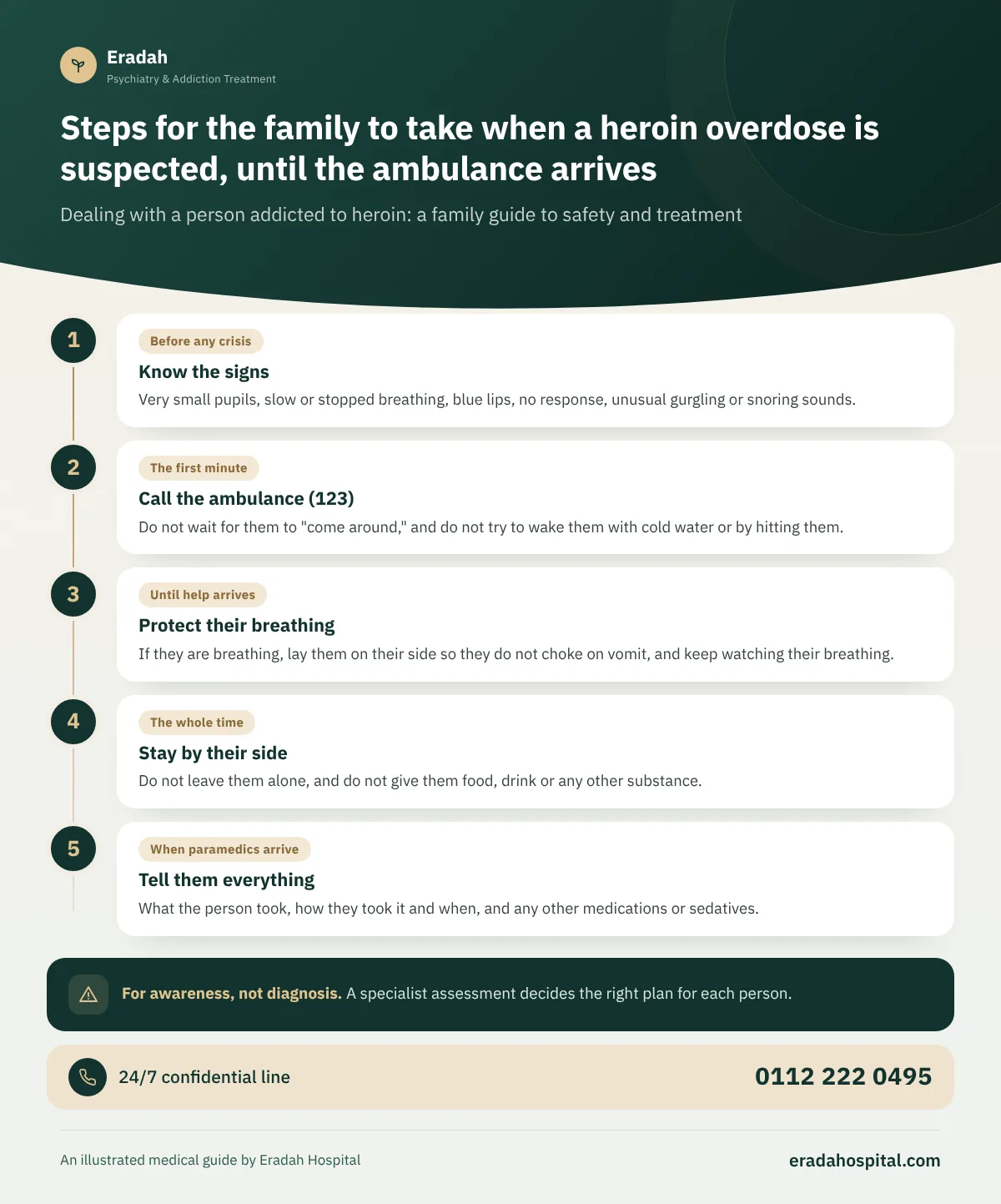
Agree on this plan as a family and memorize it, and ideally everyone who lives in the home should know it:
- Before any crisisKnow the signs
Very small pupils, slow or stopped breathing, blue lips, no response, unusual gurgling or snoring sounds.
- The first minuteCall the ambulance (123)
Do not wait for them to "come around," and do not try to wake them with cold water or by hitting them.
- Until help arrivesProtect their breathing
If they are breathing, lay them on their side so they do not choke on vomit, and keep watching their breathing.
- The whole timeStay by their side
Do not leave them alone, and do not give them food, drink or any other substance.
- When paramedics arriveTell them everything
What the person took, how they took it and when, and any other medications or sedatives.
You can find the full details on the overdose page. And remember that calling an ambulance to save a life is not a betrayal of them, whatever they say afterward.
Withdrawal is painful but usually not life-threatening
Many people addicted to heroin fear withdrawal more than anything else, and families fear it too. The US National Library of Medicine (MedlinePlus) describes opioid withdrawal as painful but usually not life-threatening, lists among its complications inhaling vomit into the lungs and dehydration and electrolyte imbalance from vomiting and diarrhea, and says its biggest complication is a return to use.
That means two things: withdrawal is not a reason to put off treatment out of fear for them, and trying to get them through it at home by locking them in or depriving them wastes the most important thing a medical program offers, which is easing symptoms and preventing a quick return to use. The place for that is detox under medical supervision, and the page on heroin withdrawal symptoms sets out the timeline.
The most dangerous moment: returning after a period of abstinence
The US National Library of Medicine says that most opioid overdose deaths occur in people who have recently finished detox, because withdrawal lowers the body's tolerance, so a much smaller amount than they were used to can cause an overdose. This is why the days and weeks after detox, release from prison or leaving treatment are the most dangerous period of all.
- Do not treat the end of detox as the end of treatment; it is the beginning.
- Agree on a follow-up plan with the treating team before discharge.
- If they go back to using, watch them closely over the following hours, and know the danger signs.
- Do not leave them alone if you know they used after a period of abstinence.
- Treat relapse as a reason to adjust the plan, not as the end of the road.
The guide to after leaving the treatment center helps you plan the first ninety days.
If they inject: what should worry you, and what should you do?
The US National Institute on Drug Abuse (NIDA) states that heroin use raises the risk of exposure to HIV and viral hepatitis through sharing syringes and equipment or unprotected sex, and that people who inject drugs are the group at highest risk of hepatitis C. It explains that snorting or smoking does not remove the risk, because behavior under the influence of the drug remains impulsive.
What the family can do: encourage them to get a medical check-up that includes HIV and hepatitis B and C, without blame or scandal, and watch for signs of infection at injection sites such as redness, swelling and warmth, which need a doctor. The page on the harms of heroin sets out the complications of injecting in detail.
How do you talk to them about treatment?
What most often keeps a person addicted to heroin from treatment is fear of withdrawal, then shame and loss of hope after previous attempts. So the most helpful message is not "you have to quit," but: "There is treatment that eases withdrawal, and you won't go through this alone." You can reassure them that medical programs treat the symptoms with medication, and that a previous relapse does not mean treatment will not work for them.
Choose a time when they are neither under the influence nor at the peak of withdrawal, and avoid threats you will not carry out. You will find the evidence-based CRAFT approach and ready-made phrases in how to persuade a person with addiction to accept treatment.
What does medication treatment for opioid addiction mean?
NIDA states that there are approved medications for treating opioid use disorder: methadone, buprenorphine and naltrexone, and that they reduce the risk of overdose deaths and of behaviors that raise the risk of infection such as HIV and hepatitis C. It also states that fewer than 1 in 5 people with this disorder actually receive these medications.
The availability of these medications and how they are used differ from one country to another and one program to another, so the right question to put to the treating doctor is: what options are available and suitable for their case? The page on heroin addiction treatment explains the role of each medication and the stages of treatment, and the page on addiction treatment medications covers the limits of medications in general. No medication should be started or stopped without a doctor.
Money, boundaries and protecting the rest of the family
- Do not give them cash, and pay for their basic needs directly.
- Keep valuables and important documents in a safe place.
- Do not pay off debts from drug use, and do not cover for their absences or legal problems.
- Do not leave children alone with them while they are under the influence.
- Seek support for yourself through a family treatment program or a specialist; the exhaustion is real and needs support.
At Eradah, the family can start on their own with a free, confidential consultation to assess the level of risk and choose the next step.
Danger signs after heroin use: call the ambulance (123) immediately
- Pupils extremely small, like pinpoints.
- Breathing very slow, irregular or stopped.
- Blue lips and fingernails and cold skin.
- No response to calling their name or to touch.
- Unusual gurgling or snoring sounds.
Call ambulance (123) immediately. If the person is unconscious but breathing, place them on their side so they do not choke on vomit. Stay with them and do not leave them alone. Do not give them food or drink, and tell the paramedics everything they took or used, and the amount and time if you know them.
Call the ambulance 123