Short-term harms of Parkinol
The immediate harms of Parkinol appear within hours of taking a large amount, and can occur from the very first time. A 2022 systematic review of anticholinergic misuse describes a picture in which physical and psychological symptoms occur together.
- A racing heart and rapid breathing.
- Dilated pupils and blurred vision, and dry skin and mouth.
- Urinary retention, unsteadiness and poor balance.
- Anxiety and agitation, followed by confusion, disorientation and delirium.
- Visual or auditory hallucinations and persecutory thoughts.
What makes these harms dangerous is that a person in a state of delirium often does not realize they are ill. They may wander into the street, behave violently or hurt themselves unintentionally, and then remember little of what happened.
Why does Parkinol raise body temperature?
The body relies on sweating to cool itself, and sweat glands need acetylcholine to work. When Parkinol blocks it in large amounts, sweating drops, the skin becomes dry, hot and flushed, and body temperature rises, especially with agitation and excess movement or in hot weather and enclosed spaces. Medical reviews list fever as part of the typical picture of anticholinergic poisoning.
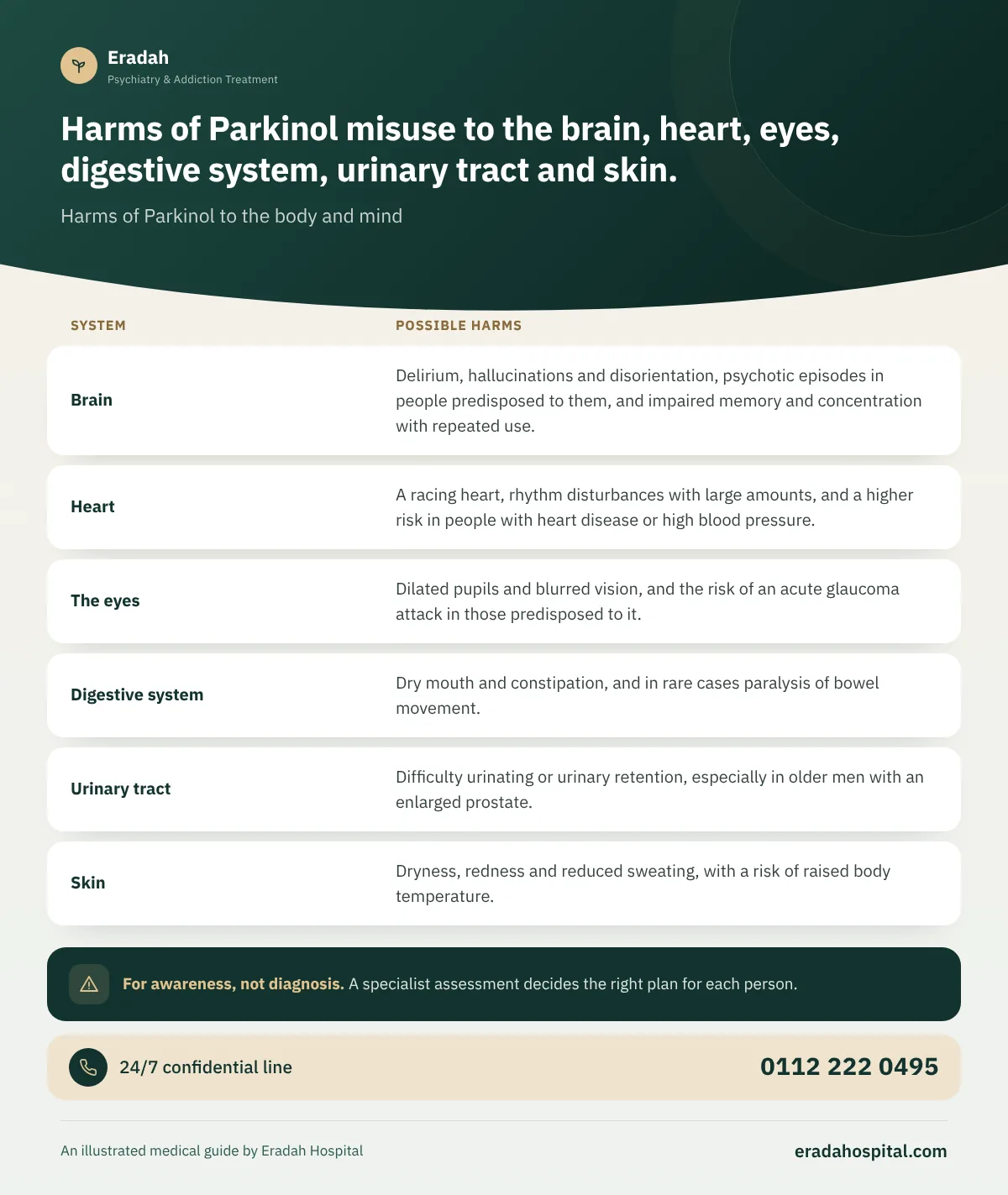
Harms of Parkinol to the body's systems
| System | Possible harms |
|---|---|
| Brain | Delirium, hallucinations and disorientation, psychotic episodes in people predisposed to them, and impaired memory and concentration with repeated use. |
| Heart | A racing heart, rhythm disturbances with large amounts, and a higher risk in people with heart disease or high blood pressure. |
| The eyes | Dilated pupils and blurred vision, and the risk of an acute glaucoma attack in those predisposed to it. |
| Digestive system | Dry mouth and constipation, and in rare cases paralysis of bowel movement. |
| Urinary tract | Difficulty urinating or urinary retention, especially in older men with an enlarged prostate. |
| Skin | Dryness, redness and reduced sweating, with a risk of raised body temperature. |
The official drug leaflet states that mild side effects, such as dry mouth, blurred vision, dizziness and mild nausea, occur in 30 to 50% of patients even at the therapeutic dose. If this is the picture with the prescribed dose, amounts far beyond it multiply all of these effects and add delirium to them.
Parkinol and the eyes: the risk of glaucoma
One of the harms many people overlook is the effect of Parkinol on eye pressure. The official leaflet calls for examining the angle of the eye and monitoring eye pressure regularly in people taking it as treatment, and states that these drugs may unmask latent glaucoma and that cases of angle-closure glaucoma have been recorded with long-term use. Someone who misuses it in large amounts exposes their eyes to this risk with no monitoring at all.
Signs of an acute attack include severe eye pain, headache, sudden blurred vision and redness, and sometimes nausea. It needs an eye doctor immediately, because delay can damage vision.
Harms of Parkinol to memory and mental health
In a study of people with schizophrenia, mental performance improved after anticholinergics were gradually stopped, which shows how much they weigh on memory and attention.
It may trigger a psychotic episode or worsen existing hallucinations in people with psychotic disorders.
Anxiety, irritability and mood swings, especially between periods of use and when stopping.
The official leaflet says that indiscriminate use in pursuit of a continued high may lead to psychiatric disturbances.
For this reason, a person who has both a psychiatric disorder and Parkinol misuse needs a plan that treats both conditions together, known as dual diagnosis. If hallucinations or suspiciousness persist after the drug's effect has worn off, specialist assessment may be needed, as in cases of drug-induced psychosis.
Harms of mixing Parkinol with other substances
| The mix | The main risk |
|---|---|
| Parkinol + other anticholinergic drugs | The same effect builds up, so delirium, fever and a racing heart become more severe. |
| Parkinol + alcohol or sedatives | Worse confusion and drowsiness, with a risk of falls and choking on vomit while consciousness is impaired. |
| Parkinol + hashish or stimulants | Anxiety, agitation and a faster heart rate, and a higher risk of psychosis. |
| Parkinol + opioids | More severe constipation and urinary retention, and a clouding of consciousness that is hard to assess in the emergency room. |
A StatPearls review explains that many drugs have an anticholinergic effect, so the danger does not come from Parkinol alone. With each additional substance, it becomes harder for the emergency doctor to know the cause of the symptoms, which is why telling paramedics everything the person has taken changes the course of treatment.
Who is most vulnerable to the harms of Parkinol?
- Older adults: the official leaflet says that people over 60 are more sensitive to these drugs, and MedlinePlus notes that older adults should not usually take it because safer alternatives exist.
- People with glaucoma, an enlarged prostate or bowel obstruction: because the drug can worsen these problems.
- People with heart disease, high blood pressure, or liver or kidney disease: they need close monitoring even at the therapeutic dose.
- People with psychiatric conditions: this is the group in which misuse is repeatedly reported in studies, and the drug increases their risk of hallucinations.
- Pregnant and breastfeeding women: it is used only on a doctor's decision after weighing benefit against risk.
Can Parkinol cause death?
The 2022 systematic review describes death after anticholinergic misuse as very rare but recorded. The greatest risk usually comes from complications such as heart rhythm disturbances, severe fever or seizures, from accidents that happen during delirium, and from mixing it with other substances. So it is not safe to be reassured that death is rare; harms that do not kill can still leave a lasting mark.
Do the harms of Parkinol go away after stopping?
Most symptoms of acute poisoning resolve when the drug leaves the body, if treated in time, although confusion can sometimes last longer than expected. Mental performance may also improve after supervised, gradual discontinuation, as in the study of people with schizophrenia mentioned earlier. But harm from an accident during delirium, or from a glaucoma attack that was treated late, may be permanent. That is why the most important step is to stop with a safe plan, and you can find the details in Parkinol addiction treatment.
Danger signs after using Parkinol: call an ambulance (123) immediately
- Delirium or severe agitation with hallucinations, or not knowing where he is or who people are
- A high temperature with hot, dry skin that does not sweat
- A very fast or irregular pulse, or chest pain
- Seizures, loss of consciousness or difficulty breathing
- Complete urinary retention with severe pain in the lower abdomen
Call an ambulance on 123 immediately, and if the person is unconscious but breathing, place them on their side so they do not choke on vomit. Stay with them in a cool, quiet place away from the street and high places, do not give them any medicine, drink or other substance, keep the empty strips, and tell the paramedics everything they took.
Call the ambulance 123