Why do Parkinol withdrawal symptoms occur?
With repeated use of large amounts of Parkinol, the nervous system adapts to the constant blocking of acetylcholine. When the drug stops suddenly, this system comes back strongly before it regains its balance, which some doctors describe as “cholinergic rebound.”
At the same time, the brain has become used to the euphoria or calm that comes with the drug, so its absence shows up as anxiety and craving. The 2022 systematic review links tolerance and withdrawal with chronic use to the effect these drugs have on the brain's reward circuits.
What are the symptoms of Parkinol withdrawal?
| Type | Symptoms |
|---|---|
| Psychological | Anxiety, restlessness, irritability, insomnia, and a craving to go back to it. |
| Physical | Sweating, headache and a racing heart. |
| In people who take it as treatment | Return of the tremor, stiffness or muscle spasms it was treating. |
| With mixed substances | Withdrawal symptoms from the other substance, which may be more dangerous, such as seizures with sedatives or alcohol. |
The same review notes that this picture was recorded in several reports of sudden discontinuation of anticholinergics, and that doctors handled it with sedative or antipsychotic drugs, or a combination of the two, depending on the case. This is a purely medical decision that is not made at home, and we do not mention any medications or doses for self-use.
Parkinol withdrawal timeline
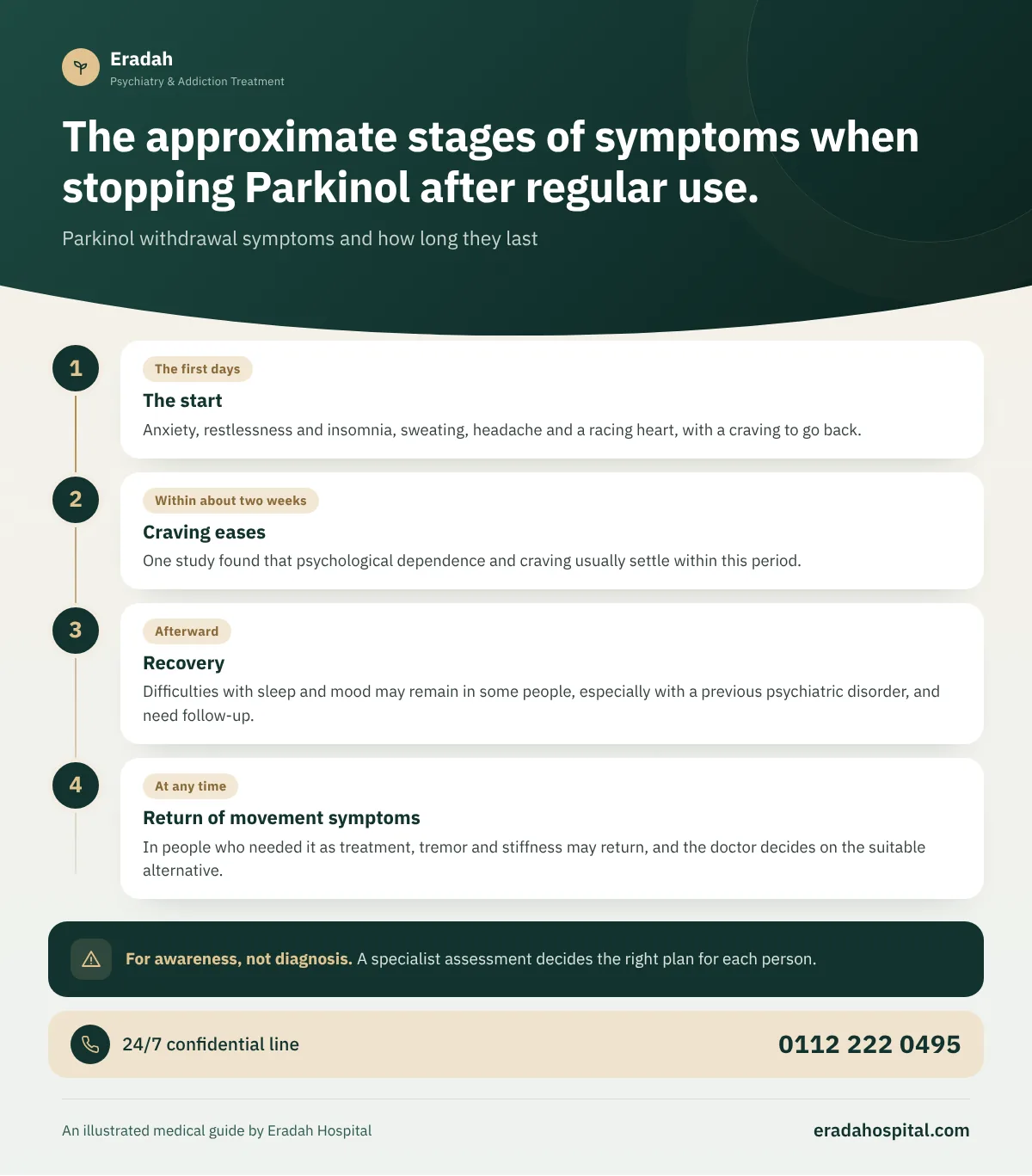
There are no large studies that define a precise timeline for Parkinol withdrawal. The course below is approximate and based on what medical reports describe, and it varies with the amount, length of use, and the presence of other substances or a psychiatric illness:
- The first daysThe start
Anxiety, restlessness and insomnia, sweating, headache and a racing heart, with a craving to go back.
- Within about two weeksCraving eases
One study found that psychological dependence and craving usually settle within this period.
- AfterwardRecovery
Difficulties with sleep and mood may remain in some people, especially with a previous psychiatric disorder, and need follow-up.
- At any timeReturn of movement symptoms
In people who needed it as treatment, tremor and stiffness may return, and the doctor decides on the suitable alternative.
If you take Parkinol on prescription
MedlinePlus warns against stopping trihexyphenidyl suddenly without consulting the doctor, because it may bring back parkinsonism symptoms. But this does not mean it is a lifelong medication for everyone who takes it; the official leaflet notes that the movement side effects of antipsychotics stayed quiet for long periods in some patients after it was stopped.
In a study of 20 patients with schizophrenia taking antipsychotics, 18 of them were able to stop the anticholinergic after a gradual reduction over several weeks, with no clear deterioration in movement or psychiatric symptoms and with improved mental performance, while two could not complete it because of restlessness. Only the doctor can decide whether reduction is right for you and how fast.
Is Parkinol withdrawal dangerous?
- If it is Parkinol alone: its symptoms appear in the reports to be more unpleasant than dangerous, but the available data are limited, and no individual case should be judged without assessment.
- With sedatives or alcohol: stopping these suddenly can cause seizures, which are often the greatest danger in these cases.
- With a psychiatric illness: the symptoms may coincide with a relapse of the underlying illness, so close psychiatric follow-up is needed.
- For someone taking an antipsychotic: movement symptoms may return severely, and rarely complications occur that need urgent intervention.
If thoughts of self-harm appear during withdrawal, do not wait: get help immediately through the mental health support line 16328 or an ambulance (123), and you can find help on the suicidal thoughts page.
Abrupt stopping compared with supervised withdrawal
| Aspect | Stopping suddenly at home | Withdrawal under medical supervision |
|---|---|---|
| Psychological symptoms | Anxiety and insomnia without relief | Assessed and treated with a medical plan |
| Movement symptoms | May suddenly return with no alternative | The doctor reviews the underlying treatment and chooses the alternative |
| Accompanying substances | Risk of seizures with sedatives or alcohol | Planned withdrawal for each substance |
| Relapse | High, to escape the symptoms | Lower, with support and transition to rehabilitation |
That is why doctors advise that stopping take place within a medically supervised detox program when use is heavy or mixed with other substances, or when there is a psychiatric illness that needs follow-up.
After withdrawal ends: what remains?
Symptoms settling does not mean the problem is over; craving can return with stress, at the sight of strips, or on meeting friends from the time of use. The reasons that led to misuse, such as anxiety or the dullness that comes with some psychiatric medications, still need a solution. That is why withdrawal is the beginning of treatment, not all of it, and you can find the next stages in Parkinol addiction treatment.
How can the family support someone going through Parkinol withdrawal?
- Understand that irritability and insomnia are part of withdrawal and are not aimed at you personally.
- Do not give them any medication from home, and do not dispense Parkinol again without the doctor.
- If the drug is prescribed, agree with the doctor on who keeps it and how it is given.
- Watch for severe agitation, fever, confusion or stiffness, and contact the medical team immediately.
- Provide regular sleep, a calm environment and enough fluids.
Danger signs after using Parkinol: call an ambulance (123) immediately
- Delirium or severe agitation with hallucinations, or not knowing where he is or who people are
- A high temperature with hot, dry skin that does not sweat
- A very fast or irregular pulse, or chest pain
- Seizures, loss of consciousness or difficulty breathing
- Complete urinary retention with severe pain in the lower abdomen
Call an ambulance on 123 immediately, and if the person is unconscious but breathing, place them on their side so they do not choke on vomit. Stay with them in a cool, quiet place away from the street and high places, do not give them any medicine, drink or other substance, keep the empty strips, and tell the paramedics everything they took.
Call the ambulance 123